.png) 3 months ago
46
3 months ago
46
In the French port city of Nantes, once France’s largest departure point for ships that trafficked enslaved Africans across the Atlantic, a new wooden mast rises 18 metres into the sky from the waterside.
The Mast of Fraternity and Memory, inaugurated this month, marks a turning point in France’s complicated relationship with the legacy of its history of enslavement – just as the French president, Emmanuel Macron, comes under pressure to make key announcements on a process of reparatory justice.
“We’re not responsible for the past, but we are responsible for the present and future,” said Dieudonné Boutrin, a descendant of enslaved Africans who were trafficked from Benin to the French Caribbean island of Martinique.
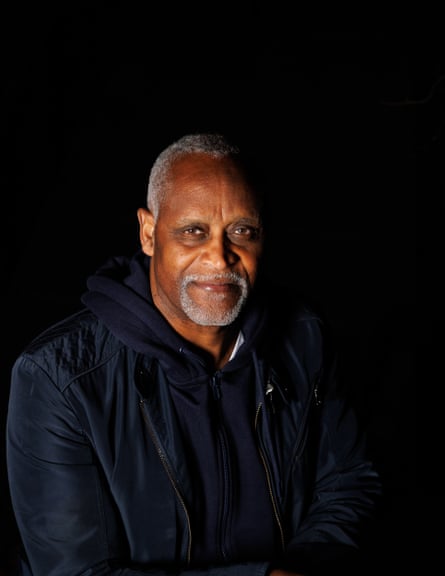
Boutrin, 61, who created the mast, heads the grassroots organisation La Coque Nomade Fraternité, dedicated to “breaking the silence” around slavery and fostering discussion on reparatory justice and community relations.
The mast, a permanent, standalone structure, is unlike any other commemoration piece in France: conceived by descendants of enslaved people and built by local students at vocational colleges. Inaugurated this month alongside a new International Federation of Descendants of the History of Slavery, the mast is expected to be replicated in other cities in Europe, Africa, the Caribbean and the US, as a network of physical markers to the global movement for reparatory justice. The next one is likely to be built in Bristol, England’s historical slaving port.
The mast’s inauguration highlights how France is under pressure to announce a framework for discussions on reparatory justice in the coming weeks. Macron is entering his final months as president amid a growing political row over racism in politics, the media and society, and as the far right poll high in the runup to the 2027 presidential race.
The sense of urgency comes amid anger in France that its representatives – alongside those of UK and other European nations – abstained in March’s UN vote to describe the transatlantic chattel slave trade as the “gravest crime against humanity” and call for reparations as “a concrete step towards remedying historical wrongs”.
Victorin Lurel, a Guadeloupe senator, wrote in an open letter to Macron last month that France had committed a “moral, historic, diplomatic and political mistake” in abstaining and had “tarnished” its image internationally.
From the 16th to the 19th centuries, France, competing with Portugal and Britain, was the third largest of the European nations to traffic enslaved people across the Atlantic and Indian oceans. France was responsible for kidnapping and enslaving about 13% of the estimated 13 to 17 million men, women and children forced from Africa across the Atlantic.
In 2001, France made history as the first country in the world to recognise the slave trade and slavery as crimes against humanity in a law brought by Christiane Taubira, a leading MP from French Guiana. But as Macron prepares to host a ceremony to mark the 25th anniversary of the law on 21 May, campaigners and politicians say France must now go further with clear action on reparatory justice.
Paris is regarded as crucial to the global discussion on reparations, because several “overseas departments and regions” remain part of France – such as the Caribbean islands of Martinique and Guadeloupe, as well as French Guiana, the Indian Ocean island of Réunion and Mayotte. In these places, structural inequalities and disparities on employment, health, the cost of living, pollution and environmental safety are seen by local parliamentarians as a direct legacy of the mechanisms of enslavement and colonialism.
France is also facing demands for potentially billions of dollars in reparations to Haiti, after it imposed a harsh financial penalty on the country in 1825 to compensate owners of enslaved people after the Haitian revolution. That debt, which many Haitians blame for two centuries of turmoil, was only fully repaid to France in 1947. In 2025, Macron announced a joint commission with Haiti to examine the issue, with conclusions due by the end of this year.

Boutrin’s initiative in Nantes shows how grassroots dialogue is shaping the mood in France and breaking taboos. He has worked in Nantes for decades in the public sector and as a trade unionist as well as running organisations on legacies of enslavement, but grew up in Martinique, where his father was a cabinet maker.
“My father taught us values. There were eight of us and my mother died when I was nine years old. There wasn’t money, we had to survive. Sometimes, I’d go two or three days without eating … It’s very complex. I know what misery is, I know where I come from, and I know how to fight to try to make sure that others don’t go through what I did.”
Boutrin said that growing up, there was a taboo about talking about being a descendant of enslaved people, a part of his heritage he did not look into until he arrived in Nantes. “It wasn’t spoken about,” he says. “At school we learned that we were the descendants of the Gauls … We didn’t talk about it. There was an aspect of shame around it, because enslavement had left such huge consequences.”
In recent years, protests in Martinique and Guadeloupe over the high cost of living have highlighted inequalities in French Caribbean départements. French national statistics show marked disparities between them and mainland France, with people on Martinique paying an estimated 30% to 42% more for food. There has been anger at the prominence in the islands’ economy of a handful of families descended from white owners of enslaved people – as well as the wide use of the toxic pesticide chlordecone to fight weevils on banana plantations, with devastating effects on health and cancer levels.
Boutrin said of the islands’ history of enslaved people: “It has created a huge consequence of trauma inside our minds today and that’s why I do what I do. All my work is to try to reconcile ourselves with this past and to try to push each person to rebuild in a different way to bring about change …… The only thing that interests me is that younger generations can live calmly together, can learn to understand and love one another.”

Five years ago, Boutrin met Pierre Guillon de Princé, a descendant of 18th-century Nantes slave shipowners whose vessels had taken part in 18 expeditions between 1766 and 1788, transporting about 4,500 enslaved Africans to the Caribbean, at least 200 of whom died at sea. Guillon de Princé’s ancestors had also owned a sugar refinery and coffee production plant on Saint-Domingue, then France’s most important colony and centre of enslaved people, now Haiti.
Boutrin and Guillon de Princé, 86, began working together on educational tours of Nantes’s slavery history and to open up discussion on reparatory justice.
Guillon de Princé, at the Mast of Fraternity’s inauguration, made what is thought to be the first formal apology by someone in France for their family’s role in transatlantic slavery. “Faced with the rise of racism in our society, I felt a responsibility not to let this past be erased,” he said, pushing for dialogue on reparation.
Guillon de Princé, who worked for the water services at Nantes city hall, said he had not inherited wealth from his ancestors who had ultimately faced financial ruin. “But if there is shame, if we don’t speak about this, we can’t tackle the real problems of today,” he said. “I think the link is not made enough between enslavement and today’s racism.” He said his apology was directed to all communities in the Caribbean “for the impact of racism on their daily life, their health, their wellbeing”.

Jean-Marc Ayrault, the former Socialist French prime minister and one of the politicians pushing for moves on reparation, said France must not be seen to be “sleeping through” this key moment in history and must galvanise other European countries.
Until now, France has focused principally on the restitution of artefacts of African cultural heritage looted during colonisation, with a new law expected to pass to streamline the process of returns that has been seen as too slow.
Organisations in France now want a focus on people and communities. Recourse through the courts has not proved viable – in 2023 France’s highest court, the cour de cassation, rejected a demand for state reparation for descendants of enslaved people that related principally to Martinique.
Before the Africa-France summit in Nairobi on 11-12 May, Samuel Okudzeto Ablakwa, Ghana’s foreign affairs minister, has said there were indications that France was ready to “collaborate” for “reparative justice”. A member of Macron’s entourage said France and Ghana would work together on this issue, “which is important for the president”.
Marie-Annick Gournet, an associate pro vice-chancellor for reparative and civic futures at Bristol University, was born in Guadeloupe. In Nantes for the inauguration, she said it was crucial for France to show action – not just words – on enslavement.
“In 2001, France recognised this as a crime against humanity, but if there are no actions to redress that issue then it’s just a void law,” she said. “I think France is very good at passing laws and making noise – specifically the right nose at political levels. But we are not seeing any change. There’s nothing in terms of repair. Yes, there’s a law recognising it but there is a reparatory justice work that needs to be done behind that.”
Gournet said of inequality in Martinique and Guadeloupe: “They are part of France without being part of France. And because people there are not treated in the same ways, it does feel that there’s a continuation of colonisation on these islands. Whether we like it or not, the reality is the disparity in terms of people’s experience which reflects exactly that. And if the government here and the people in power there are not ready to hear that, to understand that, words will only become words and there’s no change.”
Aïssata Seck, the director of France’s Foundation for the Remembrance of Slavery, an advisory body to the government partly funded by the state, said: “The question of reparations is still a taboo subject in France. A few years ago it was difficult even to say the word reparation.” But she said she hoped France was ready today to “open discussions … and to get people round the table to talk about the issue”. She said for France, this meant looking beyond “the prism of financial reparation” at issues of heritage, anti-racism and tackling inequality, particularly in the Caribbean.
Seck said: “It’s important to stress that France is the European country with the most people of African descent, and that is linked to a history of colonial enslavement and colonisation. Because we have that history, the means allocated to this must be substantial.”
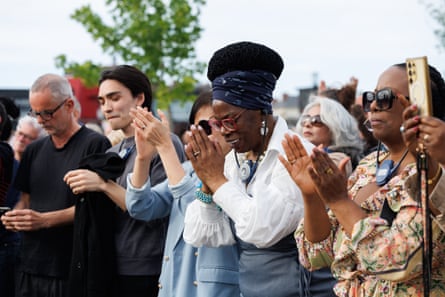
In Nantes, Asher Craig, the former deputy mayor of Bristol who followed Boutrin’s long battle to get the Mast of Fraternity and Memory built, said: “Work like this, led by Black communities, is still not supported at the level it should be. That’s not accidental. It’s systemic. And if we are serious about justice, then funding, visibility, and power needs to follow.”