.png) 3 months ago
75
3 months ago
75
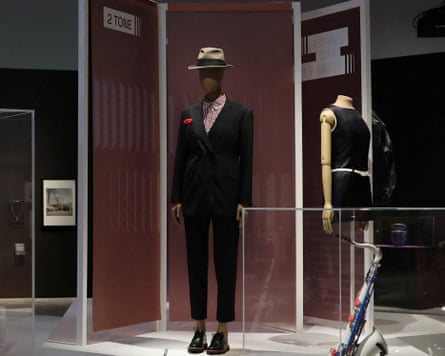
Jacqueline Springer is standing in the middle of the V&A’s new exhibition space looking wistfully at a pair of drainpipe trousers, a tailored suit jacket and a porkpie hat, which create the unmistakable silhouette of Pauline Black, lead singer of the 2 Tone group the Selector.
Springer is the curator of the V&A East’s inaugural exhibition, The Music is Black, a landmark survey of Black British music, which opens this weekend. It starts with the early drumbeats in Africa and takes us right up to the latest innovations in pop and drill via jungle, grime, garage and two-tone.
Over a three-year period, the former journalist turned academic and curator has amassed 200 items, including many permanent acquisitions, although some – such as Pauline Black’s outfit – remain tantalisingly out of reach. “She wants them back,” Springer says in mock frustration.
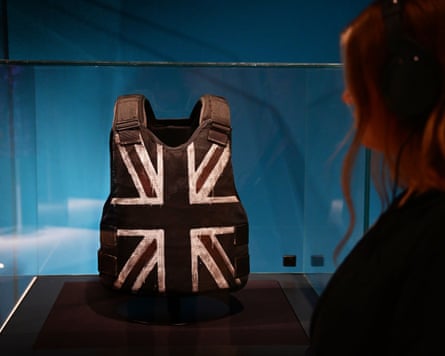
Despite some of the items being here temporarily, Springer hopes the show is part of a lasting change, not just in terms of which artefacts find their way into collections but how Black British music is seen. “Institutionally, it’s an endorsement,” she says. “The V&A has recognised that black music is worthy of this kind of coverage.”
The Music is Black sits on a continuum of Black British music exhibitions: there was the British Library’s Beyond the Bassline and the Barbican’s survey of Black London’s musical landscape. In 2022, Sonia Boyce’s Feeling Her Way, the Golden Lion-winning Venice Biennale show, focused on Black female voices, and Tate Modern’s Soul of a Nation touched on many of the themes in V&A East’s inaugural show. Springer notes the British Library and Barbican exhibitions but she argues: “This is writ large.”

The scope and scale is certainly much larger than those earlier shows. The 200 items, which start with a drum sculpture by Ben Enwonwu and run to a piece by the Turner prize nominee Rene Matić, are given the V&A treatment, setting them on the same institutional footing as the V&A’s recent blockbusters such as its Cartier show.
Outside the museum, there seems to have been a shift too. The Mobo awards just turned 30; Black acts, including Olivia Dean, Skepta and Sault, dominated the Brits; and a new piece of research claimed that Black music accounted for 80% of the money generated by the UK industry in the past 30 years.
The V&A East’s artistic director, Gus Casely-Hayford, says The Music is Black is part of a wider push to reposition the Black British sound as central to the UK’s cultural story. “What happens so often is that British music is presented as important but marginal,” he says. “What we have tried to do here is say this is our story, and it’s one of our major contributions to the world.”
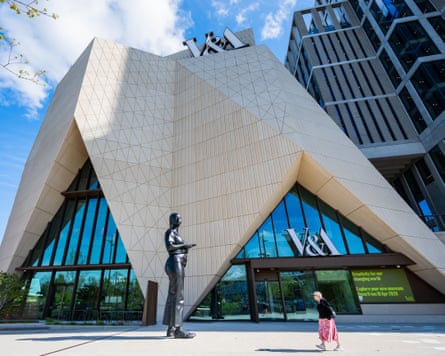
It is the opening offering from the newest part of an institution that seems to be endlessly expanding. V&A East follows the neighbouring Storehouse and Young V&A in Bethnal Green. Farther north, there’s V&A Dundee, which opened in 2018 and had a starring role in Succession.
The new addition in Stratford was designed by O’Donnell & Tuomey, which describes the £135m building as a “protective jacket”. Some cover may be necessary: it’s already been criticised by some as “ugly”, “perverse” and looking like “a reconstructed Toblerone bar”, though the Guardian’s review called it a triumph.
Economic reality has punctured the sheen of the opening. Campaign groups have organised an open letter to the V&A director, Tristram Hunt, calling for all workers at the museums to be paid the living wage. So far, more than 21,000 people have signed it.
Despite the bumps, there were hundreds of people in long, snaking queues for the museum’s official launches on Tuesday and Wednesday. Among those in attendance was Karen Gabay, the Mancunian DJ and journalist, who said the exhibition had a clear focus on giving space to overlooked figures – such as Hewan Clarke, the original Haçienda resident DJ whose Blue Spot radiogram has been acquired for the V&A’s collection.
“I was talking to Norman Jay at the launch party,” Gabay said. “He said: ‘There aren’t that many household names here, but there are a lot of pioneers.’”
The V&A will hope its latest expansion can be similarly innovative.