.png) 1 month ago
47
1 month ago
47
Starmer says he hopes ban will come into force around springtime next year
Starmer is now taking questions.
Q: When will this start?
Starmer says the government can move quickly.
We took powers, earlier this year to make sure we could move at speed.
I was very conscious that with the Online Safety Act it took the last government eight years from sort of identifying the beginnings of the problem to actually passing legislation, and [I] was determined that will not happen in this case.
He says legislation already passed gives ministers the powers to act using secondary legislation.
He says:
We hope to pass regulation before Christmas, and therefore to bring the ban into force in the early part of next year, probably about springtime, so we can move a real pace here.
Key events
Starmer restates his intention to fight any leadership challenge after Makerfield byelection
Shephard turns to the Makerfield byelection.
Q: Do you want Andy Burnham to win the byelection.
Yes, said Starmer.
Q: So what will happen if he challenges you?
Starmer said he did not think there should be a leadership challenge.
But, if there is one, he will fight it, he said.
He said he was elected two years ago with a mandate to serve for five years.
He said he always said change would take time. He completely understood why people want that to happen more quickly.
Starmer said his son was 17 and his daughter 15. She would be affected by the ban, he accepted. He said her views on this policy were “slighly mixed”.
But he and his wife Victoria had always wanted their children to be happy and confident, or happy and safe, he said.
But social media does not make children happier, he said.
Keir Starmer is being interview on ITV’s This Morning. The presenters are Ben Shephard and Cat Deeley.
Q: You used to be against a ban. Why did you change your mind?
Starmer repeated the point he made at his press conference about starting the consultation with an open mind.(See 8.35am.)
He said he spent a lot of time with parents who have lost children through social media.
He said all parents want their children to be safe and happy. But social media does not make them safe or happy, he said.
Shephard then asked about Ian Russell, and played a clip of Russell describing Starmer as a “nowhere politician” who was just cherry picking from the consultation.
Starmer stressed his respect for Ian Russell, as he did at his press conference earlier. (See 9.02am.)
When it was put to him that Russell thought this ban would let social media companies off the hook, because it covered access to social media, not the content available on social media, which Russell views as the real problem, Starmer said the government was looking at restrictions on children up to the age of 18, going alongside the ban for under-16s.
He said it would be hard for children used to social media.
But, in future, he said he hoped this ban would lead to children becoming teenagers no longer having an expectation of being able to access social media.
Keir Starmer’s social media ban for under-16s has not been universally welcomed. Campaigners focusing on privacy and individuals’ rights have expressed concerns, or outright opposition.
James Baker, the freedom of expression programme manager at the Open Rights Group, which campaigns for freedom of speech online, said:
These headline-grabbing proposals by a prime ministers on his way out fail to address the root causes on online harms – business models that reward harmful content …
Over 16s in the UK will have to hand over identity documents or biometric data to unregulated age verification companies. The government has completely failed to acknowledge the harms that could come from that.
Kerry Moscogiuri, chief executive of Amnesty International UK, said:
This is a case of the right diagnosis but the wrong prescription …
The problem is not that children exist on social media; it’s that social media companies have built platforms that are unsafe by design. Banning under-16s risks treating children as the problem rather than addressing the companies and systems that create the risks in the first place.
Young people deserve to be safe online, but they also have rights. Social media can expose children to harm, but it is also where many young people learn, connect with friends, find support, organise around issues they care about and make their voices heard.
And this is from Jack Coulson, head of advocacy at Big Brother Watch.
The British people have always, rightly, rejected mandatory ID schemes. Now the government is imposing digital ID checkpoints for the internet. This is not like Challenge 25 for alcohol. We will all face a “papers, please” demand to get online.
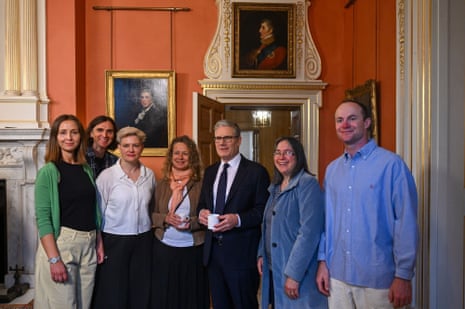
'Watershed moment for child protection' - children's charities welcome social media ban for under-16s
Charities that work on behalf of children have welcomed the government’s announcement.
Chris Sherwood, chief executive at the NSPCC, said:
Today is a win for children and parents and all of us who have campaigned for better child protection online. Big Tech must not have access to our children where their dangerous platforms are causing appalling harm to young people. This is a watershed moment for child protection.
And Lynn Perry, chief executive of Barnardo’s, said:
For too long, children have been put in harm’s way – left to navigate an online world, and the risks that come with it, alone. So we welcome the government’s decision to take decisive action in making the online world a safer place for children.
Ofcom says it is ready to enforce the new social media rules announced by Keir Starmer.
In a statement, a spokesperson for the communications regulator said:
So far, Ofcom has driven some of the strongest changes of any online safety regulation in the world, from widespread age checks to grooming protections for children.
But the industry needs to go much further to make people safe.
The government has entrusted us to build on this progress with new measures to protect children, and we’re ready to work closely with them as the detailed regulations take shape.
Starmer says he thinks there is 'correlation' between smartphone use and rise in teenager mental health issues
Q: Do you think there is a link between smartphone use and the epidemic of mental health problems that young people are having?
Starmer replied:
I think there is a correlation. Obviously establishing hard evidence is always difficult, but I do think there’s a correlation.
He did not go as far as saying there was a causal relationship.
Q: Have you spoken to President Trump about this?
Starmer said he spoke to Trump yesterday afternoon. And he will see him at the G7 later today, he said. They would discuss “this and many other issues”.
He said other world leaders were interested in this too. They would be looking to see if the UK approach provided a blueprint, he said.
Q: What is your message to Ian Russell, father of Molly Russell, who thinks you are rushing this and who is against a ban?
Starmer said he had the “highest respect” for Ian Russell. He went on:
I’ve had the opportunity to talk this through with him, on a number of occasions, including just a few weeks ago. I have the highest regard and highest respect for him and his views. I’ve heard them first hand from him, and I understand how deeply he is concerned about.
And I honestly do also recognise he’s been through an experience I haven’t been through. And, I have to acknowledge that and have to be humbled by that.
Starmer said he knew that Russell was concerned that a straightforward ban would not deal with the problem of what content is available. He said, as well as the ban, the government was also putting in place measures for under-18s dealing with stranger engagement and live streaming. He said he thought those measures addressed some of Russell’s concerns.
On the question of rushing, Starmer said there had been a consultation.
He went on:
But I don’t want anything in my answer to be in any way disrespectful to Ian, or others that hold a different view, particularly those that have lost a child. I don’t think that’s right.
It is possible to deeply respect someone of their views, but come to a different conclusion.
Starmer plays down suggestions Trump's opposition to social media ban for under-16s could cause problems
Q: How will you explain this to President Trump, whose administration has opposed this?
Starmer replied:
Look, I honestly think that, across world leaders, there has always been a recognition that leaders have to take steps to protect children. I don’t think that’s controversial.
Starmer said he did not anticipate a problem.
And he said he would be discussing this with other world leaders, including Trump, at the G7 later.
Starmer says teenagers won't be punished for trying to get round ban
Q: Will you fine children who ignore the ban? And what are the implications for freedom of speech?
On teenagers, Starmer said:
We’re not going to start taking action against 13 or 14, 15-year-olds who are trying, as they always will, to get around the rules that adults put in their path.
And, on freedom of speech, Starmer said:
I’m a great advocate of free speech, I really am.
But sending sexually explicit pictures to and from children – that’s not free speech, that’s basic protection.
UPDATE: Starmer said:
How many people in this room are prepared to defend adult strangers contacting children online? And we know what happens when that develops into the sort of abuse and worse.
How many people are prepared to stand up and say ‘that’s free speech and I wouldn’t do anything about it’ any more than you’d say we wouldn’t take measures to stop that happening in the offline world?
I think it’s extraordinary that somehow we’ve got ourselves to a position where until now we’ve shrugged our shoulders – I genuinely think it’s difficult to think in what circumstances any of us would put our children into a place where unknown adults could have access to them without us knowing anything about it one to one, we wouldn’t do it.
So, it’s not about free speech, it’s about basic protection of children.
Starmer dismisses claim this is just about announcing legacy policy before byelection
Q: Is this announcement about you wanting a political legacy?
Starmer said there were people in the room who have been campaigning for years on this issue. He went on:
And I think we do them and all those who’ve been concerned about this, a disservice to try to put that into a particular week where there’s a byelection. That’s not what it’s about.
This is a huge this is a statement of our values, who we are as a country. and it’s a way of actually bringing our country together.
So for me, this is bigger than some of the usual to and fros of politics, although there’s plenty of that.
Q: Are you worried about how Big Tech and the US will respond?
Starmer said he was “a fan of tech” and he regarded himself as pro-tech.
I think it can be pro-AI and tech, which I am, but, at the same time, protecting our children, which I am for too, are not incompatible. They’re not mutually exclusive. I think they go together.
And actually, talking to the big tech companies, they know very well that they and all of us have a responsibility to protect children.
Starmer says he thinks government will be able to enforce ban
Q: Will this stop children accessing useful services? And won’t teenagers get round this with VPN services?
Starmer said some services, like YouTube Kids, would be protected.
He repeated the point about how some children will get round this. (See 8.27am.)
And he said the government had learned from the Australian experience.
I think we’ll be better at enforcing it, actually, having learned from the Australian model and having learned from our own experience with the Online Safety Act.
So I genuinely think we can enforce it.
Starmer suggests he changed his views during consultation - and defends being willing to listen and respond
Q: When did you change your mind on this?
Starmer says he started the consulation with an open mind.
It is a step that I’ve taken after sitting down and listening, particularly to parents who had lost, usually a teenager, in relation to what happened on social media …
[I am taking the decision] having looked at the evidence, having gone through the consultation, having looked at what happened in other countries, having listened, to parents, grieving parents, listened hard.
And you can listen in two ways. You could listen in a sense if you’re just going through the motions, or you can listen and you can take in what people are saying to you.
I’m in the second category – always have been – and that’s why I’m absolutely clear in my mind that this ban is the right outcome.
Starmer says he hopes ban will come into force around springtime next year
Starmer is now taking questions.
Q: When will this start?
Starmer says the government can move quickly.
We took powers, earlier this year to make sure we could move at speed.
I was very conscious that with the Online Safety Act it took the last government eight years from sort of identifying the beginnings of the problem to actually passing legislation, and [I] was determined that will not happen in this case.
He says legislation already passed gives ministers the powers to act using secondary legislation.
He says:
We hope to pass regulation before Christmas, and therefore to bring the ban into force in the early part of next year, probably about springtime, so we can move a real pace here.