.png) 1 month ago
37
1 month ago
37
You don’t need a degree in political science to understand why so many supposedly centrist European leaders have begun talking about immigration in terms that would have been unthinkable even a few years ago.
Far-right parties across the continent have fuelled their rise by seizing on the issue as a political cosh with which to beat their more mainstream and established rivals, whom they accuse of complacency, inaction and a failure to defend borders.
Unsure of how best to respond, many parties have adopted the far-right’s language in the hope that all the tough talk will persuade voters they’re also taking immigration seriously.
Hence Keir Starmer’s speech warning that the UK risked becoming an “island of strangers”; Friedrich Merz’s assertion that anyone with daughters would agree with his plans for large-scale deportations; and the interview in which Merz’s predecessor, Olaf Scholz, famously said: “We must finally deport on a large scale those who have no right to stay in Germany.”
So, given the European centre’s rightward drift, what was Spain’s prime minister, Pedro Sánchez, up to last week when his socialist-led government announced the regularisation of 500,000 undocumented migrants and asylum seekers? Under the time-limited plan, successful applicants will be given a legal residence permit in Spain with an initial validity of one year.
“Some say we’ve gone too far, that we’re going against the current,” Sánchez said in a video posted on social media last Friday. “But I would like to ask you, when did recognising rights become something radical? When did empathy become something exceptional?”
Breaking ranks
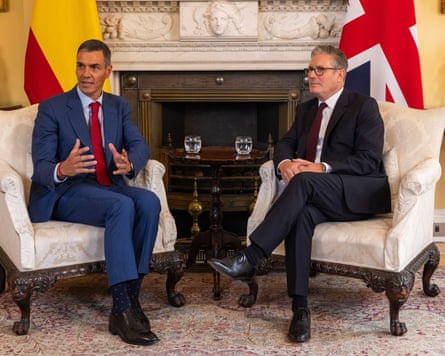
The move elicited a swift and predictable response. The conservative People’s party (PP) said the plan would attract more migrants and thereby overwhelm Spain’s public services, while the far-right Vox party once again peddled the idea that Sánchez was trying to replace the Spanish population and “accelerate the invasion”.
It was far from the first time that Sánchez had broken ranks with his political peers when it comes to migration. One of his first high-profile acts after becoming prime minister in June 2018 was to announce that Spain would welcome the 630 migrants and asylum seekers on board the rescue boat Aquarius, who had been refused entry to Italy and Malta.
Speaking to Spain’s parliament in 2024, Sánchez said the country had to choose between being “an open and prosperous country or a closed-off, poor country”. Taking in migrants, he added, was not just a question of human decency; it was the only realistic means of growing the economy and maintaining the welfare state in a country with one of the lowest birthrates in the EU.
“Throughout history, migration has been one of the great drivers of the development of nations while hatred and xenophobia have been – and continue to be – the greatest destroyer of nations,” he said. “The key is in managing it well.”
He made a similar economic case for migration during an interview with the Guardian last September, saying the numbers spoke for themselves.
“I am willing to explain the figures and how migration is helping to boost the economy and to increase our social spending. We have to do it with clear data in order to fight the populist approach,” he said. “In Spain, migration represents 25% of our per capita GDP, 10% of our social security revenues and only 1% of our public expenditure.”
Getting the timing right
Why has Sánchez chosen this moment for the massive regularisation scheme?
The move, which was agreed at the behest of the leftwing Podemos party, after years of civil society campaigning, comes at a tricky time for Sánchez and his Spanish Socialist Workers’ party.
Recent opinion polls are putting Vox’s share of the vote at almost 18%, members of the PM’s inner circle, including his wife and brother, have been accused of corruption – which they deny – while his party has been enveloped in allegations of graft and failing to take sexual assault cases seriously.
As commentators have pointed out, the regularisation decree offers Sánchez an opportunity to differentiate himself from his opponents and to show his allies that his beliefs align with theirs – and with those of their voters.
“Right now, Sánchez is in a very difficult position internally, but he also knows the only way he can survive is by shifting to more leftwing positions that will allow him to absorb the electorate of the smaller parties,” Pablo Simón, a professor at Madrid’s Carlos III University, told my colleague Ashifa Kassam on Monday.
It may also have the added bonus of painting his PP opponents into a corner by suggesting to voters that there’s now little ideological difference between them and their far-right rivals in Vox.
But, taken together with his outspoken criticism of Israel’s war in Gaza – and his refusal to be cowed by Donald Trump on defence spending – Sánchez’s decision to support migration makes him one of the few European leaders attempting to plough his own furrow and offer a different response to the rise of the far right.
And, easy as it is to get bogged down in the political ramifications of the decree, it’s also worth remembering the huge and profound effect it will have on the lives of hundreds of thousands of people. Two words have cropped up again and again in the chats I’ve had with migrants and migrant groups over the past few days. One is esperanza (hope); the other is derechos (rights).
Edith Espínola, one of those who has spent years campaigning for the regularisation, told me its benefits could not be overstated. “It gives you the opportunity to study, to be able to work with dignity and to be able to report when you’re being exploited without having to be scared about making a complaint … It means that you can break through that invisible border.”
To receive the complete version of This Is Europe in your inbox every Wednesday, please subscribe here.