.png) 3 hours ago
8
3 hours ago
8
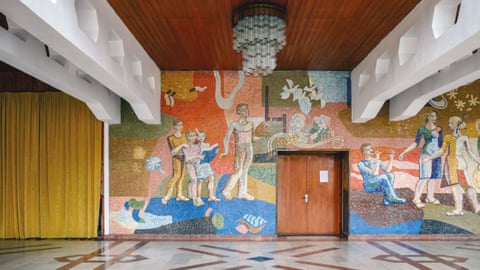
Socialist Hotels is the first photography book to focus solely on the architecture of hospitality in Eastern Europe and the post-Soviet landscape. These state-constructed buildings were used by visiting government workers and ordinary citizens. Today they are a fascinating legacy of a social and cultural idiosyncrasy.
-
Socialist Hotels by Elena Amabili is published by FUEL
Thu 17 Sep 2026 10.00 CEST
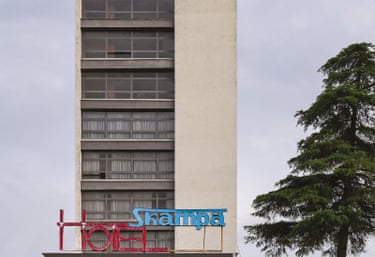
Hotel Skampa, Elbasan, Albania
Designed in 1970 by Valentina Pistoli (1928-93), Albania’s first female architect, the Hotel Skampa was part of the state-run Turizmi hotel network. Pistoli was one of Albania’s most renowned architects, known for many landmark projects, including the Hotel Tirana and the Palace of Culture in Durrës.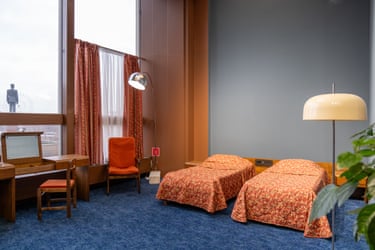
Hotel Cosmos, Moscow, Russia
This original interior shows the design of the rooms at the time of the hotel’s opening in 1979. Conceived as a showcase of openness to the west, Hotel Cosmos combined domestic expertise with French technology and international hotel standards for the 1980 Moscow Olympics. With 1,777 rooms, it was the largest hotel complex in the USSR. The square was renamed Place Charles-de-Gaulle in 1990, and the statue visible from the window was unveiled in 2005 by Vladimir Putin and Jacques Chirac.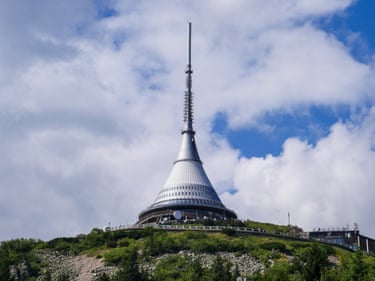
Hotel Ještěd, Czech Republic
Designed by Karel Hubáček (1924-2011) and completed in 1973, Ještěd rises 94 metres above its 1,012-metre summit, combining a mountain hotel, restaurant and television transmitter within a single hyperboloid form. Its interiors and bespoke furnishings were conceived by Otakar Binar (1931-2024), with artists Stanislav Libenský (1921-2002) and Jaroslava Brychtová (1924-2020) contributing to the design. A landmark of post-war Czech architecture, it has been included on the Czech Republic’s Unesco tentative list since 2007.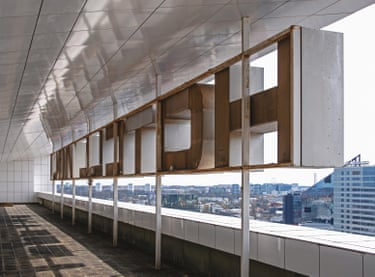
Hotel Viru, Tallinn, Estonia
Completed in 1972 as the city’s first skyscraper, the hotel had more than 400 rooms and 23 floors, but the lift only went as far as the 22nd. That’s because the 23rd floor was a KGB listening centre with a direct line to Moscow, used to spy on the guests who included foreign business people, journalists and diplomats as well as tourists. In the summer of 1991, as the Soviet Union collapsed, the hotel’s KGB agents fled, leaving behind a mass of papers and listening devices. These lay undiscovered until 1994 when the hotel was sold and renovated. Photograph: Elena Amabili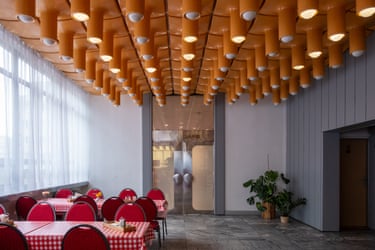
Hotel Slovakia, Žilina, Slovakia
The original suspended ceiling at Hotel Slovakia, seen here in orange in the present breakfast room, has survived in several other spaces, where it appears in different colours. Its modular design and integrated lighting were conceived as an integral part of the interiors, lending the rooms a distinctive and subtly futuristic character for their time.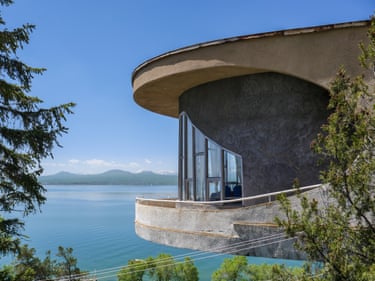
Sevan Writers’ House, Armenia
The Sevan Writers’ Resort brings together two distinct moments of Soviet modernism: the Bauhaus-influenced residential building of the 1930s and the sculptural restaurant and lounge, completed in 1965 and nicknamed ‘Baby Whale’ for its distinctive form. Conceived as a retreat for writers and intellectuals, it hosted figures including Osip Mandelstam, Jean-Paul Sartre and Simone de Beauvoir, offering a secluded setting for creative work on the shores of Lake Sevan.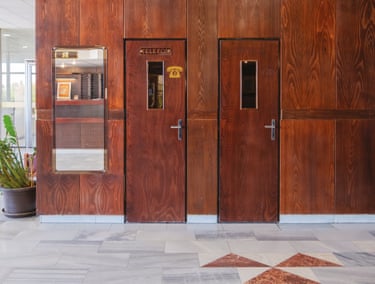
Hotel Kladno, Kladno, Czech Republic
Hotel Kladno formed part of Sítná, a new civic centre developed in the 1960s in the expanding industrial city of Kladno. Alongside the House of Culture and other public buildings, it helped shape the central square as a new focus for urban life, bringing accommodation, culture, commerce and leisure together. Rising above its broad public base, the hotel became one of the defining landmarks of this ambitious new centre.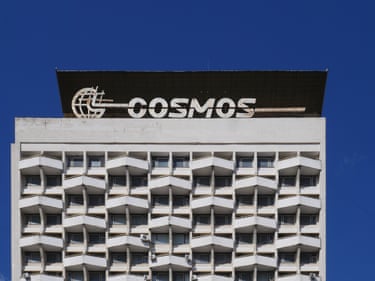
Hotel Cosmos, Moldova
Cosmos in Chișinău is a striking example of late Soviet modernism, designed by Boris Banykin (1912-76) and Irina Kolbayeva (dates unknown) and completed in 1983. Built primarily for tourism within the Soviet Union, its distinctive façade and panoramic upper volume mark the visual terminus of Gagarin Boulevard. Closed in the early 2020s, it now faces an uncertain future amid plans for demolition and preservation efforts.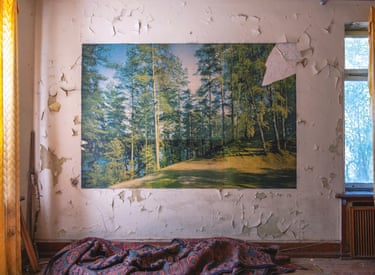
Legends Tskaltubo Spa Resort, Tskaltubo, Georgia
Built between 1947 and 1957 as a sanatorium for the Soviet Ministry of Defence, the complex accommodated about 500 guests within Tskaltubo’s planned spa landscape. Its residential pavilions, communal spaces and covered passages were organised around a large park, forming part of a wider system of sanatoria, bathhouses and therapeutic facilities. Today, the restored sections operate as Legends Tskaltubo Spa Resort, while others remain largely untouched. This room belongs to the unrestored wing, preserving the character of its original interiors.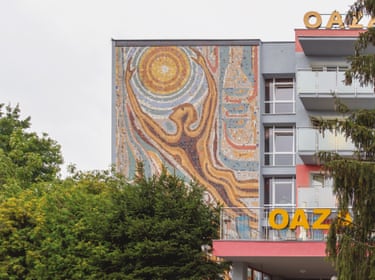
Sanatorium Oaza, Inowrocław, Poland
Opened in 1980 as Metalowiec 70, the sanatorium was part of Inowrocław’s post-war network of trade union health resorts for workers. Its architecture was conceived together with an extensive programme of monumental art by Marian Kokoszyński (1937-2023), whose Chwytające słońce (Catching the Sun) still covers the main façade, complemented by mosaics inside the building. Renamed Oaza in 2009, it is one of the many well-preserved examples of the close relationship between healthcare, collective leisure and art in socialist Poland.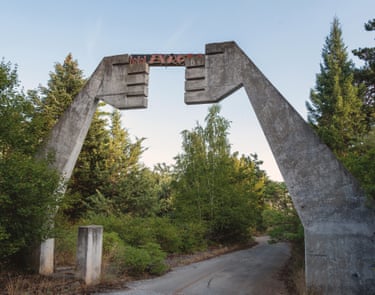
Hotel Evropa, Oteševo, Macedonia
Hotel Evropa, completed in 1987 on the shores of Lake Prespa, belongs to the late phase of Yugoslav resort architecture, conceived as an extension of the landscape, with its terraces, volumes and communal spaces following the terrain. The monumental entrance, with concrete arms holding a star-circled globe, gave this otherwise site-conscious architecture an unmistakably Yugoslav theatricality; the globe was later stolen. After a devastating fire in 2005, the complex was abandoned and progressively stripped of its interiors and fittings, before falling into ruin.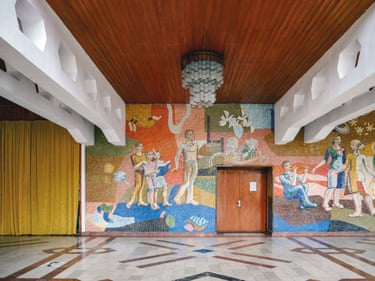
Hotel Casa Tineretului, Câmpina, Romania
Romania’s Case ale Tineretului were conceived as multifunctional centres, bringing together hospitality, culture, education and leisure in a single institution. Opened in the early 1980s, the complex remains in use today, with its hotel section integrated into a wider ensemble of exhibition spaces, performance facilities and recreational amenities. The ground-floor mosaic is tentatively attributed to Spiru Chintilă (1921-85), Titu Drăguțescu (1949-) and Romeo Zamfirescu (dates unknown).Explore more on these topics