.png) 3 months ago
78
3 months ago
78
The Scottish National party was accused of “embezzling” voters after opposition leaders highlighted the crisis over Peter Murrell’s misuse of £400,000 from party funds.
The scandal over Murrell’s guilty plea on Monday to embezzling £400,310.65 while he was the SNP’s chief executive overshadowed a Holyrood motion tabled by John Swinney to call for a second independence referendum.
Fulfilling a promise made during the Holyrood election campaign, the first minister used the first full day of parliamentary business on Tuesday to stage a symbolic vote calling for the power to stage a fresh referendum.
Swinney offered no new legal or constitutional arguments that might force the UK government to agree to do so. Instead he challenged pro-UK parties to agree Scotland had a right to decide its own future.
“Today, I seek confirmation from this parliament that this is a voluntary union and that the people of Scotland have the right to decide whether we remain in that union,” he told MSPs. “That is a principle that should be accepted by all those in this chamber who believe in independence but also all those who believe in the union. Because what is at stake are the democratic wishes of the people of Scotland.”
Anas Sarwar, the Scottish Labour leader, said Swinney’s attempt to revisit this issue immediately after the election at a time of significant global insecurity and a cost of living crisis was evidence of the SNP’s selfishness.
In a reference to Swinney’s acceptance on Monday that Murrell had embezzled SNP funds donated by the party’s members, Sarwar said Murrell’s crimes provided voters with “really stark” evidence the SNP put its own ambitions and interests first.
Swinney should instead focus on building the new homes needed, encouraging economic growth and supporting struggling families on day one, he said.
“People who are their most vociferous supporters asked to put their hard-earned cash into a movement that they believed in,” Sarwar said. “What did the people that were charged with the responsibility do? They robbed them of that opportunity. They embezzled them of that opportunity.
“And the reality is that is countless opportunities that have been embezzled by this SNP government for 20 years from people across this country.”
Russell Findlay, the Scottish Conservative leader, said the timing of Swinney’s debate was “comical” given the political agenda was dominated by Murrell’s embezzlement.
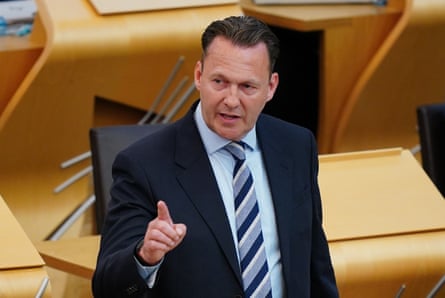
He said Swinney himself had helped quash “valid concerns” within the SNP about the party’s finances before the police investigation was launched, echoing warnings from Nicola Sturgeon to party members to “stay quiet”.
When she was interviewed as a suspect by police, Sturgeon, who was subsequently cleared of any wrongdoing, had repeatedly said “no comment” to detectives’ questions, he said.
Those were “the tactics of organised crime”, Findlay said. “Today of all days, John Swinney reckons the SNP can be trusted to take full control of an independent Scotland and our nation’s finances. The same John Swinney who didn’t have a clue that his childhood friend, who he appointed SNP chief executive, was plundering their own party.”
Swinney’s efforts to shift attention on to Scotland’s constitutional options was backed by Ross Greer, the Scottish Green party’s co-leader, who accused Holyrood’s pro-UK parties of deploying “increasingly desperate mental gymnastics” when they tried to deny that the SNP’s 58 seats and the Greens’ 15 seats had produced Holyrood’s “biggest ever” pro-independence majority.
The SNP’s election manifesto had stated only an SNP majority would deliver that mandate, but Swinney’s motion on Tuesday insisted the combined votes of both parties were a legitimate mandate.
Craig Hoy, the Scottish Tories’ finance spokesperson, challenged Greer’s stance by arguing that the SNP and the Greens won only 41% of Scotland’s regional votes on 7 May, while pro-UK parties gained 59%.
Greer dismissed that line. “It’s normal in a democracy that a parliamentary majority can pursue the issues that it’s won a mandate from the voters on,” he said. “Democracy is not a one-off event. We’ve got to wonder why people are so angry and cynical. It’s because of these anti-democratic games that are being played.”