.png) 3 months ago
55
3 months ago
55
In 1676 London musician Thomas Mace proposed a bold idea. Instead of enduring the “inconveniences of talking, crowding, sweating and blustering”, audiences should be able to enjoy music in a dedicated space: a “musick room … convenient and fit to perform in”. For the first time concert-going was open to anyone for the price of a ticket, though this hungry new audience had to wait until 1748 and the construction of Oxford’s Holywell Music Room – Europe’s oldest custom-built public concert hall – for the fulfilment of Mace’s vision and a room of their own.
Since then, concert halls have become a mirror to changing fashions, priorities and politics. Compare the gorgeous fantasy of the 19th-century’s Royal Albert Hall to the sleek postwar functionality of the Royal Festival Hall. In Oxford the Holywell has since been joined by several others, though none without their issues – until now.
Enter Blackstone founder Stephen A Schwarzman and a £185m donation to create the Schwarzman Centre for the Humanities, a home not only for Oxford University’s seven humanities faculties and new Institute for Ethics in AI, but also for theatres, a cinema, gallery space and the 500-seat Sohmen Concert Hall.
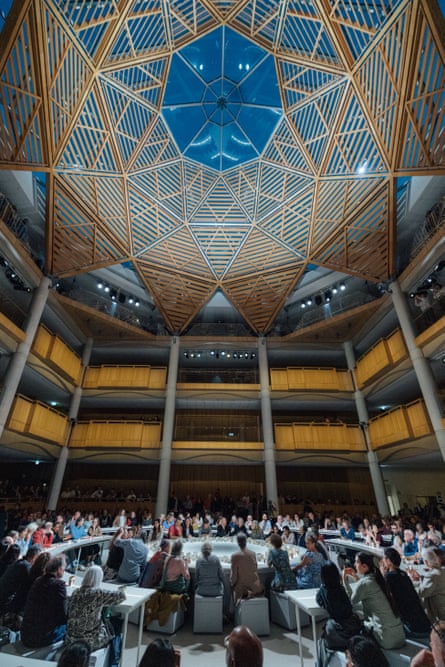
Tested, tweaked and soft-launched since last October, the building (described by chief operating officer Alexandra Vincent as “not an arts centre, not an academic building, but a hybrid”), was opened to the public for the first time this weekend, welcoming 12,000 visitors, all curious to see – and hear – the result.
The world’s first Passivhaus concert venue, meaning it passes rigorous energy efficiency standards, the wood-lined Sohmen plays a long game. The blanched sternness of the lecture hall is uppermost until the music starts, when acoustic consultants Arup prove their mettle.
There’s a haloed quality to sounds produced on this stage. The Scottish Ensemble’s launch programme of Shostakovich’s C minor Chamber Symphony and Tchaikovsky’s Serenade for Strings proved this again and again. Performing from memory, 21 string players moved through the space in fluid, shifting constellations, melding Örjan Andersson’s choreography with big, collective musical gestures that rang the space like a bell. Between the two works the ensemble drifted off, leaving leader Jonathan Morton alone, sketching out the strange, baroque arabesques of Nicola Matteis’s Alia Fantasia: every husk of bow-on-string, every flicker of ornamentation, pinprick clear.
The heart of the Schwarzman is the Great Hall – a galleried atrium crowned by an octagonal dome. A “choral installation” – 360 Vessels – by artist Es Devlin and composer Nico Muhly – supplied the opening ceremony, welcoming an audience seated Last Supper-style at long curving tables, a clay pot in front of each. A simple idea – the shared drinking of tea to the soundtrack of a newly commissioned anthem – took on lofty, portentous proportions. Devlin became a secular priestess presiding over a banal parody of the Eucharist, while Steven Grahl conducted an underpowered, under-rehearsed Schola Cantorum in music that suggested the scattered choirs of Monteverdi’s Venice, but with little of their echoing mystique. The Schwarzman is a magnificent new monument to secular culture but, when it comes to ritual, even AI can’t quite fill the spiritual void.