.png) 3 months ago
65
3 months ago
65
On the planet Carcosa, mangled, blackened trees and crimson flowers take root next to the ruins of some ancient alien civilisation, flanked by statues contorted in pain, tearing at their marble skin. There are metallic tunnels deep underground, chasms of impossible size snaked with cables, so you feel as though you’re exploring the intestines of some giant machine. There’s a House of Leaves quality to these spaces, which shift and change and clearly weren’t built for humans.
You are Arjun Devraj (played by Rahul Kohli), a space security guy who’s on a mission to find missing colonists on an alien world before it all goes a bit Event Horizon and you become the next lost expedition. Classic. There’s some unethical space capitalism happening out here, and Devraj himself is a bit of a traumanaut who brought way too much mental carry-on luggage for this extremely long-haul flight. But it’s nothing that shooting some aliens won’t fix, right?
Devraj isn’t just his trauma: he’s also a fast-moving spaceman who can shoot thousands of bullets per minute, while also dodging thousands of painful spherical projectiles from robot-esque aliens. These fights don’t look like movie choreography. Every encounter is desperate, frantic and messy; you hop, dash and try your best not to embarrass yourself as what looks like the entire contents of an alien ball pit bounces toward your face and laser beams lick at your heels.
This kind of action is sometimes described as a bullet ballet, but ballet is graceful and purposeful, and this is pure panic and instinct. It’s more like bullet-crossing-the-motorway-in-your-pyjamas, or laser-beam hopscotch. It’s brilliant.
One minute you’re amazing, sexy, invincible. The next you’re blundering, cringe, dead. But death isn’t so bad here. What kills you makes you stronger.
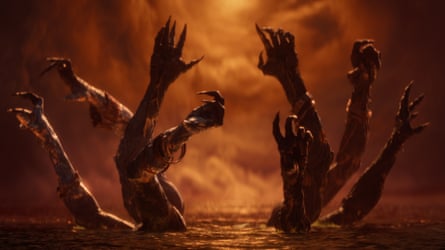
Whenever you die planetside, Devraj reconstitutes in some alien goop. You can then trade whatever you found out there for armour upgrades that give you more health, damage output, and a bunch of other useful treats. Then you return to the unmapped wilds, which reconfigure and morph each time you die, to do it all again. Each time you return, a different selection of weapons, attribute boosts and planetary layouts awaits you, but the enemies remain unchanged. That little upgrade break after every run is a boost that gets you back out there feeling more confident than before. Saros is a punishing game, but not insurmountable, and there’s something delicious about heading back to earlier areas when you’re all souped up and can mow down everything you find.
In most games, success moves the story forward, but Saros drip-feeds its narrative whether you live or (repeatedly) die. This leaves the story feeling a little disjointed, but stops you from feeling like you’re head-butting a wall when you find yourself struggling. Saros establishes a theme around obsession early on and keeps hammering it home, which works as a smart anchor for the “fight, die, repeat” loop. You might not connect with Devraj on a personal level, but the story puts you in his mindset, and the cast do a great job of making you want to know more about the characters despite the staccato delivery of the plot.
Jane Perry is excellent as your commanding officer, and Kohli gets a couple of moments that show his range. Unfortunately, you spend so much of the game staring at the back of his head while he fires a shotgun (or rifle, or explosive projectile launcher, etc). Most conversations are poorly framed, emotionless and static, so you only get to see that range in cutscenes toward the end. This is a weird blemish on an otherwise well-presented game.
Then there are the guns. Oh, the guns. Every time you pull the trigger, it’s like watching a firework show through a kaleidoscope or seeing Thor smack an anvil in Valhalla. Every fight is busy with sparks, dust, debris and liquid heat. Every weapon you find adds another dynamic to fights. There are pistols with ricocheting bullets, shotguns that create a wall of hot pellets before spitting them out, ripsaws that fly out and spin in their targets. You must switch between primary and alternate fire to adjust to the situation in front of you, all while dodging, jumping, and grappling through a wall of death. If more dynamic conversations had to be sacrificed to make room for all of this, developer Housemarque made the right call.
There’s so much happening during the action that you learn to focus on the centre of the screen, relying on reflexes and peripheral vision to take it all in simultaneously as the scene explodes. Saros asks a lot of you – you’ll strafe until your thumbs hurt – but it taps into something primal, pulling you into a flow state where even a screen full of flaming orbs spat by towering hostile aliens no longer seems that big a deal.