.png) 3 hours ago
6
3 hours ago
6
Russia and North Korea are close to completing a bridge that will form the first road link ever built between them, amid concerns the two increasingly close allies are creating infrastructure to boost military cooperation in the Ukraine war.
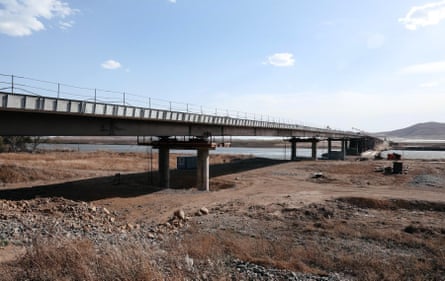
The bridge spans the Tumen River, between Khasan in Russia’s far east and Tumangang in North Korea, a remote, thinly populated stretch of borderland where the river marks the final few miles of the frontier before it reaches the coast.
The crossing is now largely complete. North Korea finished its side of the project, including customs and quarantine facilities, ahead of a planned opening on 19 June, but Russia has fallen behind on its own side of the border, and no new opening date has been confirmed.
Russian and North Korean authorities have made no secret of the bridge project, saying it is intended to expand trade and tourism. North Korea’s state media news agency, KCNA, has similarly cast the bridge as a way to boost “travel of persons, tourism and circulation of commodities” between the two countries.
However, a new investigation by Ukrainian human rights group Truth Hounds and shared with the Guardian suggests it is intended more to provide a discreet military logistics corridor than to boost trade.
Nazar Myhun, who led the open-source research at Truth Hounds, said a key reason behind its conclusion was the fact that it is much easier to evade satellite monitoring – a surveillance method used by the west to understand Russian and North Korean activities – by using roads compared with a rail network.
The new crossing over the Tumen River runs alongside the Friendship Bridge, which is the only rail link between the two countries.
Russia and North Korea’s road network is far bigger than their rail network, he said, making it harder to watch in its entirety. Loading and unloading of trucks can also take place much more quickly than for railcars, which are exposed to satellite passes for a longer period of time.
“The type of railcar visible in an image reveals a great deal about the cargo, and certain categories of goods are transported in open railcars, which allows them to be identified,” Myhun told the Guardian.
“Trucks, by contrast, almost always look the same in satellite imagery.”
Road cargo can also be loaded anywhere, as opposed to trains, which rely on a handful of fixed rail hubs, Myhun said.
Russian officials have presented the project as a way to expand trade and tourism. Andrey Nikitin, Russia’s transport minister, said: “The opening of the new road bridge will increase mutual trade, optimise logistics, strengthen cultural ties, and transform border areas into dynamically developing economic hubs.”
However, Truth Hounds argues that the bridge’s economic rationale is weak. The crossing is estimated to have cost more than $100m, versus bilateral trade that was reportedly worth just $34m in 2024. Tourism from Russia into North Korea remains tightly controlled and largely limited to escorted tours, with around 10,000 Russian visitors in 2025. Pyongyang, where most foreign tourists visit, lies over 500km from the crossing.
Instead, the investigation concludes that the crossing is better understood as strategic infrastructure: a corridor for moving North Korean troops, construction brigades and military officials into Russia, and for Russian technology and resources to move in the opposite direction.
Myhun said Truth Hounds monitors Russia-North Korea cooperation closely because it considers it “one of the key factors affecting Russia’s strength in this war” on Ukraine.
The deepening relationship has also made the two-way exchange of weapons and technology between the two countries “easier and less transparent”, he said, which also poses a threat to North Korea’s neighbours.
The Kremlin has been contacted about the claims made in the investigation but has yet to respond.
A growing military alliance
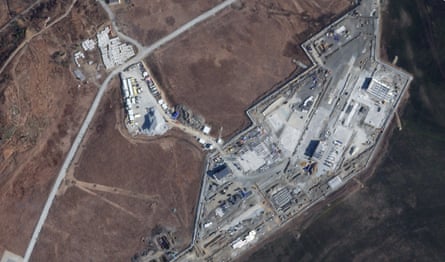
The bridge over the Tumen River is about 1km long and seven metres wide, with two lanes, part of a wider 4.7km crossing that includes approach roads. Satellite imagery also shows supporting infrastructure being built on the Russian side, including a helicopter landing pad.
However, the rail line is hobbled by a mismatch in rail gauge between Russia and North Korea, meaning wheelsets must be changed to allow trains to travel further into either country’s network, a limitation the new road bridge does not share.
Open-source researchers have previously relied on satellite imagery of the rail crossing to monitor suspected weapons transfers between the two countries.
Construction of the bridge began after Vladimir Putin and Kim Jong-un signed a comprehensive strategic partnership pact in June 2024, cementing military ties that have since seen North Korea provide troops, artillery ammunition and ballistic missiles to support Russia’s war in Ukraine.
It forms a small part of a much broader military relationship. More than 14,000 North Korean troops have fought alongside Russian forces in the Kursk region, after Ukraine staged a surprise counter-invasion in August 2024. Ukrainian president Volodymyr Zelenskyy has now warned that Russia is preparing to receive a further 30,000 soldiers. Moscow and Pyongyang have expanded cooperation on weapons, military technology and reconstruction.
In 2023, Reuters reported that satellite images showed an estimated 2,000 containers exported from the North Korean port of Rason to Russia, believed to have contained artillery shells and possibly short-range missiles.
Kim has praised North Korean soldiers who fought and died for Russia and unveiled housing for the families of those killed. At least 2,000 North Korean servicemen are believed to have died fighting in Russia’s war, with two badly wounded soldiers taken prisoner.