.png) 2 hours ago
2
2 hours ago
2
On a humid morning in Uyo, Nigeria, Ubokobong Amanam shows off the lifelike prosthetic where his fingers once were. The skin bears tiny wrinkles, and the nails are naturally shaped. Seven years ago, he was badly injured in a firework accident. Doctors could save him, but not his fingers.
The prosthetics available at the time were clumsy, poorly fitted and designed for bodies nothing like his.
“At first, it was deeply disappointing to realise there were no hyper-realistic or even realistic African-style prosthetics,” he says. “That discovery made me feel worse and intensified my depression.”
But his brother, John Amanam, was a special effects artist, making replicas of human bodies for film and theatre. Together they began work on a better hand for Ubokobong, designing a prosthetic that did not yet exist, one made for Africans by Africans.
There was, they knew, a staggering level of need: millions of Africans cannot access prosthetics due to high costs and a lack of availability. And even when prosthetics are available, they are often imported and designed for western body types, making them less suitable for African users.
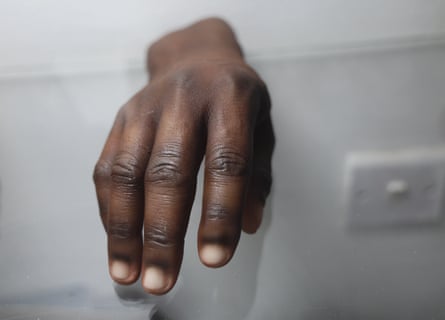
Data is scarce but unofficial estimates suggest that up to 2 million people in Nigeria need prosthetic limbs. For those who have the money, imported limbs can cost $2,000 to $3,000 (£1,500 to £2,250).
This reflects a larger global shortage. According to the Global Health Observatory’s 2022 report on assistive technology, nine out of 10 people worldwide who need assistive devices such as prosthetics, wheelchairs or hearing aids do not have access to them.
The situation is especially difficult in low- and middle-income countries. For Ubokobong it was a shock.
“The first thing I discovered is that prosthetics aren’t really made for people like us,” he says.
The colours didn’t match, repairs meant importing spare parts, and high-quality products were simply not available.
The Ubokobong Bionic Arm was the culmination of three years of dedicated research and the brothers’ company, Immortal Cosmetic Art, now leads the way in lifelike prosthetics for amputees across the continent, with a mission to make them more accessible to Nigerians and other Africans.
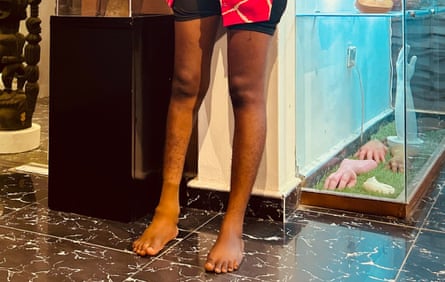
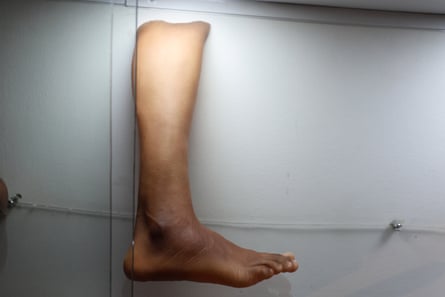
Their customers include amputees such as 30-year-old Emediong Bassey, who lost her lower right leg in a motor accident in 2010.
Bassey first heard about John Amanam on Facebook. After a consultation, she completed a form, and her leg measurements were taken. A few weeks later, she received her prosthetic.
“It feels like my real leg,” Bassey says. “It’s comfortable and matches my skin tone. Most people don’t even realise it’s not my real leg because it so closely resembles my other leg in colour and shape.”
John uses all his artistic skills to incorporate the smallest details – wrinkles, veins, fingernails and fingerprints – created from silicone moulds of each user’s body.
Not only focused on appearance, the company is now developing bionic prosthetics that use electromyography to read muscle signals, allowing users to control movement – a significant advance in a field dominated by expensive foreign technology.
Each bionic limb costs about $7,000 – cheaper than many western options but still unaffordable for most Africans, and so the brothers have been working to raise backing from governments and NGOs to make the technologies accessible. They have already provided free prosthetics to more than 10 clients, including Bassey.
But the gap between innovation and access remains wide, a global inequality. In the US, for example, bionic limbs often cost tens of thousands of dollars without full insurance coverage, forcing many who need them to crowdfund. In India, affordable options such as the $45 Jaipur Foot compromise on realism and function.
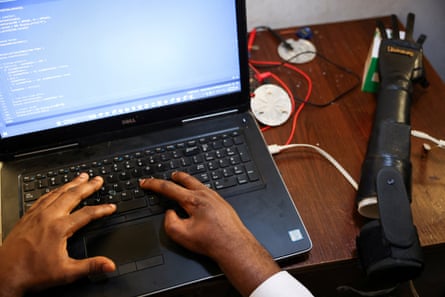
For Dr Natasha Layton, an occupational therapist and associate professor at Monash University in Australia, it is not just a technological problem but a policy failure.
“Assistive technology has often been treated as an optional extra rather than a core part of health services,” Layton says. “But it is essential for access to education, employment and social inclusion.”
She argues that the global prosthetics gap reflects decades of underinvestment, as governments and international bodies prioritised acute healthcare over long-term support.
“But without assistive technology,” she says, “many people are unable to fully regain their independence.”
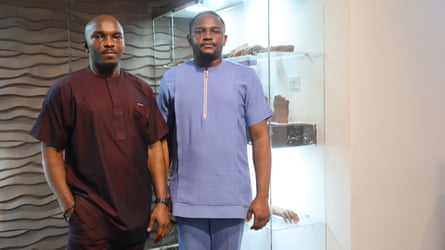
Experts say the Amanam brothers’ community-based prosthetics approach could help improve access to these essential services.
Local manufacturing offers a promising alternative, enabling customisation to the climate, work environment and lifestyle of local communities.
For example, prosthetic limbs manufactured in Europe may not withstand the demands of physical labour such as farming or the terrain common across Africa, and repairs are costly and difficult to arrange.
And according to Opeoluwa Akinola, co-founder of the Accesstech Innovation and Research Centre, assistive technology must begin with the lived realities of people with disabilities.
Akinola, who lost his sight as a child, designs inclusive technological solutions that serve people across Africa.
“Assistive technology is often designed far from the people who will use it, leading to solutions that are costly, culturally mismatched and hard to maintain,” he says.
Locally driven design can change this, he says. “When technology is developed within communities, it reflects real needs. It becomes more accessible and sustainable.
“This is not by playing catchup. It is a chance for African innovators to redefine what inclusive technology means.”
For researchers such as Layton, the rise of African innovation marks a broader shift in global health technology.
“Traditionally, advances have flowed from high-income to low-income countries,” she says.
“Now the trend is reversing, as innovations emerge from countries that must think creatively under constraints.”
These constraints, she says, can spur creativity. “Where systems have failed, people tend to be more innovative and flexible in the technologies they develop.”
She adds: “The effects could reach the global prosthetics industry. If this technology can be produced more cheaply without sacrificing quality or functionality, its market could extend beyond Africa to the world.”
For the Amanam brothers, the mission is personal and they know realism makes a world of difference to their customers.
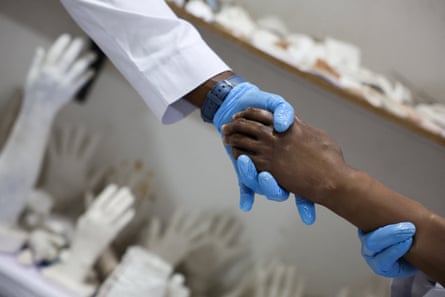
This human dimension lies at the heart of the brothers’ work. Their prosthetics now attract international orders, from Ghana and Côte d’Ivoire as well as the African diaspora in the US, with more than 5,000 produced.
Their journey – from a personal accident to a thriving business – points to a different kind of world: one where technologies are no longer imported luxuries but locally built tools of independence, and where innovation is no longer a one-way street, says Akinola.
“When the people closest to a problem design the solutions, those solutions are fundamentally different,” he says.