.png) 1 month ago
47
1 month ago
47
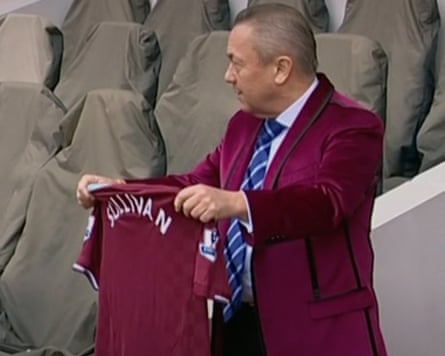
At this point, is it even worth saying that British football has a problem with safeguards around club ownership? In the context of the various sports-washing petrostates, incompetent investment conglomerates, oddball entrepreneurs and publicity hounds who control the purse strings of “the beautiful game” in the UK, West Ham United’s billionaire owner David Sullivan didn’t seem that much of an outlier. By the end of his tenure, West Ham fans largely hated him. But while they had their reasons and many of them were entirely valid, they didn’t always seem connected to either his business dealings or his tabloid past.
Football fans are nothing if not morally flexible. They (perhaps, in the interests of full disclosure, I should say “we”) will overlook almost anything if there’s a trophy or two finding its way into the cabinet. While Sullivan’s recent decision to step down as West Ham’s owner has been widely celebrated in east London, that’s mainly a result of the club’s recent relegation from the Premier League.
But the plight of West Ham may be the least of Sullivan’s problems. This Panorama investigation – a collaboration between the BBC and the Times newspaper and fronted by the journalist Billy Kenber – is a frequently skin-crawling affair. But does it tell us much about David Sullivan?
No allegations in this documentary relate to football or to West Ham. All are historical and date from the 1990s. Some might say the documentary confirms certain things to which Sullivan has already alluded. A potted biography tells us that Sullivan made his money in adult entertainment. He owned sex shops and produced pornographic films. He served a short prison sentence for “living off the immoral earnings of prostitutes”. He once said: “What’s the point in owning a sweet shop if you can’t eat a few sweets?” Whatever you assume him to mean by that is probably correct. If he’s been hiding, it’s been in plain sight.
So this documentary finds itself in an odd position. Lots of what is being uncovered is already in the public domain. Parts of it double as a dismal reminder of how searingly bleak many aspects of 90s media culture were. Sullivan owned the Sport newspapers. The Sunday Sport was in the habit of featuring photos of partly clothed schoolgirls alongside a countdown to their 16th birthdays (“There’s only FIVE days to go!” yowls one splash) before publishing topless photos when the big day arrived.
When asked about this, the former Sport group editor Nick Cracknell equivocates. “It’s very hard to put into context something that was legal and socially appropriate 30 years ago.” Is it though? Was this ever socially appropriate? Cracknell is reluctant to be drawn in. He will accept, however, that it would be inappropriate now “because it’s highly illegal”. Which, in itself, is fascinating. Only that, Nick? If there was any doubt that this was consistent with Sullivan’s moral code, it is revealed that Sullivan has admitted that he once paid for sex with a girl he believed to be “16 or 17” in the 1990s. Legal when he did it, but illegal now – it only became illegal to pay for sex with a 16- or 17-year-old in 2003.
Fortunately, seven brave women have come forward to stand some of this up. From Sacha and Anna, there’s an impression of wheedling manipulation, offers of advancement for sexual favours. From “Florence”, there’s something much worse. She visited Sullivan’s opulent mansion to be assessed for modelling jobs. She was accompanied by her boyfriend but met Sullivan alone. “If you let me fuck you, you’ll be one of my regular girls,” he reportedly said. After that, Florence alleges, Sullivan pressed ahead with sex despite her trying to make it clear she didn’t want to sleep with him. Sullivan’s lawyers say her allegations are implausible given the layout of his house. She didn’t go to the police at the time because, in her words, “What’s the point? Who would give a shit?” These are allegations it is easy to imagine Sullivan being able to brush off. Trauma and the passing of time have rendered Florence’s recollections hazy.
But in the context (which is the truly valuable thing established by this film), nothing in here is hard to believe – even though it is categorically denied by Sullivan, who says he intends to sue. Florence says she was introduced to Sullivan by Tony Livesey, who was the Sport’s editor-in-chief in the 90s. Livesey denies this. He also denies coming up with the birthday countdowns with Sullivan. In fact, Livesey claims that large parts of the book he wrote about this time at the Sport were fictionalised to make himself central to these tales of grotesque journalistic derring-do. Which is pathetic behaviour however you slice it, but maybe it beats admitting culpability.
Livesey has been a presenter on BBC Radio 5 Live for a decade and a half. Yet another triumph for the BBC’s recruitment team, then. The Football Association were made aware of the historical allegations and subsequently launched a safeguarding enquiry. West Ham have made it clear that Sullivan stepped down before the publication of the “serious historical allegations” and told the Times and the Panorama team that they were unable to comment on individual cases. So, finally, this is a brave piece of reporting that has every chance of bumping up against various institutional brick walls. However, that isn’t to say it isn’t valuable. If there’s one thing we can learn – from David Sullivan, from Tony Livesey, from Nick Cracknell and the nation’s football administrators – it’s surely that we should demand better.