.png) 1 hour ago
6
1 hour ago
6
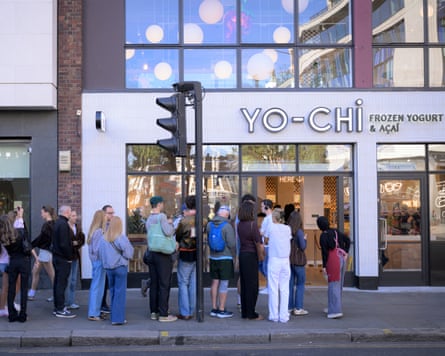
At 9.45am on a warm Saturday in September, a queue snakes down the pavement in Notting Hill, west London. Stretching for 20 yards past office blocks, estate agents and cafes, the line is waiting peacefully for an unusual morning snack: frozen yoghurt. The purveyor is the dessert shop Yo-Chi, which opened only a fortnight ago, one of the many hospitality businesses making queueing an increasingly common part of the British dining experience.
“We wait in line for everything now,” says 23-year-old Hannan Mahamud as she stands midway down the queue with three friends. “I queued for an hour the other week for a cookie, although it wasn’t worth it. We heard about Yo-Chi through a creator on TikTok who works in an office building across the road and posts queue updates. We thought it might be a fun day out.”
A few places ahead of Mahamud is Ewa Hemmerling, with her 14-year-old daughter, Lily, and Lily’s friends Georgia and Niamh. “I’d never usually wait for something like this, but it feels like something all the kids are up to now,” Hemmerling says. “It’s down to TikTok and Instagram and, to be honest, it’s an easy activity for us parents to do with the kids.”
Inside, after a 30-minute wait, customers fill tubs with swirls of soft-serve frozen yoghurt and dollop on top an array of sweet toppings. The modestly sized two-storey shop buzzes with chatter and the beep of card machines charging £2.70 for 100g.
“We have more than 70 shops in Australia and a presence in Singapore – we know to expect queues wherever we open,” says Yo-Chi’s training leader, Monique Kyling. “We want to make it a space where kids can hang out or do homework. On Fridays and Saturdays, we even have a DJ and a disco ball. Last night, the queue was around the block, but we make it fun – we have a dedicated person managing the queue and another going up and down, playing games like push-up contests or paper-plane throwing. The queue becomes part of the experience and the staff enjoy the pressure.”
This morning’s queue manager, Aisha, is outside clutching two handbag-sized dogs while their owners grab a morning dessert in the animal-free space. “It’s fun working here and everyone has a good time in the queue,” she says. “People are in high spirits and it’s nice to have a job in service where that’s the case.”
The British hospitality industry is facing a crisis. Nearly a quarter of bars, pubs and restaurants have operated at a loss so far in 2026, while produce and energy costs continue to rise owing to the Ukraine war and instability in the Middle East. To be able to draw a queue in this climate is no mean feat – and usually involves harnessing the power of social media.
“The Yo-Chi opening was a masterclass in social media marketing,” says Mairi Livsey, the co-founder of the viral food brand CZER. “They had every influencer there at the same time drumming up hype and it brought in the crowds in a difficult market. Operating costs are so high now that if you’re not running at close to full capacity, I have no idea how on earth you can survive.”

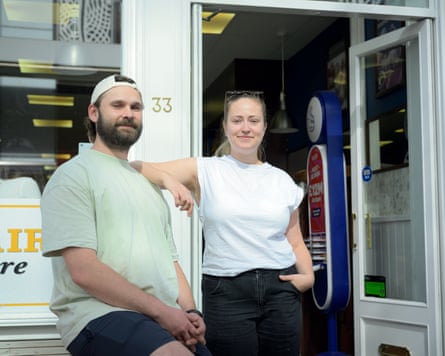
While Yo-Chi is a multinational operation, CZER is still finding its feet. Working in hospitality consultancy, Livsey and her partner, Marius Baltaitis, had their first taste of fame in 2025 when a hot chocolate recipe they designed for the food market Mercato Metropolitano in Mayfair picked up traction online.
Inspired to find the next viral trend, Livsey came across a TikTok from a US creator noting that there was nowhere to buy chopped chicken caesar salad wraps in London. “I’d had that exact craving a few months before and even came up with the name CZER because of it,” Livsey says. “But that post made me determined to actually start the business, so I commented under the TikTok that we were bringing caesar salad wraps to Mayfair, even though we had no premises or proper plans yet.”
Over the next three weeks, the couple found an unused service counter at the back of a corner shop in Mayfair, maxed out their credit cards to pay a recipe development company to come up with two wraps and hired three members of staff. They documented the entire process on social media. When they opened in May 2026, they had queues round the block. “We had planned to sell 50 wraps a day, but it was 400 a day almost at once,” Livsey says. “I obviously wanted the business to be popular, but I had never planned for there to be a queue seven days a week for three months straight. Once the influencers got hold of it, it went nuclear – we had to hire a full-time queue manager.”
Along with the frenzied demand came some vicious online criticism. “People who had never been to see us were posting comments saying it was an embarrassment to queue for a £13 wrap, or that we were faking it all,” she says. “I would read them all at night after a long day and cry myself to sleep. I was so worried about people in the queue that I would run up and down giving them sweets, or umbrellas if it was raining – but the people who turned up were so lovely and actually happy to be there. It’s mostly women and they want to chat with each other and be part of a social experience.”
As demand increased, Livsey began operating a virtual queue system, where customers can scan a QR code, place their order and then return to the premises when their wrap is ready. In August, she opened another outlet in Soho and she now has 40 staff on the payroll, although the queues have started to dissipate.
“We still do on average 400 wraps a day in Mayfair, but it’s an unpredictable industry and this is a summer product, so going into the winter we’re thinking about demand a lot,” she says. “We haven’t paid for any online coverage and we haven’t been able to take any profit out of the business yet – it’s a bootstrap operation. We do it because we love it – but it’s brutal. I wouldn’t want to live in a world where the only way you can survive in hospitality is to have queueing and virality.”
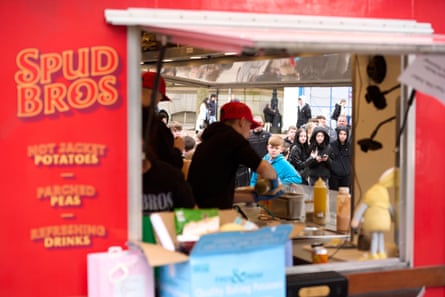
This is not just a London phenomenon. In Manchester, the hole-in-the-wall sandwich shop Fat Pat’s has had viral queues since opening in 2021, while the opening of the ramen franchise Maki & Ramen in Birmingham in August also resulted in lines down the street. In Preston, one of the most sought-after viral foods is a jacket potato served from an old tram carriage and documented for more than 1 million followers on Instagram. “We’ve had 2,000 people in the queue and even people camping out and waiting almost 24 hours for a potato,” says Jacob Nelson, one of the co-founders of SpudBros. “We would never advise that, because we want everyone to stay safe. Still, me and [brother and co-founder] Harley love the chaos. When it gets really busy, you go into that higher gear and it makes it more fun.”
Although the pair only started posting online during the pandemic to drum up business, they have since become influencers as much as restaurateurs, collaborating with the likes of the mega-popular YouTuber MrBeast in 2025. “We never set out to be influencers, but social media can really help people see the effort that goes into a business,” Nelson says. “You’ve got all these hidden costs and social media has allowed us to make sure people understand why our prices are what they are.”
For many businesses, online popularity can be a burden as much as a gift. South-west London’s August Bakery opened in 2024. Since the Instagram influencers Bite Twice posted a positive review of its pastries to their almost 300,000 followers in February 2026, the queues have been nonstop. “We’re not interested in social media at all, because we don’t enjoy it,” says the co-owner Florrie Beard. “At the beginning, a well-known duo approached us to make content in the shop, but we said no, because we knew it would create an impossible demand.
“Still, that demand has come and it means people often come in wanting exactly the same thing they’ve seen on screen, even though we change the menu seasonally, depending on produce. It’s really hard work for the team to motor through people without dismissing them and it’s pretty much just a queue out the door until we sell out.
“We spend so much time thinking about how best to reduce the bottlenecks and make it more efficient. And even though most people are happy to be social in the queue and chat, we hate that it makes the bakery less accessible to people who can’t physically stand for 40 minutes. When we had the heatwaves this summer, we would get people fainting, which wasn’t good.”
Oula, a Tunisian cafe in central London, has faced unpredictable spikes in demand since it went viral with a merguez sandwich. “The queues scare me a little,” the founder Boutheina B Salem says. “We built Oula around hospitality and conversation and those things become harder under pressure. Virality also strips away context and expectations can become more rigid when customers have been influenced by a short video or an image online. People have challenged me about Tunisian dishes because they differed from something they had eaten in Morocco, for example. I think influencer culture is here to stay, but when hype becomes your main currency, distinct cuisines are flattened into familiar formats and curiosity is narrowed.”
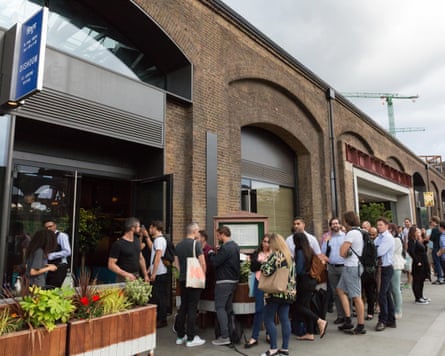
Even for more established businesses, queues can be something to be wary of. The Indian restaurant chain Dishoom is known for its lines, but the chief operating officer, Nina Panayiodou, says it “isn’t a badge of desirability”. She believes the focus on waiting times can make people nervous about coming at all. “Over the years, the perception of queueing at Dishoom has grown, rather than the queueing itself,” she says. “We only have queues because we want to keep Dishoom a place where you can decide to visit on the day.”
At The Dreamery, a north London ice-cream and wine shop, the co-founder George de Vos has his own reservations about the social media that brings customers flocking to his door. “Not everything should be explained and available to view for customers before they walk in,” he says. “You ideally want people to discover an experience for themselves.”
Still, he adds: “You also have to embrace social media, because it’s here to stay. We have people in our queue with ring lights or even tripods ready to set up and shoot content – sometimes we have to gently ask them to make space. But when you see so many other good places closing soon after opening, it’s just a relief to be busy.”
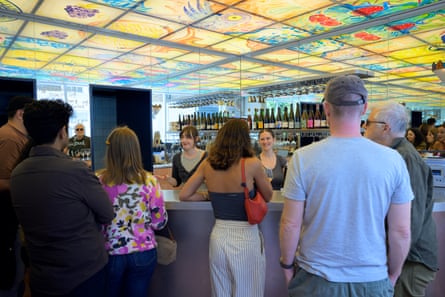
Demand has been so intense this summer that the chef, Jack Coggins, estimates they have been getting through 80 litres of ice-cream a day. “The queue keeps you on your toes. Since people wait so long, you have to make sure it’s good,” he says. “It often feels like a party while people wait, so I think that entices others to come in. And I love it when people post about it, because it’s a way to show off what we’re doing without it being staged.”
With swirling, impressionistic ceiling art designed by Lucy Stein, The Dreamery tries hard to conjure a sense of cool for customers who are happy to pay £5 for a scoop of ice-cream. With a typical queueing time of at least 20 minutes and celebrity endorsements from the K-pop star Lisa and others, the small shop on a quiet residential street is humming with activity on the Saturday afternoon when I arrive. “It looks so inviting from the window and I think since Covid we’ve all gotten used to queueing, so it’s not hard work to wait for something that seems like a luxury,” says Em Watson, a 28-year-old customer. “There are a lot of things you can do that are expensive and mediocre, but it’s good to support local, independent businesses like this when you can.”
If you make food for the love of it as well as to earn a living, there’s no denying that the power of social media raises some unsettling questions. Are people lining up to eat at your venue because the food is good, or are they queueing simply because there is a queue? Can today’s customers still decide whether to visit a place without it first becoming verified, reviewed and videoed online?
But those are issues for another day. The food I have tried is consistently delicious – Yo-Chi’s frozen yoghurt is unctuous and creamy, Czer’s wraps are umami-packed and ginormous and The Dreamery’s ice-cream and wine pairings are refreshingly smooth. “I think we’ll come again,” says Mahamud at Yo-Chi, on her way out. “This one was worth the wait.”