.png) 3 hours ago
8
3 hours ago
8
Datacentre nimbys are holding Britain back, George Osborne has said in reaction to nationwide protests about the giant water- and energy-guzzling structures.
The former Tory chancellor is now the head of AI for countries at OpenAI, the developer of ChatGPT. His job is to represent the company to governments around the world and he also has a role in enabling the building of datacentres and other infrastructure.
Speaking at the Big Brue festival in Somerset on Sunday, Osborne said: “You try and build a datacentre in Britain … I spent my life when I was politician trying to get people to agree to have new roads and railway lines and airport runways, and communities go up in arms – it’s really hard to build a datacentre.”
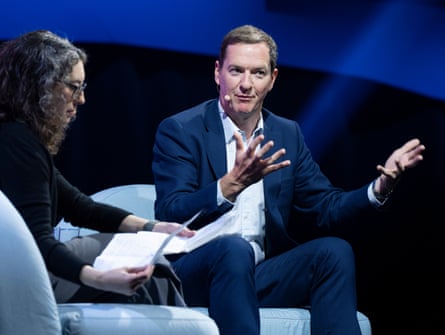
He said the UK would lose its “sovereignty” over tech to the US if it failed to allow datacentres to be built.
He explained: “You can either choose to have these datacentres in Ohio and Georgia and Michigan, which is where they’re all being built … we don’t allow these things to be built. They’re going to be built elsewhere, and you know that’s a loss of some sovereign control over the physical location where these things are.”
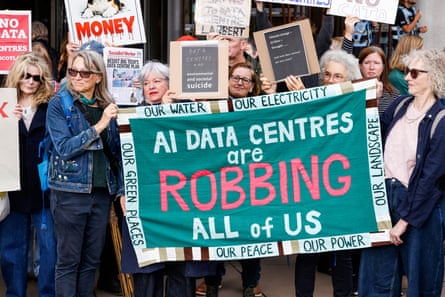
There have been protests about datacentres across the UK, including in central London, Devon and outside Holyrood in Edinburgh. People have said they are a blight on the landscape, questioned whether they will bring jobs to the local area, and argued they will take investment and space that could be used for affordable housing. There are also concerns about the vast water and energy use.
The government has classified AI datacentres as critical national infrastructure to get them built more quickly. But the Green party in England has called for a moratorium on building them.
Osborne dismissed the concerns over datacentres as nimbyism. He said: “I think a lot of the to opposition datacentres is very much like ‘not in my back yard’. There’s an enormous building boom going on in the United States of datacentres, even as the political opposition undoubtedly is growing.”
Verity Harding, the head of the AI and geopolitics project at Cambridge University’s Bennett School for Public Policy, said people had wider concerns over these centres.
after newsletter promotion
She said: “The reason everyone hates datacentres has nothing to do with datacentres. It’s the only tangible thing to protest against … [people] just don’t like what’s happening and they don’t feel that anybody’s in control or thinking about the impact of it.
“It’s exactly because the tech industry execs are talking in this ridiculous way … You know, you cannot go out on the one hand and say this [AI] might kill everybody one week and then the next week go and appear at a big sales conference saying that you should integrate it into your business.”
Bosses of OpenAI and Anthropic, two of the largest AI companies, will be meeting world leaders at the UN general assembly in New York City this week amid debate over the prospect of dangerous, superintelligent AI and whether and how it should be regulated.
Osborne said: “The fact that corporate leaders are sitting down with the presidents and prime ministers of the world in the UN security council I would say actually shouldn’t be alarming. It’s actually reassuring that people are beginning to try and use the kind of institutions of the world to think about how we regulate this new technology.”