.png) 4 hours ago
9
4 hours ago
9
Olga Soffer, who has died aged 83, brought a revolutionary idea into the conversation about prehistoric ice age people: women mattered. Inspired when working on archaeological excavations in the former USSR, and by remains from a dig in Moravia, in the 1990s she presented a case for women as makers of textiles, baskets and nets, critical to survival in bleak northern conditions 30,000 years ago.
Her achievement was the more remarkable for her career path. By then a professor of anthropology at the University of Illinois, she had obtained her three degrees over three decades, partly while also working as a cosmetics buyer and fashion promoter for a New York department store.
Since the 20s, Soviet Russia, looking to historical materialism, generously funded large archaeological excavations. Unlike most of her colleagues in the west, Soffer, whose family had fled Tito’s Yugoslavia and settled in Brooklyn in 1955, could read the reports. In 1977 she began years of travel and research, supported by grants from the US government, the National Geographic Society and many others. Among 30 sites she worked on, four stood out: Mezhyrich, Ukraine; Avdeevo, Russia; and Dolní Věstonice and Pavlov, Moravia (now in Czechia).
At such places, people built tent-like houses with mammoth bones. At Mezhyrich, 160 kilometres south of Kyiv, male archaeologists credited the remains to heroic male hunters. To Soffer there were too many mammoths – one house was assembled from 95 jaws. She argued instead that the bones had been collected from natural death sites, while noting that archaeologists had overlooked remains of smaller animals. “Maybe they killed one mammoth every 10 years,” she commented, “and never stopped talking about it.”
Already doubting the existence of male-dominated ice age communities, in 1990 she noticed marks in a few tiny clay fragments excavated decades before at Pavlov. She showed them to James Adovasio, an archaeologist at Mercyhurst College, Pennsylvania, who had been digging with her at Mezhyrich, and who knew about basketry and textiles. He recognised impressions of woven threads. They went on to identify 79 such marks among thousands of clay scraps, from Dolní Věstonice and Pavlov, with explosive implications.
Adovasio saw evidence, fortuitously imprinted in clay, for cordage, plaited basketry and woven textiles, made from plants, not animal sinews or hides. Soffer found indications of dress and headgear, previously overlooked in favour of attention to breasts and buttocks (characterised by Soffer as “paleoerotica”), on small female figurines, many of which were found at Avdeevo (carved from mammoth ivory and stone) and Dolní Věstonice (ceramic), similar to the Venuses of Willendorf, west of Vienna, and Kostenki, south of Voronezh, in Russia. Soffer later wrote that the head of the Willendorf figurine offered the clearest depiction of a fibre-based woven cap or hat, “rather than a hairdo, as posited by scholars”.
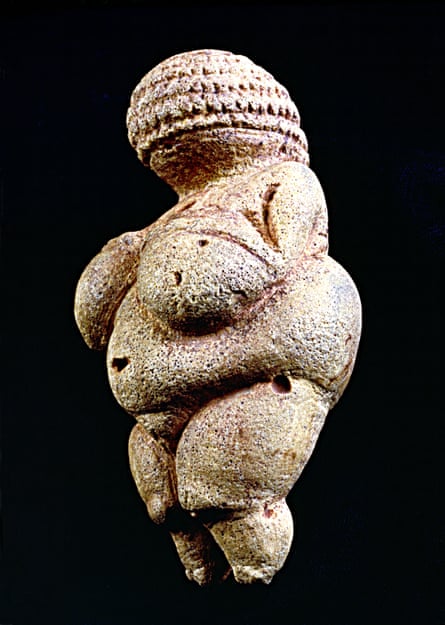
With Adovasio and his colleague David Hyland, Soffer conjured a world featuring mats, wall hangings, blankets and bags, shawls, shirts, skirts and sashes. Knotted string suggested nets, used by women to hunt small animals. She compared Palaeolithic tailoring to “something from Donna Karan or Calvin Klein”. A figurine’s beaded string item was a “skirt … to die for”. “We’re not talking protection from the elements here,” she told the New York Times.
The sophistication of the weaving and cord-making prompted Adovasio to suggest a history that went back at least 40,000 years. Noting more recent practices, they believed the crafts would have been invented and executed by women.
In 2007 Soffer and Adovasio co-authored, with the science writer Jake Page, The Invisible Sex: Uncovering the True Roles of Women in Prehistory, in which they addressed a perceived male bias. It was widely reported, but the public narrative of ice age life was led by Jean Auel, whose multi-million-selling Earth’s Children novel series was to end in 2011. Soffer was consulted on two titles (The Mammoth Hunters and The Plains of Passage), but the protagonist Ayla, a blond, blue-eyed modern human who challenges the patriarchal world of Neanderthals, nonetheless wears animal skins. Soffer’s wider message, that what survives from the ancient past is a tiny and often misleading representation of reality, has yet to be absorbed, even by many archaeologists.
Olga was born in Nazi-occupied Belgrade. As an infant she was taken with her maternal grandparents to a labour camp: she was treated favourably by the camp commander, she was told, due to her Aryan colouring and looks.
Her parents, Galina (nee Girs) and Alexander Shabunin, came from Russian migrant families scattered after the 1917 Bolshevik revolution. In New York, reached via Yugoslavia and four years in a displaced persons camp in Italy, her father assembled window blinds and her mother worked as a seamstress, while Olga went to Thomas Jefferson high school in Brooklyn.
After obtaining a BA in political science (1965) at Hunter College, City University of New York, she began working at Abraham & Straus, a Brooklyn-based department store chain, first as an assistant buyer for cosmetics, then special events coordinator for fashion. In the latter role she created a gourmet festival featuring the television chef James Beard, and hired a young Brooke Shields as a model.
Bored with work, she took night courses in art history at Hunter, which led to an interest in archaeology and ethnography, and her eventual MA in anthropology there (1975).
In 1978, having gone part-time at the store, she became an adjunct instructor of anthropology at Hunter, moving to Lehman College, then the University of Wisconsin at Milwaukee. After a PhD on the archaeology of eastern Europe at the Graduate Center, City University of New York (1984), Soffer joined the University of Illinois Urbana-Champaign as assistant professor of anthropology. She rose to professor, with stints as visiting archaeology professor at the Centre de Recherches Archéologiques, France (1992), and heading the department of Slavic languages and literature at Illinois (1993–98). She retired in 2008 as professor emerita. Her awards included an honorary doctorate from the Russian Academy of Sciences.
Both her marriages, to Mark Soffer, a history teacher, in 1962, and Dmitry Bobyshev, a poet and professor of Russian literature, in 1979, ended in divorce. She is survived by her daughter from her first marriage, Alex, and two grandchildren, Jake and Mena.