.png) 5 hours ago
5
5 hours ago
5
Tatsuya Fujiwara is no stranger to London’s Barbican theatre. It was here nearly 30 years ago that one of Japan’s biggest film stars, now 44, made his stage debut. He was just 15, plucked out of an audition of more than 5,000 hopeful youngsters by the revered theatre director Yukio Ninagawa for his play Shintoku-Maru. It kickstarted Fujiwara’s career, and three years later he landed a role in the cult dystopian film Battle Royale, going on to star in hit TV dramas and blockbuster films, all the while continuing to perform in Ninagawa’s acclaimed productions.
Now, Fujiwara returns to where it all began, to perform in a stage adaptation of Haruki Murakami’s science fiction novel Hard-Boiled Wonderland and the End of the World. The story alternates between two seemingly unrelated narratives: a cyberpunk thriller set in Tokyo, and a surreal fantasy that unfolds within a mysterious walled town. Directed by the French choreographer Philippe Decouflé, the play premiered in Tokyo in January, toured Japan until March, then Singapore in April. After the Barbican run this autumn, the tour will wrap up in Paris.
“When performing in Japan, you become accustomed to your own audience,” says Fujiwara. “You develop a feel for what reaches them and how they receive you. The moment you cross a border, that certainty disappears.”
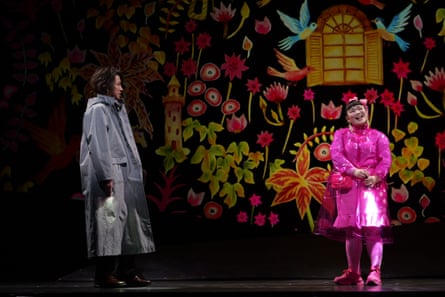
We meet in April, backstage at the Esplanade theatre in Singapore just a few hours before the production’s first performance to an English-speaking audience. (The play is performed in Japanese, with English surtitles.) The response was rapturous, the audience more animated than with any performance during the Japan run, according to the director and cast. The Singapore house laughed freely, while in Japan the comic moments did not land with such warmth.
Whether that’s due to cultural differences in self-expression or humour is up for debate, but backstage during intermission the cast are giddy. “It definitely gives us confidence for London,” says the director.
This play arrives at a time when Japanese culture is experiencing a global boom, particularly in London. The last five years alone have seen a cluster of UK exhibitions about Japan. The British Museum has curated shows on manga, Hokusai and the samurai; the V&A did the history of kimonos; Oxford’s Ashmolean explored art and photography from Tokyo; and Somerset House celebrated 50 years of Hello Kitty. However, productions that have broken through to a mainstream audience overseas have largely been based on anime and manga. This summer saw a musical adaptation of Death Note at the Barbican, as well as Pretty Guardian Sailor Moon at the West End’s Here at Outernet and Koko in Camden Town, and Spirited Away, which enjoyed a six-month run at the London Coliseum in 2024.
“The barriers are considerably lower,” says Miyako Kanamori, senior executive and veteran producer at HoriPro. As one of Japan’s largest entertainment companies, HoriPro has been exporting Japanese theatre to the UK for many decades. “Thirty years ago, when we first brought [Yukio] Ninagawa’s productions to Britain, that cultural landscape simply did not exist. Today, there is a far broader curiosity about Japanese storytelling and aesthetics, and I feel audiences approach our work with a greater sense of familiarity.” Perhaps now is the time for homegrown theatre to shine. Plus, as a global bestseller, Murakami’s name carries instant esteem and recognition.
However, the world of Murakami does not naturally lend itself to the stage. His novels can be cryptic and allegorical, making them hard to adapt for its native audience, let alone an international one.
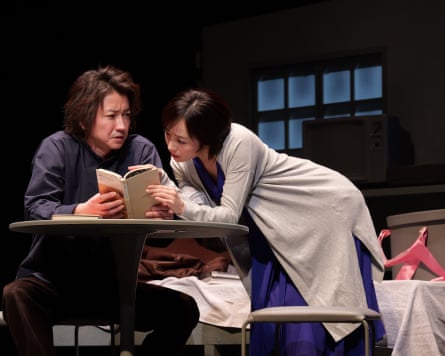
Hard-Boiled Wonderland and the End of the World spans 400 pages and features curious creatures such as unicorns and the “Murks”, monsters that lurk in the sewers. Fujiwara plays Watashi, the protagonist of the cyberpunk narrative the Hard-Boiled Wonderland, a human data processor known as a “Calcutec” who is essentially a cyborg. He encrypts data using a technique known as “shuffling”, described as a supernatural kind of mind alteration. His routine job slowly reveals a darker conspiracy buried deep within his own consciousness.
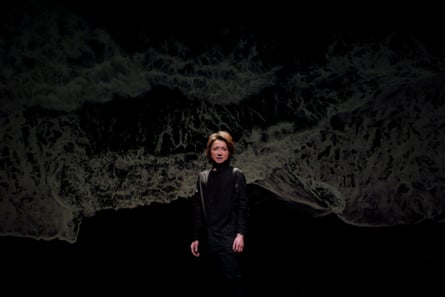
The parallel narrative is even more peculiar. End of the World unravels within a mythical walled town. Upon entering, the second protagonist, Boku – played on alternating nights by Kiita Komagine and Ryunosuke Shimamura – is stripped of his shadow and all his memories, and tasked with reading dreams from the skulls of dead unicorns. The two plots eventually converge, and while they are both totally removed from the reality we know, the stories are strangely relatable.
Murakami wrote the novel more than 40 years ago, but in an age of AI and algorithmic control, his questions about what remains when memory and selfhood are stripped are more pertinent now than ever.
“At first I thought it was impossible to do anything with [the material],” says Decouflé, who is best known for directing music videos for New Order and Fine Young Cannibals, as well as France’s 1992 Winter Olympics opening ceremony. “I’m not Japanese, so I can never fully grasp what lies beneath the text, but then I thought: ‘They’ve asked me to do it, so I’m going to do it my way, with my dreams, my ideas, my vision.’”
For the production company, bringing in a European director with a background in movement was a deliberate decision. Having worked on several adaptations of Murakami’s novels – Ninagawa’s Kafka on the Shore in 2015 and Simon McBurney’s The Wind-Up Bird Chronicle in 2023 – producer Kanamori learned that expressing the spiritual and psychological dimensions of the author’s world through dialogue alone was “profoundly difficult”.
after newsletter promotion
She came to realise that “music and physical expression might offer a more truthful theatrical language for his work”, particularly for a play that was intended to be performed to a non-Japanese-speaking audience. Working closely with Japanese scriptwriter Ako Takahashi to decode the text, Decouflé has made a highly visual adaptation. He casts ballerinas as unicorns, dressing them in golden leotards and pointe shoes with stilted forelimbs. Street dancers armoured in urchin-like spikes writhe and scuttle through the sewers, while Tokyo-based dancer Rikubouz moves in long, liquid phrases to connect the two worlds between scenes.
Murakami came to rehearsals himself. “He was always very contained, very still,” says Decouflé. “And then suddenly he saw the stage. He saw it alive. And I could see that he was happy – happy that I had given life to his dreams, to his book.” After the premiere, the author made a short speech. “He said something like: ‘I wrote this novel 40 years ago, and I had forgotten everything. Tonight, you all reminded me of what I created.’”
Decouflé had made two productions in Japan before – once 30 years ago, another 15 years ago – and has observed the rise of Japanese dance in that time. “Thirty years ago, we could not find dancers of the quality we needed. Even 15 years ago it was so-so. And now Japan has some extraordinary dancers.” He was also impressed by the professionalism of the performers. “I never heard anyone complain,” he says. “I gave them hard work, I really pushed them. And at the end, they were overjoyed. It was a great luxury to work that way.”
Cultural exchange has always been a crucial part of Japan’s story and how its art travels. Back in the Edo period, artisans commonly used discarded Ukiyo-e prints to package ceramics. These were later discovered by the impressionists, inspiring the Japonisme movement and artists such as Monet, Van Gogh and Klimt. The dialogue that followed, between eastern aesthetics and western modernism, moulded the development of modern art on both sides.
Perhaps something of that pattern persists here. The play’s star hopes international interest in Japanese theatre will also ignite a new energy back home. “It would be amazing if theatre in Japan could one day command the kind of broad cultural engagement it has in the UK, where it’s truly part of public life,” says Fujiwara, who knows better than most what it takes to carry culture across borders. At the Barbican in 2015, performing Ninagawa’s Hamlet on Shakespeare’s home turf, the pressure was paralysing.
“It’s a bit like a British company staging kabuki in Japan,” he says. “But this time it’s different because it’s Murakami. There’s more room to breathe, and more hope that we can offer something that reaches people broadly.”
End of the World and Hard-Boiled Wonderland is at Barbican theatre, London, 8 to 11 October.