.png) 1 month ago
37
1 month ago
37
JD Vance says 'great progress' made in the last few hours as he gives update on US-Iran peace talks
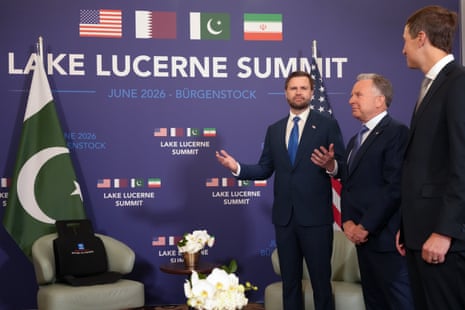
US vice-president JD Vance has been giving an update on the latest in the talks between Iran and the US in Switzerland today and says “great progress” has been made.
Vance told reporters that he wanted that while “Iran has been a driver of regional instability” he could see a future where everyone “can work together to promote peace and prosperity”. He said president Donald Trump was committed to see a full regional ceasefire, but admited ceasefires are “a little bit messy”.
He added the technical negotiations may not solve every disagreement but “allow us to sit together as teams for the first time in history”.
“Outside the last few months, never before have the Iranian and American leadership met at such a high level.”
He added US negotiators are in Switzerland to, “through diplomacy, through working together, transform the Middle East, where Iran and the Gulf have been at war with each other.”
Key events
Four months after the horrific Iran school bombing, fears grow that Trump and Hegseth will bury the truth

Andrew Roth
A secretive investigation into the attack that killed at least 175 has concluded, reports suggest. Will its findings ever see the light of day?
The attack on a girl’s elementary school in the Iranian town of Minab was one of the US military’s deadliest civilian bombings in decades. But nearly four months on, the Pentagon has produced no answers about why the military fired a Tomahawk cruise missile into a school on the first day of the war, killing at least 175 people, mostly children.
Some critics doubt that the Pentagon ever will, or will bury the results under classifications to keep the worst mistakes secret from the public.
As the US signs a shaky memorandum of understanding on a ceasefire with Iran, the secretive investigation into the attack has also become a test case for the self-styled secretary of war Pete Hegseth’s new approach to what he calls “warfighting”. As he said in early March, nearly two weeks after the attack, “our rules of engagement are bold, precise and designed to unleash American power, not shackle it”.
Shortly after the attack, Donald Trump suggested that it was carried out by Iran. When it became clear that the strike used a US-made Tomahawk missile, he suggested that Iran also had access to the cruise missiles. It does not.
Read more:
Envoys from regional heavyweights Pakistan, Turkey, Saudi Arabia and Egypt pushed for swift progress in US-Iran talks at a meeting in Cairo on Sunday, as negotiations between the two countries began in Switzerland.
In a joint statement, the ministers called for a “swift and successful conclusion” to negotiations aimed at reaching a solution to outstanding issues that is “lasting, verifiable and mutually acceptable”, while taking into account regional concerns, particularly the security and stability of Gulf states.
Saudi Arabia, which was hit by Iranian attacks during the conflict, joined mediator Pakistan alongside Turkey and Egypt in facilitating negotiations weeks into the Middle East war.
My colleagues Heather Stewart and Philip Inman have done some analysis on how despite the ceasefire and ongoing peace talks, the Iran conflict is continuing to cast a shadow over the global economy
You can read their analysis here:
A technical fault in air traffic control, triggered by security measures for peace talks between the US and Iran in Switzerland, caused disruptions at Zurich airport on Sunday, aviation authorities said, adding the problem had been resolved.
The glitch occurred after the integration of a restricted zone over Buergenstock, the Swiss mountain resort where negotiations are taking place, into radar display systems, Swiss air traffic control authority Skyguide said.
The zone was only decided at the last minute because the decision to hold the latest round of talks was not finalised until Saturday, according to a statement.
Operations have since returned to normal, Skyguide said, adding: “The systems are running smoothly, and security was ensured at all times.“
By midday, 12 arrivals and 14 departures had been cancelled, an airport spokesperson told Reuters. At least 60 departures were delayed, she added. US vice-president JD Vance arrived for peace talks with Iran at Buergenstock on Sunday as foreseen in a tentative peace deal, but the diplomacy was overshadowed by Iran’s announcement that it had reimposed its blockade of the strait of Hormuz.
Qatari mediator confirms that US-Iran talks have begun
Mediator for Qatar has confirmed the US-Iran talks in Switzerland have begun, according to AFP.
The talks between Iran and the US aimed at building out the fragile interim deal to end have been beset by difficulties including an Iranian decision to keep the strait of Hormuz closed in protest at Donald Trump’s inability to force Israel to end the fighting in Lebanon.
In a statement Qatar’s foreign ministry announced “the launch of the Lake Lucerne Summit and the first meeting of the high-level committee with the participation of representatives from the United States of America, the Islamic Republic of Iran, and the two mediating states, the State of Qatar and the Islamic Republic of Pakistan”.
The US vice-president, JD Vance, leading the US delegation, earlier said he was adding Lebanon to an agenda that had originally been conceived to focus on the opening of the strait, the lifting of US sanctions on Iranian oil exports and the unfreezing of Iranian assets held overseas.
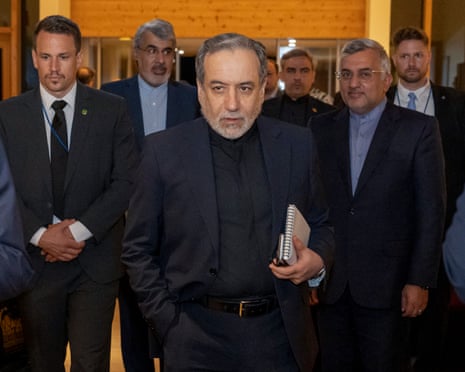
The Iranian delegation is led by the speaker of the parliament, Mohammad Bagher Ghalibaf, but the presence of the deputy oil minister and the governor of Iran’s central bank shows how Iran had wanted to focus on the terms for lifting sanctions.
The Swiss foreign ministry said the US and Iranian delegations, plus mediators from Pakistan and Qatar, were all present at the luxury resort.
Israel will not withdraw from security zone in Lebanon, says defence minister
There was and is ‘no restriction’ on Israeli soldiers to act to eliminate threats in Lebanon, and that troops would not withdraw from the security zone, Israeli defence minister Israel Katz said in a statement on Sunday, according to Reuters.
Israeli strikes killed at least 20 people in Lebanon on Saturday, Lebanon’s state news agency NNA reported, a day after a ceasefire with Iran-backed Hezbollah took effect after months of escalating violence.
UN nuclear energy chief in Switzerland to 'take stock' of Iran developments
Rafael Grossi, the chief of the International Atomic Energy Agency, says he has met Swiss Foreign Minister Ignazio Cassis in Burgenstock “to take stock of recent developments regarding Iran, the path ahead and the important role of the IAEA”.
The pair shook hands as teams from Iran and the US met to negotiate in Switzerland.
“At this critical moment, it’s important to give diplomacy every opportunity to succeed,” he said.
Earlier this month, IAEA’s governing board passed a US-backed resolution demanding Iran provide “complete information” on its enriched uranium stocks and grant access to inspectors to verify them.
Poll finds Israelis believe Iran won war
Israelis overwhelmingly believe that Iran emerged stronger from the Middle East war and its subsequent deal with the United States, a poll released on Sunday found, as reported by AFP.
The poll of 3,644 respondents, conducted between 17 June and 20 by the Hebrew University of Jerusalem in collaboration with the Agam Institute, paints a stark picture of public sentiment after the US-Iran deal.
Of those surveyed, 92.1% said Iran had won or gained more from the conflict, while 82.9% felt that Israel’s long-term security had been weakened.
The survey found that even among voters who support the right-wing bloc, the electoral base of prime minister Benjamin Netanyahu, 93.1% believed Iran had won.
Opposition to the US-Iran agreement was widespread, with 63.2% of respondents opposing it compared with just 12.1% expressing support.
The findings pointed to a broader crisis of confidence in Israel’s leadership.
Nearly three-quarters of those surveyed, 72.5% , said they did not believe Netanyahu’s claims about the military campaign’s achievements, while 56.4% rated his management of the campaign as “failed” or “poor”.
The poll also pointed to the political price paid by Netanyahu, with support for his premiership plummeting from 40.5% in early March to 29.4% in June.
Despite this, the survey found ongoing support for military action against Hezbollah in Lebanon.
Nearly half of respondents, 48.2%, backed renewed major military action against Hezbollah in Lebanon, even if it risked confrontation with Washington, while only 21% opposed such a move.
US-Iran talks in Switzerland to get under way as strait of Hormuz remains closed

Patrick Wintour
Talks between Iran and the US aimed at building out the fragile interim deal to end the war are due to get under way in Switzerland, beset by difficulties including an Iranian decision to keep the strait of Hormuz closed in protest at Donald Trump’s inability to force Israel to end the fighting in Lebanon.
The US vice-president, JD Vance, leading the US delegation, said he was adding Lebanon to the agenda, which had originally been conceived to focus on the opening of the strait, the lifting of US sanctions on Iranian oil exports and the unfreezing of Iranian assets held overseas.
Vance arrived at a Qatari-owned Swiss mountainside resort in Bürgenstock early on Sunday to meet Iranian negotiators for the second time since the months-long conflict began. He has already held direct talks with the Iranians in Islamabad.
The Iranian delegation is led by the speaker of the parliament, Mohammad Bagher Ghalibaf, but the presence of the deputy oil minister and the governor of Iran’s central bank shows how Iran had wanted to focus on the terms for lifting sanctions.
The first clause of the memorandum of understanding published last week requires a ceasefire on all fronts including Lebanon, where fighting has escalated between Israel and the Iranian-backed militant group Hezbollah.
Full report here:
Iran says not seeking nuclear weapon or relinquishing enrichment rights
Iranian President Masoud Pezeshkian reiterated on Sunday that Tehran was willing to provide assurances that the country was not seeking a nuclear weapon, while insisting that Iran would not relinquish its right to enrich uranium, AFP reports.
“What the United States demands is that Iran not build an atomic bomb. This is nothing new, and we can also state in writing that we have no intention of building a bomb,” the president’s website quoted him as saying.
“However, we will not relinquish our right to enrichment, and the other side will have no choice but to accept this right,” he added, before Iranian and US negotiators were set to meet for talks in Switzerland later on Sunday.
Iran says Lebanon conflict 'main topic' in US talks
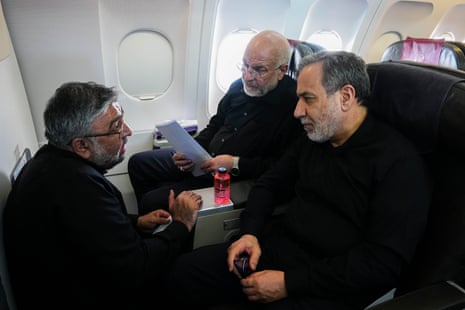
Iran said on Sunday that the ongoing conflict in Lebanon between Israel and militant group Hezbollah will top the agenda in talks with the US in Switzerland, as well as issues such as frozen Iranian funds and the sale of the country’s oil.
“The Zionist regime continues to violate its commitment in Lebanon, this issue will be the main topic of discussion in today’s talks,” foreign ministry spokesperson Esmaeil Baqaei said in a video shared by IRNA state news agency.
Tehran said on Thursday it had signed a deal with Washington to end months of hostilities that began on 28 February following US-Israeli attacks on Iran.
Under the agreement, the Israel-Hezbollah conflict in Lebanon was also due to stop.
Israeli strikes on southern Lebanon on Saturday killed at least 16 people, local authorities said, despite reports of a renewed ceasefire aiming to end the continuing clashes.
Lebanon’s civil defence agency said its personnel transported “16 dead and 12 wounded” to hospital, adding that they had been working “since the early morning hours” in the Nabatieh district.
Iran says it is closing strait of Hormuz over Israeli strikes in Lebanon
Iran has said it is closing the strait of Hormuz after waves of Israeli strikes in Lebanon in a move that threatens to derail the fragile interim peace deal with the US, signed just days ago.
The Islamic Revolutionary Guard Corps warned ships not to approach the strategic waterway, which before the war carried a fifth of global oil and liquid gas supplies, citing what it called Israeli crimes in Lebanon and a US violation of commitments to establish a ceasefire there.
It was unclear if the threat had been carried out, or if it would jeopardise talks in Switzerland scheduled for Sunday that were supposed to start the process of turning the current interim agreement between the US and Iran signed this week into a more detailed deal covering Iran’s nuclear programme.
Donald Trump promptly declared that “NO TOLLS” would be charged on ships seeking to pass through the strait during or after the 60-day interim ceasefire. In a social media post on Saturday, however, he raised the prospect of the US imposing a toll should negotiations fail.
US-Iran talks to begin in Switzerland
Hello and welcome to our coverage of the latest in the Middle East and updates on the on going peace talks between the US and Iran.
Here are the latest developments:
-
On Sunday delegations for the US and Iran delegations have arrived at Swiss resort for talks. Mediators from Pakistan and Qatar will also be in attendance according to the Swiss foreign ministry. Washington and Tehran signed a memorandum of understanding earlier in June.
-
This follows news that Iran has said it has closed the strait of Hormuz over continued strikes from Israel in Lebanon. On Sunday Iran’s Fars news agency agency cited a military source as saying that the strait of Hormuz remains closed and the Revolutionary Guards navy has not issued permission for any vessels to transit until further notice.
-
Israeli strikes on southern Lebanon on Saturday killed at least 16 people, local authorities said.
-
US vice-president JD Vance arrived at the Swiss mountainside resort of Burgenstock early on Sunday to meet Iranian negotiators for the second time.
-
US Central Command says 55 merchant ships transited strait on Saturday.
Read our latest report here:
Iran has said it is closing the strait of Hormuz after waves of Israeli strikes in Lebanon in a move that threatens to derail the fragile interim peace deal with the US, signed just days ago.
The Islamic Revolutionary Guard Corps warned ships not to approach the strategic waterway, which before the war carried a fifth of global oil and liquid gas supplies, citing what it called Israeli crimes in Lebanon and a US violation of commitments to establish a ceasefire there.
It was unclear if the threat had been carried out, or if it would jeopardise talks in Switzerland scheduled for Sunday that were supposed to start the process of turning the current interim agreement between the US and Iran signed this week into a more detailed deal covering Iran’s nuclear programme.