.png) 1 month ago
57
1 month ago
57
Iran says coastal attack will lead to full Gulf closure and mine-laying
Iran’s defence council threatened to lay sea mines to block the entire Gulf if Iran’s coasts or islands are attacked, according to the Fars news agency.
“Any attempt by the enemy to attack Iranian coasts or islands will naturally, and in accordance with common military practice, cause all access routes and communication lines in the Persian Gulf and the coasts to be mined with various types of naval mines, including floating mines that can be released from the coasts,” the statement read.
“In that case, the entire Persian Gulf will practically find a situation similar to the strait of Hormuz for a long time. This time, along with the strait of Hormuz, the entire Persian Gulf will be practically blocked, and the responsibility for it will lie with the threatening party.”
Iran has permitted some friendly countries, including China, India, Pakistan, to secure safe passage of their ships through the strait, but has effectively closed it down for others by attacking ships and reportedly laying mines in the waterway, causing a major crisis in global energy markets.
The US is reportedly considering plans to occupy or blockade Iran’s strategically crucial Kharg Island to pressure Tehran to reopen the vital waterway, in what would mark a huge escalation in the US-Israeli war.
As we have reported, the US president, Donald Trump, who is facing domestic pressure as oil prices soar, warned late on Saturday that the US will “obliterate” Iranian power plants if the strait is not open before a 48-hour deadline (23:44 GMT on Monday according to the time of his Truth Social post).
Key events Show key events only Please turn on JavaScript to use this feature

Callum Jones
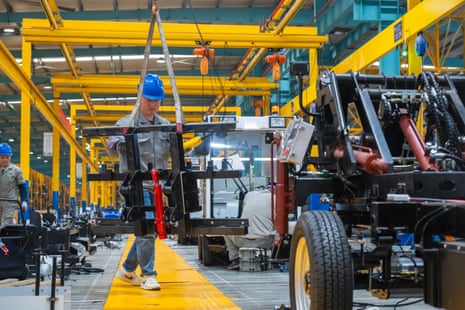
The Guardian US’s deputy business editor, Callum Jones, has written an interesting analysis piece exploring why China, which has long braced for a Gulf oil supply shock, is in a much better position to absorb disruption to energy supplies than many other Asian countries. Here is an extract:
Oil exports from the Middle East have tumbled 61% over recent weeks, according to maritime tracking consultancy Kpler – roiling countries across Asia, which relied on the region for 59% of its crude imports in 2025, and have been left racing to conserve energy.
But China, the world’s second-largest economy, appears to be in a very different position to much of the continent.
Its energy system has “significant buffers”, Michal Meidan, the head of China energy research at the Oxford Institute for Energy Studies, an independent research institute, explained in a recent paper – from huge reserves of oil and liquefied natural gas (LNG) to a robust domestic supply, including alternative energy sources, such as wind and solar.
China, which usually imports around half its crude supplies from the Middle East, is not as exposed as other Asian economies. “While a very high proportion, it is limited when compared to Japan, India or Korea,” said Meidan. Japan, for example, sources about 95% of its oil imports from the region.
Asked about Donald Trump’s threats to “obliterate” Iran’s power plants, Chinese foreign ministry spokesperson Lin Jian warned:
“If the war expands further and the situation deteriorates again, the entire region could be plunged into an uncontrollable situation.”
“The use of force will only lead to a vicious cycle,” he said, adding that the war – which the US and Israel are widely seen to have started illegally – should not have begun in the first place.
The UAE’s defence ministry said in a post this morning that its defences were responding to incoming missile and drone “threats” from Iran. There were no immediate reports of any injuries or casualties.
It said yesterday that it had responded to 1773 drones, 345 ballistic missiles and 15 cruise missiles since the war was triggered by the killing of the former Iranian supreme leader, Ali Khamenei, in joint US-Israeli airstrikes on 28 February, which then led to Iran responding with attacks across the Gulf region.
Iran says coastal attack will lead to full Gulf closure and mine-laying
Iran’s defence council threatened to lay sea mines to block the entire Gulf if Iran’s coasts or islands are attacked, according to the Fars news agency.
“Any attempt by the enemy to attack Iranian coasts or islands will naturally, and in accordance with common military practice, cause all access routes and communication lines in the Persian Gulf and the coasts to be mined with various types of naval mines, including floating mines that can be released from the coasts,” the statement read.
“In that case, the entire Persian Gulf will practically find a situation similar to the strait of Hormuz for a long time. This time, along with the strait of Hormuz, the entire Persian Gulf will be practically blocked, and the responsibility for it will lie with the threatening party.”
Iran has permitted some friendly countries, including China, India, Pakistan, to secure safe passage of their ships through the strait, but has effectively closed it down for others by attacking ships and reportedly laying mines in the waterway, causing a major crisis in global energy markets.
The US is reportedly considering plans to occupy or blockade Iran’s strategically crucial Kharg Island to pressure Tehran to reopen the vital waterway, in what would mark a huge escalation in the US-Israeli war.
As we have reported, the US president, Donald Trump, who is facing domestic pressure as oil prices soar, warned late on Saturday that the US will “obliterate” Iranian power plants if the strait is not open before a 48-hour deadline (23:44 GMT on Monday according to the time of his Truth Social post).
Keir Starmer is expected to hold an emergency Cobra meeting this afternoon to discuss the economic fallout of the Iran war on the British people, amid the threat of higher inflation. Chancellor Rachel Reeves and Bank of England governor Andrew Bailey are expected to be in attendance
The meeting comes after Starmer spoke with Trump overnight for 20 minutes in a meeting that was described as “constructive”. The two leaders spoke about the “essential” need to reopen the strait of Hormuz to boost oil supplies to the global economy.
Iran has effectively halted all traffic through the shipping corridor since the US and Israel launched a joint attack on Iran on 28 February. Trump has pushed for European allies to send ships to help reopen the strait but no leaders have so far committed to get involved.
Interim summary
If you’re just joining us, here’s a snapshot of the latest key developments in week four of the US-Israel war on Iran.
-
Iranian president Masoud Pezeshkian said “threats and terror” were strengthening Iranian unity, after Donald Trump warned on Sunday he would “obliterate” Iranian power plants if the strait of Hormuz was not fully opened within 48 hours. Tehran said it would destroy essential infrastructure including water systems across the Middle East if Trump carried out his threat.
-
The situation facing the world is now more serious than the two oil crises in 1973 and 1979 as well as the gas crisis sparked by Russia’s invasion of Ukraine, said the head of the International Energy Agency, Fatih Birol. It was like “two oil crises and one gas crash put all together”. He also said the IEA would release more stockpiled oil “if it is necessary”.
-
The Israeli military said early on Monday it had begun a wide-scale wave of strikes targeting Iranian infrastructure in Tehran. Air raid sirens sounded across parts of northern and central Israel, including Tel Aviv, and the occupied West Bank overnight on Sunday, warning of incoming missiles from Iran.
-
Global stock markets were hit and oil prices rose on Monday after Trump’s 48-hour ultimatum and Israel’s warning that the war would continue for several more weeks. A wave of selling is sweeping through Asia-Pacific markets, while the US dollar is rising today as investors seek out a safe haven.
-
British prime minister Keir Starmer is set to chair an emergency meeting on the economic fallout from the Iran war on Monday, with chancellor of the exchequer Rachel Reeves and Bank of England governor Andrew Bailey also attending, the UK government has said.
-
Vietnam and Russia are expected to sign energy deals during Vietnamese prime minister Pham Minh Chinh’s visit to Moscow that started on Sunday, Hanoi said, amid surging fuel prices in Vietnam.
-
Indonesia is eyeing up to 80tn rupiah ($4.7bn) in savings to cushion its economy from the fallout of the war, according to the government.
-
New Zealand will temporarily permit fuel meeting Australian standards to be supplied domestically for up to 12 months, the government said, amid soaring prices and potential supply risks.
-
Four ambulances belonging to the Jewish community ambulance service have been set on fire in London, with police saying they were treating the incident as an “antisemitic hate crime”.
With agencies

Graeme Wearden
Donald Trump’s threat to “obliterate” Iran’s power plants unless the strait of Hormuz reopens is hitting global stock markets today, as reported earlier.
A wave of selling is sweeping through Asia-Pacific markets at the start of the week. Japan’s Nikkei has dropped by 3.4% in afternoon trading, China’s CSI 300 has lost 2.8% and South Korea’s KOSPI index has slumped by 6.5%.
The US dollar, meanwhile, is rising today as investors seek out a safe haven.
Trump’s ultimatum, and Tehran’s threat to “irreversibly destroy” essential infrastructure across the Middle East in response, means the war is entering a new phase of escalation, analysts warn.
Markets are finally starting to wake up to the gravity of the potential for long-term impact on energy markets, reports Neil Wilson, an investor strategist at Saxo UK.
This is an escalatory doom loop – or ‘escalation trap’ with currently no realistic off-ramp. Neither side has an incentive to back down as the costs of doing so are increasing day by day. Each side thinks pushing harder will force the other to back down.
As well as fears of escalation in the conflict, investors are also bracing for rises in interest rates this year, with central banks under pressure to fight a rise in inflation.
See more on the Iran war’s fallout in our business blog here:
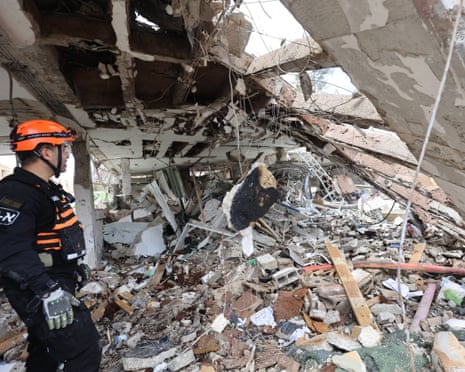
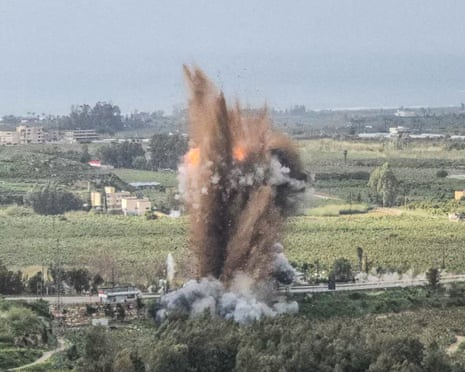
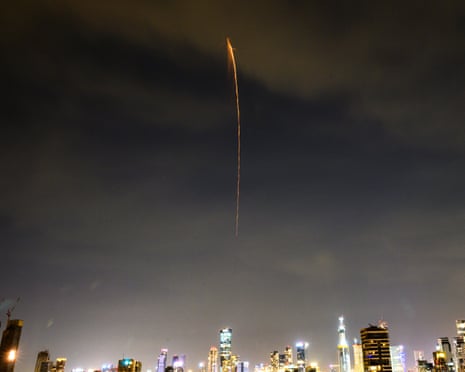
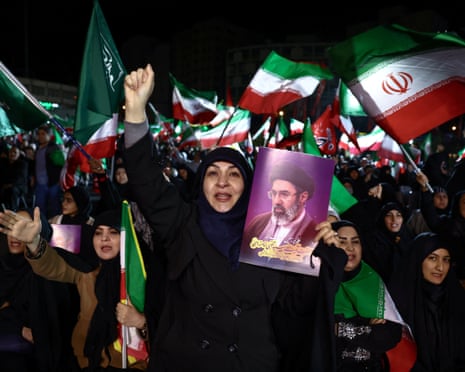
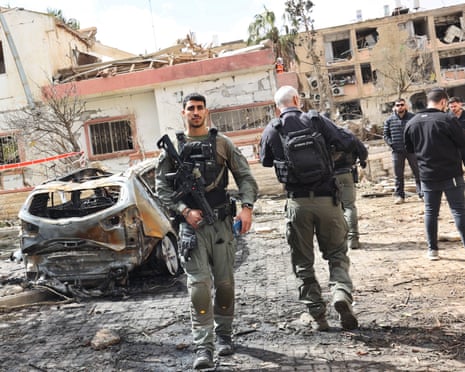
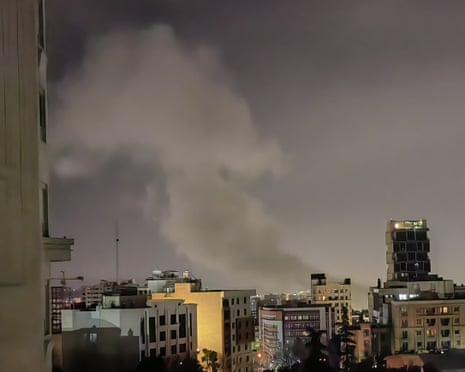
Here are some of the latest images coming in from the Middle East amid the escalating war.
Arson attack on London ambulances being treated as antisemitic hate crime, police say
Four ambulances belonging to the Jewish community ambulance service have been set on fire in London, with police saying they were treating the incident as an “antisemitic hate crime”.
Officers were called to Golders Green about 1.45am on Monday after receiving reports of a fire.
The Metropolitan police confirmed the incident in north London was being treated as an antisemitic hate crime.
The London fire brigade (LFB) said it had sent six fire engines and about 40 firefighters to the fire, which damaged four vehicles.
Several cylinders on the vehicles exploded and caused windows to break in an adjacent block of flats, the LFB said. No injuries were initially reported.
Police superintendent Sarah Jackson said police were on the scene to carry out urgent inquiries and “we are in the process of examining CCTV and are aware of online footage”.
We believe we are looking for three suspects at this early stage.
See the full story here:
Starmer calls emergency meeting on UK economy as risks from war mount
British prime minister Keir Starmer is set to chair an emergency meeting on the economic fallout from the war in Iran on Monday, with chancellor of the exchequer Rachel Reeves and Bank of England governor Andrew Bailey also attending, the UK government has said.
Financial markets face another turbulent week after Iran said it would strike its Gulf neighbours’ energy and water systems if Donald Trump followed through on his threat to “obliterate” Iran’s power plants if it doesn’t fully open up the crucial strait of Hormuz.
The UK is watching with particular unease, Reuters reports. The country’s heavy dependence on imported natural gas, persistently high inflation and stretched public finances have pushed its government bonds into a far steeper decline than those of international peers.
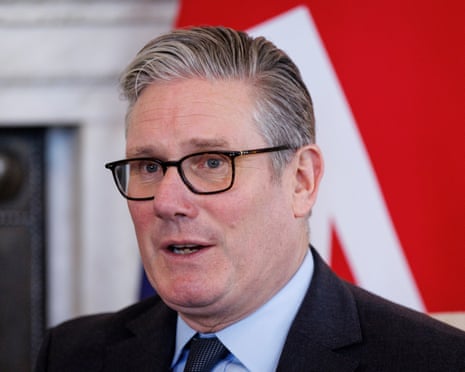
Britain’s finance ministry said before the so-called “Cobra” meeting:
Topics expected to be covered are the economic impact of the crisis on families and businesses, energy security and the resilience of industry and supply chains alongside the international response.
Foreign secretary Yvette Cooper and energy secretary Ed Miliband will also attend.
Reeves has said it is too soon to say what the impact of the war will be for Britain’s economy and has resisted calls for sweeping cost-of-living measures for households, saying instead that more targeted support is under consideration.
Starmer and Donald Trump spoke by phone on Sunday evening, the UK government said in a statement. “The leaders discussed the current situation in the Middle East, and in particular, the need to reopen the Strait of Hormuz to resume global shipping.”
China and Hong Kong stocks dive
Stocks in China and Hong Kong are on track for their worst day in nearly a year amid the Middle East war.
Investors dumped stocks in sectors ranging from tech to travel to agriculture, fearing they would be hit by soaring oil prices and weaker demand, as the US-Israel war on Iran fans fears of stagflation and rattles global financial markets.
But sectors including coal, oil and electric vehicles attracted inflows on bets they would benefit from a growing pursuit of energy security triggered by the oil shock, Reuters reports.
China’s benchmark Shanghai Composite Index slumped 2.5% at the lunch break, heading for its biggest one-day drop since April 2025. The blue-chip CSI300 Index lost 2.4% to reach a four-month low.
Hong Kong’s Hang Seng Index tumbled 3.5%.
As reported earlier, stocks fell while oil prices rose after Donald Trump and Iranian leaders traded threats over the vital strait of Hormuz and Israel said the war could last several more weeks.
The escalation hammered stock markets, with Seoul and Tokyo – standout performers before the war started – taking the brunt of the selling, shedding as much as 6% and 5%, respectively, at one stage.
Turning to Indonesia now, the country is eyeing up to 80tn rupiah ($4.7bn) in savings to cushion its economy from the fallout of the war in the Middle East, according to the government.
South-east Asia’s largest economy is also considering fuel-saving measures including one day of remote working a week for government and certain public sector workers amid soaring global oil prices.
In an interview recorded last week, President Prabowo Subianto was asked about a possible shift in budget priorities for the country that heavily subsidises fuel for its population of just over 284 million. The former general said the government was “making every effort” to cut costs by curbing energy consumption and boosting production of renewables, mainly solar power, Agence France-Presse is reporting.
During the interview, presidential spokesman Prasetyo Hadi suggested the government is seeking savings of 80tn rupiah – a number confirmed to AFP by the presidency on Monday.
Prasetyo did not detail where the money would come from.
The government has repeatedly insisted Prabowo’s signature free meals program will remain untouched, and has so far staunchly defended its fuel subsidy, which covers about 30-40% of the cost for consumers and represents around 15% of the budget
Attack on Iran broadcaster kills one, says state TV
A strike on a broadcast station in southern Iran killed at least one person, state television reported on Monday.
“The 100-kilowatt AM transmitter of the Persian Gulf Radio and Television Centre was attacked by the American-Zionist terrorist army,” the state-run Islamic Republic of Iran Broadcasting said, quoted by AFP.
In this attack, which was against international laws, one of the centre’s security colleagues was martyred and another person was injured.
IEA will release more stockpiled oil if needed, chief says
The International Energy Agency is consulting with governments in Asia and Europe on the release of more stockpiled oil “if necessary” due to the Iran war, its executive director has said.
“If it is necessary, of course, we will do it,” Fatih Birol said on Monday. “We look at the conditions, we will analyse, assess the markets and discuss with our member countries.”
IEA member nations agreed on 11 March to release a record 400m barrels of oil from strategic stockpiles to combat the spike in global crude prices. The drawdown represented 20% of overall stocks.
There would not be a specific crude price level to trigger another release, Birol said in an address to Australia’s national press club in the capital of Canberra, Reuters reports.
He said:
A stock release will help to comfort the markets, but this is not the solution. It will only help to reduce the pain in the economy.
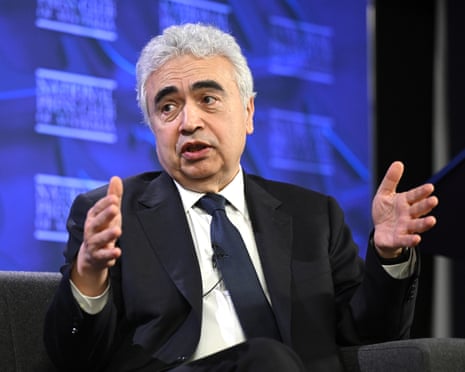
Birol is beginning a world tour in Canberra because the Asia Pacific is at the forefront of the oil crisis, he says, given its reliance on oil and other crucial products such as fertiliser and helium transiting the strait of Hormuz.
After meeting Australian prime minister Anthony Albanese, Birol is to travel to Japan this week before a Group of Seven meeting.
Turning for a moment to Vietnam and Russia, the two countries are expected to sign energy deals during Vietnamese prime minister Pham Minh Chinh’s four-day visit to Moscow that started on Sunday, Hanoi said.
The two sides were expected to sign “important agreements“ focusing on energy, trade and investment, Vietnam’s government said in a statement late on Sunday.
Chinh is scheduled to meet his counterpart Mikhail Mishustin and Russian president Vladimir Putin in a visit that comes as Vietnam has faced surging fuel prices amid the US-Israel war on Iran, with petrol prices up 50% and diesel prices rising 70%, Reuters is reporting.
Communist-run Vietnam maintains close ties with Russia, its longtime top supplier of military equipment, while Russian oil and gas companies operate offshore of Vietnam.
The two countries have been in talks for a Russian company to build Vietnam’s first nuclear power plant, and officials said they are likely to officially sign a nuclear power agreement during Chinh’s trip.
Saudi Arabia says two more ballistic missiles have been fired towards the Riyadh area and it has intercepted one, while the other fell into an uninhabited area.
Its defence ministry also said on X that it had intercepted a drone in the eastern region, as Iran continues attacks around the Gulf region in response to US-Israeli strikes.
New Zealand will temporarily permit fuel meeting Australian standards to be supplied domestically for up to 12 months, the government said on Monday, as it seeks to mitigate supply risks linked to the Middle East conflict and soaring prices.
Associate energy minister Shane Jones said the alignment of fuel standards would give importers access to more options and reduce the risk of disruptions.
“This is a sensible, time-limited step that gives importers access to a broader range of fuel shipments, including those already in our region,” Jones said in a statement cited by Reuters.
But New Zealand would not follow Australia in relaxing its own standards to allow access to higher sulphur fuel, he added.
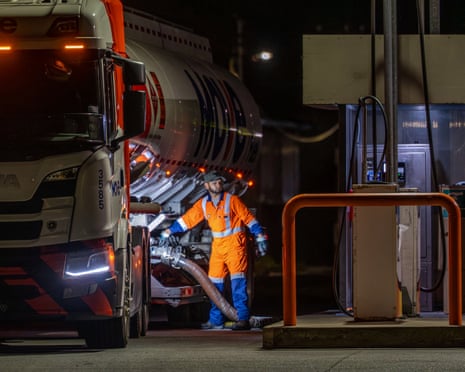
Asian stocks tumble
Stocks have fallen while oil prices rose after Donald Trump and Iranian leaders traded threats over the key strait of Hormuz and Israel said the Middle East war could last several more weeks, AFP is reporting.
The escalation hammered stock markets, with Seoul and Tokyo – which had been the standout performers before the war started – taking the brunt of the selling, shedding as much as 6 and 5%, respectively, at one point.
Hong Kong shed more than 3%, while Shanghai, Taipei and Manila all lost more than 2%. Sydney, Singapore and Wellington were also deep in negative territory.
South Korea’s won dropped to 1,510 won per dollar, its weakest level since 2009.
Oil prices edged up, with Brent sitting around $112 and West Texas Intermediate just below $100.
Opening summary
Hello and welcome to our live coverage of the US-Israel war on Iran, the broader regional conflict and the impact on the world economy.
The head of the International Energy Agency, Fatih Birol, has said the public needs to understand the “depth of the problem” facing the globe as a result of the war on Iran.
Birol told Australia’s national press club on Friday that the situation was now “very serious”, more so than the two oil crises in 1973 and 1979, and more serious than the gas crisis sparked by Russia’s invasion of Ukraine.
“At that time, in each [oil] crisis, the world has lost about 5 million barrels per day, both of them together 10 million barrels per day. And after that we all know that there were major economic problems around the world. And today we lost 11 million barrels – so more than two major oil shocks put together,” he said.
Plus after Russia’s invasion of Ukraine, the gas markets – especially in Europe – we lost about 75 billion consumer metres (BCM). And as of now, as a result of this crisis, we lost about 140BCM, almost twice. So the situation is, if we want to put in a context, this crisis as it stands now, two oil crises and one gas crash put all together.
Birol added that the crisis was also having a severe impact on other “vital arteries of the global economy”, including petrochemicals and fertilisers, which would have lasting impacts.
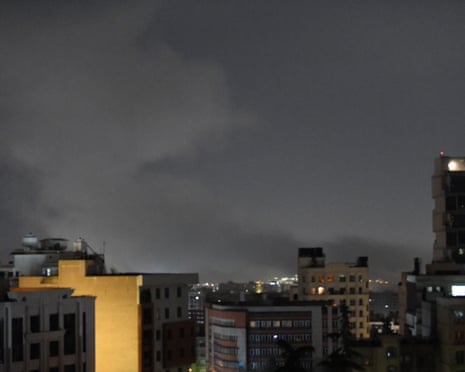
In other developments:
-
Iranian president Masoud Pezeshkian said “threats and terror” were strengthening Iranian unity, after Donald Trump yesterday warned he would “obliterate” Iranian power plants if the strait of Hormuz was not opened within 48 hours.
-
The price of oil increased early on Monday after Trump’s 48-hour ultimatum to Iran – and Israel warned the war would continue for several more weeks. Shortly after the 2200 GMT open, the price of West Texas Intermediate – the US benchmark crude – for May delivery was up 1.8% to just over $100 a barrel, before retreating slightly.
-
US treasury secretary Scott Bessent, asked if Trump was “winding” down the war or “escalating” it, told NBC News: “They are not mutually exclusive. Sometimes you have to escalate to de-escalate.” He also said the US government had “plenty of money” to fund the war against Iran but was requesting supplemental funding from Congress to ensure the military was well supplied in the future.
-
Lebanon’s health ministry said on Sunday that 118 children and 79 women were among those killed during Israel-Hezbollah fighting, while at least 2,786 others had been wounded, according to the Associated Press. The country’s death toll as of Saturday was 1,024 people.
-
The director general of the International Atomic Energy Agency (IAEA), Rafael Grossi, said he hoped to “re-establish” talks between Iran and the US about Tehran’s nuclear program despite the escalating nature of the conflict. “I’ve been having important conversations here at the White House, and also with Iran. There are some contacts, and we hope to be able to re-establish that line,” Grossi told CBS News.
-
UK prime minister Keir Starmer and Trump spoke by phone on Sunday evening, according to a statement from the UK government. “The leaders discussed the current situation in the Middle East, and in particular, the need to reopen the Strait of Hormuz to resume global shipping.”
-
Pope Leo said the death and suffering caused by the war in the Middle East were a “scandal to the whole human family”, as he once again pleaded for an immediate ceasefire. “We cannot remain silent in the face of the suffering of so many people, the defenceless victims of these conflicts. What hurts them hurts the whole of humanity,” Leo said on Sunday at his weekly Angelus prayer in St Peter’s Square.