.png) 1 month ago
60
1 month ago
60
Hegseth reiterates claim that Trump 'knew nothing' about attack on gasfield
When asked by a reporter whether he felt Israel was pursuing its own objectives, in relation to the attack on Iran’s South Pars gasfield which Donald Trump said the US “knew nothing” about, Hegseth said: “We hold the cards.”
“We have objectives. Those objectives are clear. We have allies pursuing objectives as well,” he added. He explained earlier in the press conference that the US’s objectives were to destroy Iran’s missiles, launchers, defence industrial base and navy, and for Tehran to never obtain nuclear weapon.
On the South Pars gasfield attack, he said: “Iran has weaponised energy for decades. Israel clearly sent a warning.”
Key events Show key events only Please turn on JavaScript to use this feature
Lorenzo Tondo
A reporting team came under fire in southern Lebanon on Thursday, when an Israeli airstrike struck within metres of their position as they were filming. RT correspondent Steve Sweeney and his cameraman, Ali Rida, were wounded in the blast, according to their account.
The two said an Israeli aircraft launched a missile towards their filming location near the Al-Qasmiya Bridge, an area situated close to a local military installation. Rida alleged the strike was deliberate, insisting the crew had been clearly identifiable as media, wearing uniforms marked with press insignia.
Footage captured by Rida’s camera appears to show the moment the missile landed, detonating less than ten metres behind Sweeney as he instinctively drops to the ground in an attempt to shield himself.
Both men remained conscious after the strike and were taken to a nearby hospital, where they are receiving treatment.
Trump administration has 'lost control of its own foreign policy', says Oman
A negotiated deal between the United States and Iran to avert war “appeared really possible”, Oman’s foreign minister who mediated talks between the two sides has said.
Writing in The Economist, Badr Albusaidi abandoned the usual reserve of diplomatic language to call the war a “catastrophe” and said Donald Trump’s administration had “lost control of its own foreign policy”.
He mediated a second round of indirect negotiations that resumed in Oman on 6 February, with the final round held in Geneva on 26 February.
“It was a shock but not a surprise when on February 28th – just a few hours after the latest and most substantive talks – Israel and America again launched an unlawful military strike against the peace that had briefly appeared really possible,” Albusaidi wrote.
The details of what was on the table in Geneva is of major significance, experts say, because Trump justified the war by saying Iran posed an “imminent” threat with its nuclear programme.
Albusaidi blamed “Israel’s leadership” for persuading Trump that “an unconditional surrender would swiftly follow the initial assault and the assassination of the supreme leader” Ali Khamenei, who was killed in the opening salvo of the war.
“The American administration’s greatest miscalculation, of course, was allowing itself to be drawn into this war in the first place.”
“America’s friends have a responsibility to tell the truth,” he continued, adding that one of the messages “involves indicating the extent to which America has lost control of its own foreign policy”.
The Guardian revealed this week that Britain’s national security adviser Jonathan Powell attended the final round of US-Iran talks in Geneva and viewed Iran’s proposals as “significant enough to prevent a rush to war”.
US Treasury secretary Scott Bessent said the Trump administration may “unsanction” Iranian oil that is already being shipped, as he tried to allay concerns over the rising price of oil amid the war.
“In essence, we will be using the Iranian barrels against the Iranians to keep the price down for the next 10 or 14 days as we continue this campaign,” he told Fox Business.
Hegseth reiterates claim that Trump 'knew nothing' about attack on gasfield
When asked by a reporter whether he felt Israel was pursuing its own objectives, in relation to the attack on Iran’s South Pars gasfield which Donald Trump said the US “knew nothing” about, Hegseth said: “We hold the cards.”
“We have objectives. Those objectives are clear. We have allies pursuing objectives as well,” he added. He explained earlier in the press conference that the US’s objectives were to destroy Iran’s missiles, launchers, defence industrial base and navy, and for Tehran to never obtain nuclear weapon.
On the South Pars gasfield attack, he said: “Iran has weaponised energy for decades. Israel clearly sent a warning.”
Caine admits Iran retains 'some capability' to attack US assets
Answering a reporter’s question on Iran’s missile capabilities, considering the country has managed to strike numerous states in the Gulf, Gen Dan Caine, the chair of the joint chiefs of staff, said Tehran retains “some capability” to attack American assets.
“They came into this fight with a lot of weapons.,” he said, adding that the US was continuing to be “as aggressive and assertive” in striking Iran.
Hegseth says US 'on track' but declines to say when war will end
Hegseth declined to say when or how the war with Iran could end, other than saying the US was “very much on track”.
He said:
It will be at the president’s choosing ultimately, where we say, hey, we’ve achieved what we need to on behalf of the American people to ensure our security. So no, no time set on that. But we’re very much on track.
When asked by a reporter which countries were being the most cooperative with the US, Hegseth said Israel “from day one has been an incredible and capable partner, willing and able”.
He said the Gulf states have “stepped up incredibly”, adding: “We’re proud to be defending with them, standing with them, you name it. UAE, Qatar, Bahrain, Kuwait, Saudi Arabia and others.”
Hegseth ended his prepared speech with an overtly religious plea for Americans to pray for US troops “on bended knee with your family, in your schools, in your churches, in the name of Jesus Christ”.
Hegseth said the US-Israeli strikes against Iran has “struck over 7,000 targets”.
He said:
To date, we’ve struck over 7000 targets across Iran and its military infrastructure. That is not incremental. That is overwhelming force applied with precision.
He added that Iran’s ability to manufacture new ballistic missiles has “probably taken the hardest hit” and was “down 90% since the start of the conflict”.
“UAVs [unmanned aerial vehicle], think kamikaze drones, down 90%,” he said.
'We will finish this', says Hegseth of Iran war
US defence secretary Pete Hegseth has opened a press conference on the Iran war saying he spoke to the families of six US service members who died when a military refueling aircraft crashed over Iraq last week.
He said:
They said, finish this. Honour their sacrifice. Do not waver. Do not stop until the job is done. My response, along with that of the president, was simple, of course we will finish this. We will honour their sacrifice.
Starmer: 'We are working towards a swift resolution to the situation in the Middle East'
UK prime minister Keir Starmer has condemned the Iranian strikes against a Qatari gas facility.
Iran attacked Qatar’s key Ras Laffan liquefied natural gas (LNG) facilities in retaliation against Israel’s strike on its South Pars gasfield in the Persian Gulf.
In a post on X, Starmer said:
I condemn in the strongest terms the overnight Iranian strike on a Qatari gas facility.
We are working towards a swift resolution to the situation in the Middle East, in the best interests of the British people – because there is no question that ending the war is the quickest way to reduce the cost of living.

Deborah Cole
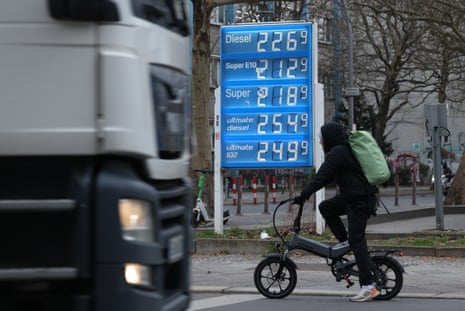
Germany’s parliament is taking unusual action to curb fuel prices in the wake of a spike from the Iran war.
Under a draft law set for approval today by the Bundestag lower house, petrol stations will only be able raise prices once a day, at 12 midday. They may be reduced at any time. Businesses violating the rule can be fined up to €100,000.
Watch for angry scenes in the queue at 11.55am.
After topping the list of EU countries with the highest rise in pump prices early on, Germany remains among the countries whose motorists are bearing the biggest brunt of the surge.
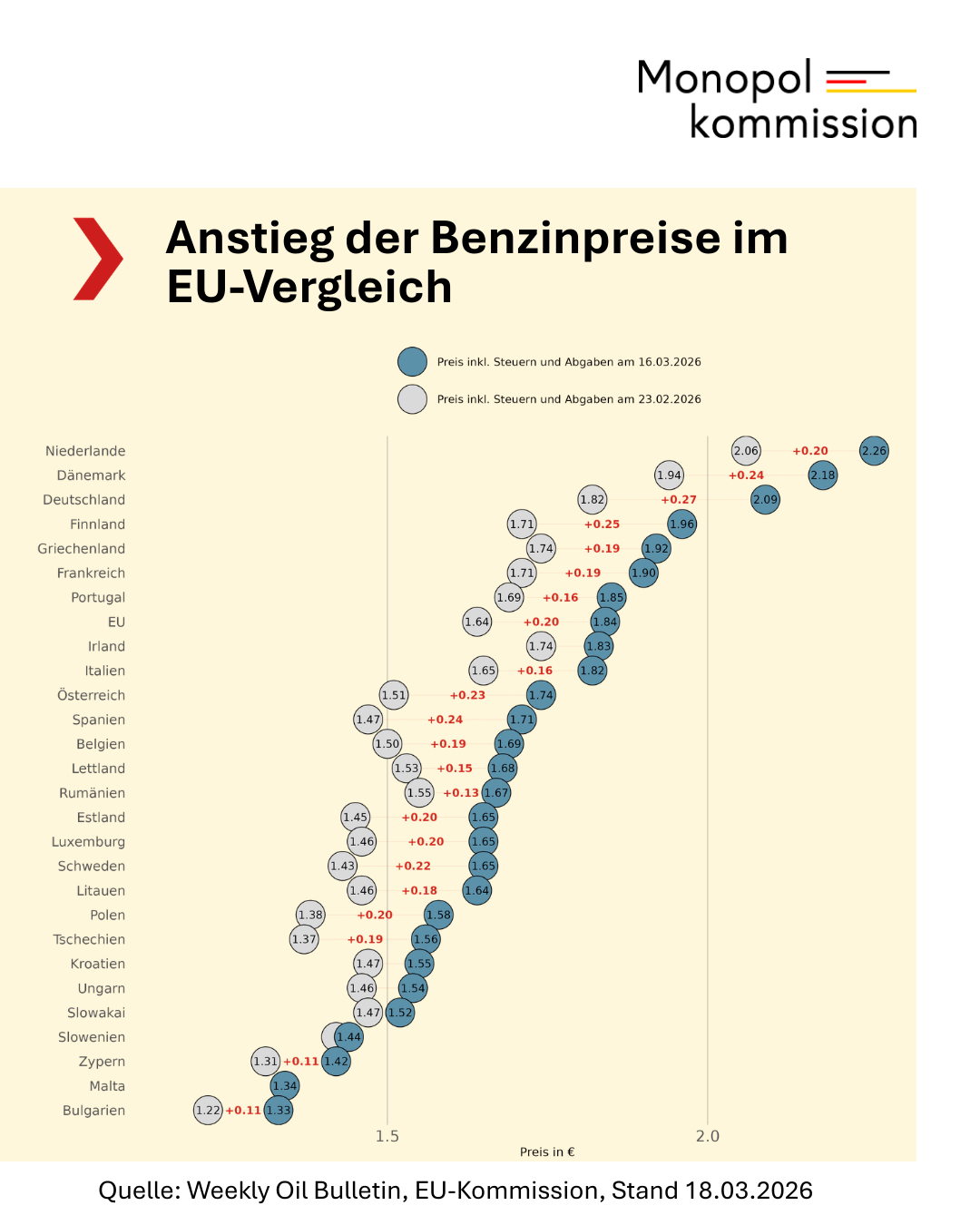
Compared to the week before the US-Israeli military action, prices had increased by 27 cents per litre for petrol and 42 cents for diesel, above the EU average of 20 cents/litre for petrol and 36 cents for diesel, according to EU Commission figures compiled by Monopolkommission, an independent economic advisory body to the German government.
It attributed the rapid rise in fuel prices in Germany to heavy market concentration.
The legislation before the Bundestag will also give the German Federal Cartel Office expanded powers to fight price gouging.
Armand Zorn, deputy chair of the Social Democrats parliamentary group, accused the industry of profiteering.
“We do not have a supply problem in Germany, but a clear pricing problem,” he told Bild newspaper. In hardly any other European country had such steep profits been made at the expense of consumers during the crisis, Zorn said.
But market watchers are divided whether the high noon rule, due to go into effect in early April for at least a year after passing the Bundesrat upper house, will do much to help consumers.
The Federation of German Industries (BDI) criticised the planned tightening of antitrust law and the speed with which it is being pushed through.
“The federal government is introducing far-reaching and risky changes to competition law through a rushed fast-track procedure,” said Holger Lösch, deputy chief executive of the BDI. He said that was creating uncertainty among businesses and jeopardising investment across sectors.
“Without involving industry and without a broad public debate, rules are being changed under the pressure of high fuel prices that go far beyond the current situation and would permanently alter the playing field for all companies,” Lösch said.
“This intervention in competition law threatens to do a disservice to the entire economy in terms of regulatory policy.”
Prices in recent weeks had been particularly volatile as well as generally elevated so advocates cite a calming effect that will kick in simply due to more predictability and transparency.
The stakes are high for the ruling coalition partners, chancellor Friedrich Merz’s Christian Democrats (CDU) and the Social Democrats.
The parties are running neck-and-neck in a key state election on Sunday in Rhineland-Palatinate, two weeks after the CDU lost to the Greens in the car manufacturing region of Baden-Württemberg by a whisker. The parlous state of the German economy, the EU’s biggest, and inflation fears driven by the Iran war and US tariffs will be at the front of voters’ minds.
US defense secretary Pete Hegseth is due to hold a press conference on the Iran war at 8am ET (midday GMT).
We will have a live stream of that so you can watch along, and we’ll also provide text updates.
Iran’s foreign minister has criticised Emmanuel Macron, accusing him of failing to condemn Israel and the United States’ war with the Islamic republic, while voicing concern over Tehran’s retaliation.
On Wednesday, Macron called for imposing a moratorium on strikes after Iran attacked Qatar’s key Ras Laffan facilities, part of the world’s largest gas field.
The strikes followed an attack on Iranian facilities in the same gas field, which it shares with Qatar.
Abbas Araghchi responded by accusing Macron of ignoring earlier US-Israeli attacks on Iran.
He said the French president “has not uttered one word of condemnation of the Israel-US war on Iran”, and that he had failed to denounce strikes on fuel storages in Tehran on 7 March.
Araghchi wrote:
His current ‘concern’ didn’t follow Israel’s attack on our gas facilities. It follows our retaliation. Sad!

Julia Kollewe
As we’ve been reporting, gas prices jumped and oil prices have risen again after the escalation of attacks by Israel and Iran on gasfields heightened fears of prolonged disruption to international energy supplies.
Brent crude, the global oil benchmark, rose by 8% to $116 a barrel. Crude prices have soared by nearly 60% since US and Israeli attacks on Iran started the war on 28 February.
European gas prices jumped, with the Dutch wholesale gas price up 24% at €68 a megawatt hour, its highest since the end of December 2022. UK gas prices have more than doubled since late February.
You can read our full report on this here:

Jakub Krupa
Germany’s chancellor Friedrich Merz, meanwhile, also called for de-escalation in the Middle East, welcoming what he said were signals by Trump that combat action in Iran could come to an end, which could allow Europe to contribute to securing peace in the region.
“I am expressly grateful that the US president sent a signal in this regard last night that he is prepared to bring the fighting to an end,” he told reporters ahead of an EU summit in Brussels in comments reported by Reuters.
Obviously, since then Trump has changed his narrative a bit again…
Either way, Merz reiterated that Europe is ready to help stabilise the Middle East once combat action has stopped.
Jakub Krupa
French president Emmanuel Macron has repeated his public call from last night after his phone calls with US president Donald Trump and the Emir of Qatar to de-escalate and prevent energy sites from being destroyed.
He also condemned the latest Iranian attacks on Gulf energy sites as “reckless escalation”.
He warned that if Middle Eastern energy “production capacities themselves are destroyed, this war will have a much more lasting impact”, calling for “direct talks between the Americans and Iranians on this matter”.
Energy sites in the Middle East that have come under attack
Lorenzo Tondo
In retaliation for an Israeli strike on Iran’s South Pars gasfield — the largest natural gasfield in the world — Tehran is exerting pressure on Gulf states by targeting critical energy infrastructure.
Officials in Qatar said this morning that Iranian missiles struck Ras Laffan, the country’s principal gas hub, causing what officials described as “significant damage”.
Kuwait Petroleum Corporation reported that a drone hit an operational unit at the Mina Al-Ahmadi refinery, about 50km (31 miles) south of Kuwait City, sparking a fire. No casualties were reported.
A second drone strike targeted the Mina Abdullah refinery in southern Kuwait, also igniting a fire, according to the state oil company.
UAE authorities said they were dealing with incidents at Habshan gas facility and Bab oilfield, after debris from intercepted missiles fell in the area. No injuries have been reported.
Saudi Arabia’s defence ministry said a drone crashed at the Saudi Aramco-operated Samref refinery in the Red Sea port of Yanbu, with “damage assessments” ongoing.
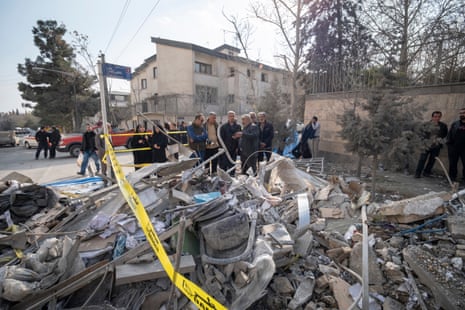
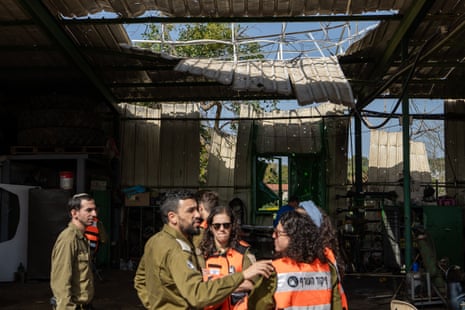
Here are some pictures on the newswires from the Middle East: