.png) 1 month ago
54
1 month ago
54
In a nervy theatre economy, with familiar material most likely to sell tickets, nights out often feel nostalgic for nights in. TV detectives including Morse, Barnaby and Rebus have been put on stage, as have sitcoms such as Some Mothers Do ’Ave ’Em, Only Fools and Horses and Yes, Prime Minister.
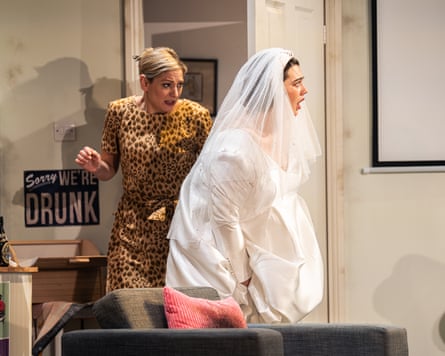
As its sequel to that last show transfers to the West End, the Barn theatricalises another telly comedy: Simon Nye’s 90s peak-time powerhouse Men Behaving Badly – about manchild flat-sharers and the women who try to mature them – whose Christmas 1998 finale was watched by 13.9 million viewers.
That’s a huge pool of viewer goodwill to draw on, but making a show from the box successful at the box office can be problematic. A crucial decision is whether the stage cast impersonates or reinterprets the screen stars. In this case, Matt Howdon’s Tony and Tricia Adele-Turner’s Deb would get high marks for doing role originators Neil Morrissey and Leslie Ash on another TV franchise, Stars in Their Eyes. However, Ellie Nunn’s Dorothy and Ross Carswell’s Gary are as distinct from Caroline Quentin’s and Martin Clunes’s versions – respectively posher and rougher – than one Ophelia or Hamlet may be from another, making it sometimes seem as if there are two new housemates.
Howdon is effectively trapped into impersonation because Morrissey makes an enjoyable video appearance as a ghost speaking from the present day to the characters in 1999 – the play is set on millennium eve. But, as a result, Joseph O’Malley’s production veers between re-enactment and acting.
TV-to-stage plays also struggle with pacing. Two-hour cop shows naturally fit theatre, but the half-hour unit of sitcoms requires stretching that can become forcing. John Cleese expertly turned three Fawlty Towers episodes into seamless theatre farce. Nye’s play goes beyond the TV plots, though the dialogue sometimes refers to choice moments.
He introduces two ticking clocks across the evening. In order to inherit from a moralistic aunt, a device seeming more 1890s than a century later, Gary must marry the heavily pregnant Dorothy before she gives birth. (It’s unclear why the presbyterian relative overlooks the couple’s first child.) Deb has flown back from Australia for the last-minute hitching, giving Tony 24 hours to persuade her that he should emigrate to Melbourne and wed her.
That’s a lot of plot, but even with an extended musical interval entertainment – nicely done by Neil Jennings and Valerie Antwi as landlord Ken and his girlfriend, Eve, respectively – the audience goes home after 100 minutes. That isn’t enough time to establish if the script is rebuking or celebrating the boys for their boorish sexuality. And while in the original the female characters were at least allowed to enjoy sex, a relatively feminist impulse, in this version they exist mainly to be impregnated in a project that feels like a misconception.
-
At Barn theatre, Cirencester, until 7 March