.png) 1 hour ago
6
1 hour ago
6
Arriving at the turn of the millennium and the twilight of the video arcade, Marvel vs Capcom 2: New Age of Heroes has long been a high-water mark for fighting games, with no heir apparent; its massive, colourful roster and frenetic, spectacular combos have lured newcomers and elite competitors alike. Developer Arc System Works, a fan-favourite studio famous for its hyper-fluid and extremely technical anime-style fighting games, has been on a long journey to usurp Capcom’s throne. With Marvel Tōkon: Fighting Souls, it may have finally achieved this difficult task.
Marvel Tōkon is less an attempt to recreate a Marvel vs Capcom-esque phenomenon out of whole cloth, and more a thoughtful evolution of the developer’s previous riffs on the formula such as 2018’s BlazBlue: Cross Tag Battle and Dragon Ball FighterZ, building on its low-floor, high-ceiling approach. Simplified inputs allow players to execute combos and finishers with a single button, which gives novices the confidence to keep playing and inspires them to study and improve – because when anyone can pull off a flashy ultimate skill or EX attack, strategy and mastery take on a premium. And Marvel Tōkon has great depths to plumb.
Matches are 4v4 affairs, with each player fielding a squad that – in a departure from similar games – shares a single health bar. The first character is the leader, taking the stage at the start of a match. The three others can either perform designated assists (a ranged attack, an aerial counter and an “assault” skill), extend combos or swap places with the leader. However – in another twist – they have to be unlocked in-match by filling an assemble gauge.
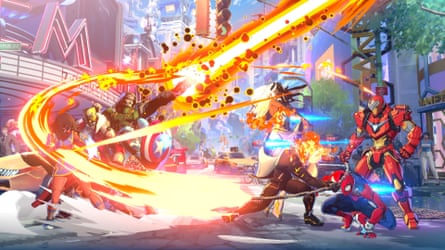
These team mechanics are key to Marvel Tōkon’s complexity. It can feel like a traditional 1v1 fighter at times, but judicious and careful deployment of your team is what separates good players from great. It feels amazing to flip the momentum of a match: to recover from a seemingly endless combo chain and subject your opponent to one of your own, using your team as a single organic unit. But doing so takes practice.
And self-improvement is the goal. Marvel Tōkon offers very little to those who aren’t interested in fighting for fighting’s sake: the lightweight story mode is comprised of five “episodes”, each a breezy introduction to a team of heroes such as the Avengers or X-Men, and mostly useful as tutorials. Beyond that, there is a bizarre party mode called Arcadia Rumble, where avatars scramble to improve their stats in between matches, and there are a handful of arcade ladders (a single-player sequence of opponents) to tackle. Otherwise, you’re running sets: against the CPU or other players locally or online, in casual matches, ranked matches and open lobbies.
This can feel like a loss when compared with other fighting games with robust solo options, including other Arc System Works efforts. Yet while the package is spare, the product is dazzling: it’s a sensory assault that challenges players to find calm in the storm of superpowered brawls, to really dig in and learn the clockwork of meter management, character mastery and team building. All of it is presented with stellar art direction, idiosyncratic music and a jovial tone.
This is another way in which Marvel Tōkon succeeds Marvel vs Capcom: it’s not just mechanics or characters, it’s cultural exchange, as American superheroes are once again reinterpreted by Japanese game developers in a genre that facilitates international competition. Marvel Tōkon is built to show off how fun it can be to participate in that evolving conversation. Won’t you go a few rounds?
after newsletter promotion