.png) 1 month ago
60
1 month ago
60
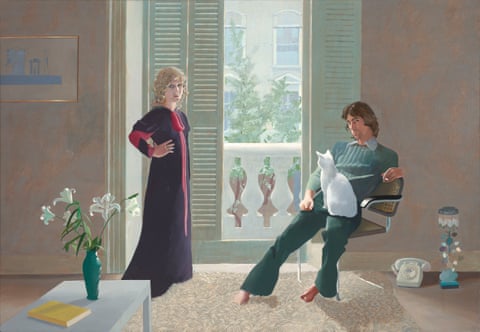
From his taut, sun-kissed portraits of LA to his vast psychedelic Yorkshire landscapes to his 70m iPad Normandy epic – here’s our pick of the artist’s best works
The misnamed cat … Mr and Mrs Clark and Percy, 1970-71. Photograph: Jonathan WilkinsonSun 14 Jun 2026 14.00 CEST
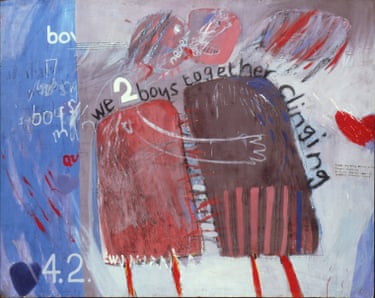
We Two Boys Together Clinging, 1961
One of several homoerotic paintings created by Hockney in 1961, this was inspired by a newspaper story about a mountaineering accident headlined: “Two Boys Cling to Cliff All Night.” Hockney enjoyed the double meaning here, having quite a crush on Cliff Richard. It is also a nod to the Walt Whitman poem of the same name.Photograph: © David Hockney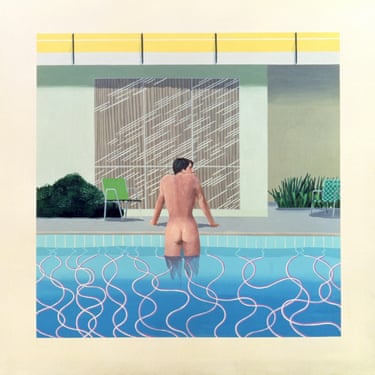
Peter Getting Out of Nick’s Pool, 1966
Peter is Peter Schlesinger, Hockney’s boyfriend at the time, and Nick is Nick Wilder, an art dealer and gallery owner who lived in Hollywood. Hockney copied the figure of Peter from a Polaroid he had taken of him leaning naked against a car bonnet and used simple wavy white lines to suggest ripples in the pool and bring the focus on Peter. Photograph: © David Hockney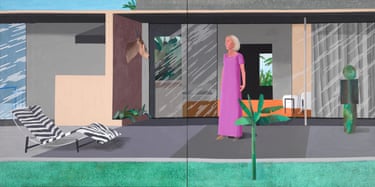
Beverly Hills Housewife, 1966-67
Hockney’s close friend Betty Freeman was an art collector. He came to paint her pool but decided to portray her instead, giving the work its tongue-in-cheek title. Freeman’s striking pink dress instantly draws the eye while other elements – zebra-print Corbusier chair, abstract sculpture and antelope head – add to the opulent, tasteful, mid-century atmosphere. The flattened California light became a staple of the artist’s LA paintings. When Freeman died, the work was auctioned for $7.9m, then a record for a Hockney.Photograph: David Hockney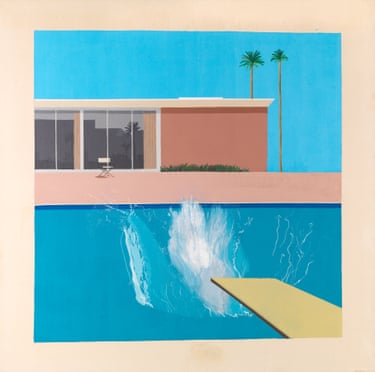
A Bigger Splash, 1967
Is this the most famous splash in art? In California, it seemed to Hockney, everybody had a swimming pool and from 1964 to 1971, he painted as many as he could, each time taking a different approach to the challenge of capturing the water’s ever-moving surface. Hockney enjoyed California’s laidback, sensual way of life. ‘When I arrived,’ he said, ‘I had no idea if there was any kind of artistic life there and that was the least of my worries.’Photograph: David Hockney/© David Hockney Collection Tate, UK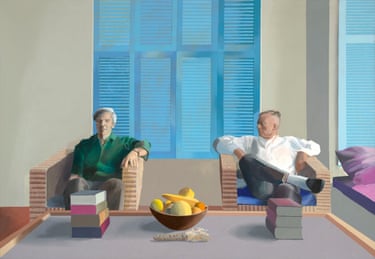
Christopher Isherwood and Don Bachardy, 1968
This was a landmark moment in queer art, painted when homosexuality was illegal in California. Novelist and playwright Christopher Isherwood sits on the right, with the painter Don Bachardy on the left, in the living room of the couple’s house in Santa Monica. Hockney took lots of photographs of the couple in preparation. Every time he said ‘Relax’, Isherwood would put his leg over his knee and look at Bachardy, who never returned the gaze, staying facing forward. Hockney said: ‘So I thought, “That’s the pose it should be.” And I began the picture.’Photograph: © David Hockney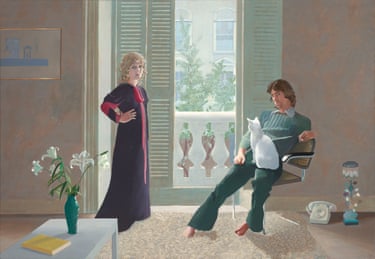
Mr and Mrs Clark and Percy, 1970–71
Percy may now be one of the most famous cats in art but the feline’s actual name was Blanche. The pet belonged to Hockney’s close friends, the fashion designer Ossie Clark and textile designer Celia Birtwell. This was painted in their flat in Notting Hill Gate. Clark and Birtwell were were big names in London fashion and Hockney was best man at their wedding, painting this shortly after. He intentionally swapped wedding portrait conventions, seating the husband while the wife stands upright. Blanche became Percy in the title because Hockney liked the rhythm.Photograph: David Hockney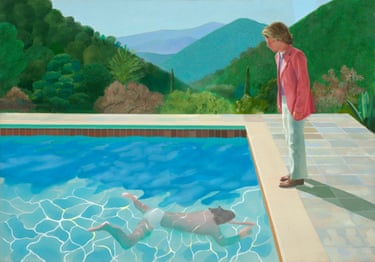
Portrait of an Artist (Pool With Two Figures), 1972”
By the end of the 1960s,” wrote Jonathan Jones in his Guardian tribute to Hockney, “an eerie stillness dominated his paintings as he became more openly the observer, the looker-on. The loneliness of looking is the theme of what may be his greatest painting, Portrait of an Artist (Pool with Two Figures). It’s certainly his most expensive, selling in 2018 for $90.3m. In this huge 1972 canvas, an almost mystically radiant work, a young man in a pink jacket stands by an open air swimming pool watching a swimmer whose pale flesh flickers under translucent turquoise water. To give the kind of gossipy detail Hockney came to loathe, the man by the pool is Peter Schlesinger and the painting captures the end of their affair, a trauma that gives it painful authority.”Photograph: David Hockney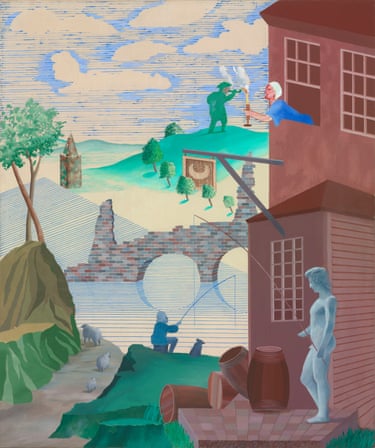
Kerby (After Hogarth) Useful Knowledge, 1975
This painting was a milestone, it being the first time Hockney deliberately experimented with “reverse perspective”, challenging the rigid, fixed point perspective traditional to western art. The work is a parody of Satire on False Perspective, a 1754 engraving by the British satirist William Hogarth for a book by his friend John Joshua Kirby. It was called Dr Brook Taylor’s Method of Perspective Made Easy and Hockney deliberately spelt his name wrong. Photograph: David Hockney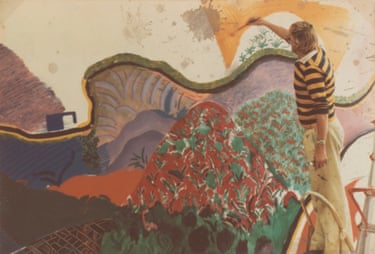
Hockney painting Mulholland Drive: The Road to the Studio, 1980
This famous work, more than 6m wide, captures Hockney’s daily commute from his Hollywood Hills home to his studio on Santa Monica Boulevard. Vividly coloured, it has a dynamic, epic quality, a love letter from the artist to the California landscape, from hillside homes and swimming pools to the Los Angeles sprawl.Photograph: Richard Schmidt/David Hockney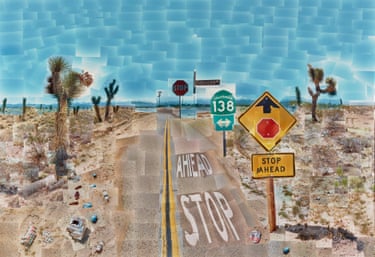
Pearblossom Hwy (Second Version), 1986
Another pioneering work, this photographic collage collapses traditional perspective and thrusts the viewer right into the road trip it conveys. Assembled from hundreds of 6x4 inch photos of Joshua trees, sky, scrub and road signs, all taken from different spots, it is a cubist take on the Mojave Desert in California. Photograph: The J Paul Getty Museum, Los Angeles, CA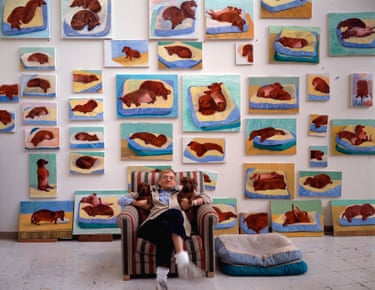
Hockney and his dachshunds Stanley and Boodgie in Los Angeles, 1995
Hockney adored his dachshunds Stanley and Boodgie. The playful pups appear in hundreds of pictures across a range of mediums, with Hockney’s loving depictions revealing their personalities.Although the subject may feel light-hearted, Hockney still used these works to explore perspective, colour and compsition. Photograph: Richard Schmidt/David Hockney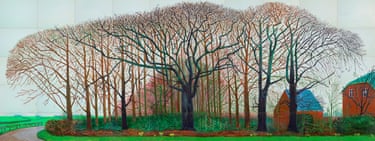
Bigger Trees near Warter, 2007
More than 12m wide, this is one of Hockney’s largest works. It shows a coppice near Warter in Yorkshire before spring. Although Hockney lived in LA, he returned home to his mother’s in Bridlington for Christmas. After moving back in 2005, he decided to depict Warter trees on a huge scale. Because of studio space considerations, he couldn’t work on a ladder or scaffold. ‘The trouble,’ he said, ‘is that … you need to step back. Artists have been killed stepping back from ladders.’ Instead he used computer technology to see the work emerge.Photograph: © David Hockney Collection Tate, UK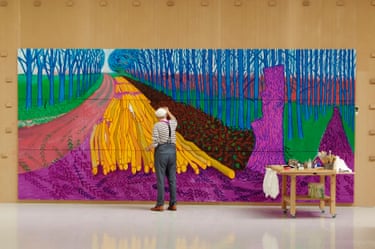
Hockney painting Winter Timber, 2009
This work, full of striking Fauvist hues, marks a triumphal phase of Hockney’s late career as he produced large-scale paintings seeking to capture the dramatic beauty he saw in the Yorkshire landscape. Strong verticals dominate the top of the painting, contrasting with the felled trees beneath and lane sweeping left. “Winter is all about line,” he once said. “People have it all wrong, imagining it to be a time when the world goes all dead. Trees are never more alive than in winter. You can virtually see the life force.” Photograph: Jean-Pierre Gonçalves De Lima/David Hockney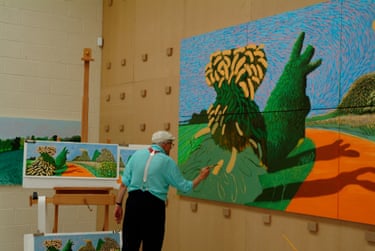
Hockney painting May Blossom on the Roman Road, 2009
Stretching across eight canvases, this lush panorama shows blooming hawthorn bushes near the village of Kilham in the East Riding of Yorkshire. He is now settling into his new environment, clearly finding Yorkshire an endless source of inspiration, taking liberties with colour, in this work using them in ways that aren’t always natural.Photograph: Jean-Pierre Gonçalves De Lima/David Hockney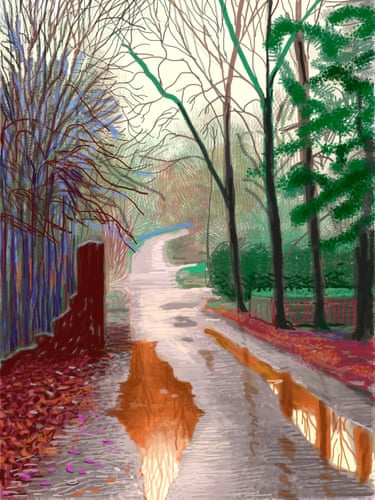
The Arrival of Spring in Woldgate, East Yorkshire, 2011
This image is from a landmark series of iPad drawings capturing winter turning to spring in the East Yorkshire landscape. Created in 2011, the images burst with colour as they show trees waking from winter and new plants growing, all beneath a brightening light. The series highlights Hockney love of technological innovation as he takes traditional British landscape painting digital.Photograph: David Hockney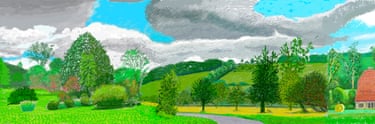
A Year in Normandie, 2020-2021
Inspired by the Bayeux Tapestry, this 70m long work, currently on show at the Serpentine in London, was a vast visual journey through the changing seasons. Hockney moved to Normandy in 2018 and worked there intensively during lockdown. A Year in Normandie is a composite work, formed of 100 images completed outdoors on his iPad. Visitors can see the seasons unfold as the walk through the gallery.Photograph: © David HockneyExplore more on these topics