.png) 1 month ago
39
1 month ago
39
There is a bit they like to do in pantomimes when an audience member appears to have arrived late. To get them up to speed, there is a high-velocity replay of the opening 10 minutes. Leo Butler’s family saga creates something of the same effect – except instead of bringing us up to date on a couple of scenes, it races, boldly and exhaustively, through the last six decades.
We get 1969 and Neil Armstrong; 1971 and decimalisation; 1974 and the Wombles; 1979 and Margaret Thatcher; 1984 and Orgreave – right up to 2020 and Covid, followed by the Barbie movie and Ukraine.
Seen through the lens of one Sheffield family in a council house in Burngreave, historically home to miners, steelworkers and immigrants, the play ticks off Vietnam, the winter of discontent, the Falklands war, the stock market crash, Northern Rock and 9/11, with local nods to Cabaret Voltaire, Nick Clegg and Arctic Monkeys.
In its attempt to capture the shifting sands of modern history, it has the ambition of Our Friends in the North, if not the political scope, and a three-hour running time to match. We see the arrival of VHS recorders, CDs and the iPod Mini.
The play is at its best when it shows characters being shaped by circumstance: the freedom-loving dropout Brian (Kenny Doughty) turning from striking agitator to Thatcherite materialist, or his daughter Rebecca (Abby Vicky-Russell) growing from acid-house partygoer to warzone activist. It is weaker when the business of babies, illness and ageing pushes us towards soap-opera sentiment.
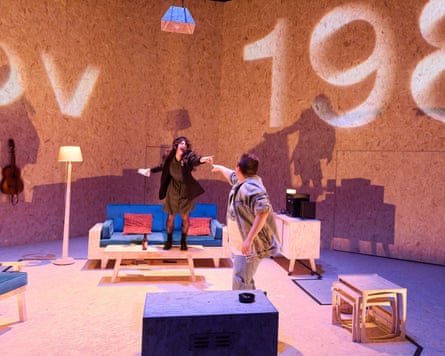
With its political purpose in focus, Butler has sharp observations about everything from feminism to “incels”. When that slips out of view, especially in an endless closing sequence, it feels shapeless.
Vigorously directed by Abigail Graham on Sarah Beaton’s set of amorphous chipboard, Beaton’s costumes keep pace with changing fashions. And it is tremendously acted. Joining Doughty and Vicky-Russell at the story’s heart are Liz White as mother Kathy and Samuel Creasey as son Mike, all excellent as they chart the transitions from optimistic youth to damaged maturity. They are subtle, sensitive and tireless in a play that works better as a mirror of our experience than as an analysis.