.png) 5 hours ago
7
5 hours ago
7
This evening was, in a sense, a tale of two orchestras. On one hand, the international heavyweight, returning to the Proms for the first time in more than 20 years. On the other, the rapidly ascendant homegrown outfit founded while its members were still at school, already making its fourth Proms appearance.
Taking the early evening shift, the LA Phil and Gustavo Dudamel performed Beethoven’s Pastoral Symphony in an ultra-polished hybrid of period-performance style and modern instruments. String textures were a deluxe fine-knit, individual notes lifted but phrase endings subtly elongated so that the music seemed to breathe. The woodwind solos were cool and bright, offering further oxygenation to an already limpid sound, where massed trills spoke as one and countermelodies usually buried under orchestral busyness suddenly became audible.
Beethoven’s merry peasants inspired some rougher edges, but nothing exceeding good clean fun, while Dudamel bounced on the spot as if on an invisible pogo stick. Later, there were harsh growls of timpani and threatening rumbles of double bass, before the storm dissipated into sunset-mellow brass. Throughout, Dudamel relished the slow blossoming of tutti passages, easing into them after energetic surges forward.
You can have too much of a good thing, of course. So much sheen gradually becomes bland, and all those warm glows left me hankering for quieter, riskier pianissimos. After the interval, Inferno from Thomas Adès’s ballet score Dante – hot on the heels of the NYO’s performance of its second part – ditched the historically informed politeness in favour of vigorous snap, crackle and bop. String scrubbing was thunderous, woodwind voluptuous, and trumpets snarked and rasped. Almost-jazz almost-grooves seemed to bubble beneath the surface. Dudamel leaned into the score’s allusions to Wagner and Liszt, Ravel and Tchaikovsky. Yet not even he and this phenomenally accomplished orchestra could prevent the intoxicating farce of the penultimate movement from feeling like the real ending, with the miasmic layers of the actual last movement an effervescent afterthought.
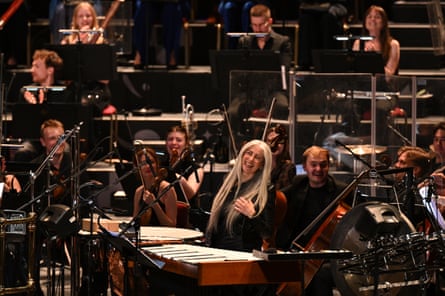
The high-contrast approach to programming continued in the late-night Prom, where the Fantasia Orchestra and conductor Tom Fetherstonhaugh were joined by superstar percussionist Evelyn Glennie for what Fetherstonhaugh called a concert on the theme of listening. Inevitably, in music, that theme is too broad to have much force. What resulted was a kind of live playlist experience that took in energetically played show tunes (lights! Stage smoke! Instant pizzazz!), an exquisitely intense extract from Morton Feldman’s Rothko Chapel and a movement of Caroline Shaw’s a cappella Partita, compellingly sung by the BBC Singers, plus solo percussion works and a Radiohead arrangement, a snippet of Dvořák in full folksy-mode and Vaughan Williams’s Serenade to Music.
It was a peculiar, bitty menu – and not ideal conditions for the world premiere of Héloïse Werner’s The Wood Pigeon in all its gnomic self-ironising and musical multilingualism. Glennie’s extract from Vincent Ho’s Sandman’s Castle for solo tam-tam was most persuasive: seven minutes of fibrillations and rattling, tapping and stroking, turning a single gong into an unfamiliar, haunted surface and inviting us, finally, to listen in.