.png) 1 month ago
31
1 month ago
31
There is a lot to look at in Glyndebourne’s first production of Monteverdi’s L’Orfeo. Directed by William Kentridge with a set by Sabine Theunissen, this staging is rooted in an artist’s studio and borne along by objects and images. Some are three-dimensional, real-life: ladders, chairs, sketchbooks, a mid-century desk lamp. Some are cartoonishly 2D or purely symbolic (placards shaped like oak-leaves, concertinas of coloured cardboard, big sheets of paper printed with Kentridge’s own work, an oversized metal cone used as a loudhailer). And many are projected on to the back wall of the stage in a video (designed by Janus Fouché) that starts before the first note of Monteverdi’s score and runs throughout as a constant, often hyperactive spool of Kentridge’s animated charcoal drawings, annotated archive documents and fragmentary phrases.
The cumulative effect is overwhelming – particularly if you want to read the surtitles. Some may find the visual busyness frustrating, its symbolism gnomic. (I remain foxed, I confess, by the repeated images of telephones and the map of Johannesburg.) And there are a few scenes in which the animated whirlwind seems to make up for a shortfall of drama embodied by the singers. But elsewhere the connection between stage and screen is clearer. Kentridge has the figure of Music (who in this production also sings the minimal vocal lines allotted to Euridice) painting at a desk throughout, as if generating the projections and with them the opera’s world. Euridice has a dancing counterpart performed by Roseline Wilkens, who is captivating onstage as she whirls and lunges, but also spins across the projections as an animated sketch. There is something exhilarating about a production so determined to match the Orpheus myth’s own obsession with the power and dangers of sensory overload – from music helping Orpheus into the underworld to the fact that the final catastrophe is caused by a single desperate glance.
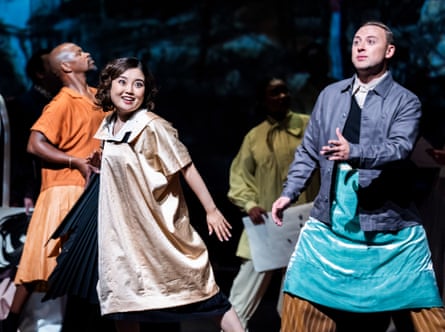
Musically, there is a similarly hell-for-leather quality to the performance. Under conductor Jonathan Cohen, the Orchestra of the Age of Enlightenment turned up the bass with its substantial, deep-pile continuo section and provided sympathetic, characteristically stylish light and shade. The chorus provided a lusty, finely blended gaggle of nymphs, shepherds and spirits. As Orpheus himself, Krystian Adam is a kind of straw-boatered colonial figure, vocally at his best as he pleads with Charon. Among the rest of the large cast, excellent diction and stylish ornamentation came as standard, with particularly charismatic turns from Hugo Herman-Wilson and Henna Mun. Xenia Puskarz Thomas’s Messenger is fearless and almost raw in her mezzo’s arresting power. As Musica and Euridice, Francesca Aspromonte is all laser-focused vocal beauty as well as a compelling dramatic presence. I just wished that Monteverdi had written more for her to sing.