.png) 6 hours ago
3
6 hours ago
3
If you spend enough time swiping online, you may have seen skits by the American comedian and influencer Druski (real name Drew Desbordes), in which he parodies everything from Republican patriots to flashy mega churches. Once again, he has exploded on social media channels with a skit satirising “conservative women in America”, a nakedly targeted roast of Erika Kirk, now the CEO of Turning Point USA (TPUSA) after her husband, Charlie Kirk, was assassinated last year.
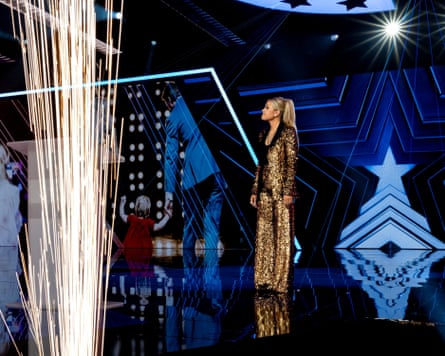
Predictably, it has drawn conservative backlash, with Ted Cruz calling the video “beneath contempt”. But Desbordes is far from the only one mocking Erika Kirk. Her entrances to the Charlie Kirk memorial and TPUSA’s AmericaFest have been widely memed online for their surreal, WrestleMania-like production and pyrotechnics. In fact, much of the opprobrium comes from her own side. Far-right live streamer Nick Fuentes has disparaged Kirk’s public appearances after her husband’s death (“she looks like she’s over the moon”), and commentator and conspiracy theorist Candace Owens, a former darling of TPUSA, repeatedly takes aim at her (Owens describes Druski’s skit as “hilarious”).
What this brings to the fore is the succession crisis that has plagued the Maga movement since Charlie Kirk’s death. Erika Kirk was swiftly appointed the CEO of TPUSA as a mark of continuity. But it is evident that her appointment has only deepened divisions within Maga, and she has failed to establish the same authoritative leadership as her husband. And so, outside the White House, the Maga movement lacks something crucial: disciplined institutional influence.
This matters beyond an assessment of TPUSA – it speaks to the lack of an institutional structure to absorb the fragmentations and diversity of thought among the US political right. That void aligns with a very modern form of politics, where political projects are hinged on influencers, podcasters and radio hosts. Like Fuentes and Owens, figures such as Joe Rogan, Alex Jones, Megyn Kelly and Matt Walsh were instrumental to the election of Trump 2.0. They hold the Maga movement together. That had always been Maga’s strength and a sign of its modernity – a decentralised influencer ecosystem, viewed as authentic, anti-establishment, voice-driven and better able to connect with ordinary people.
The problem is that it is exactly this decentralisation that prevents Maga from functioning effectively as a governing coalition. These figures may have championed Maga, but they are personalities with their own brands who refused to allow their platforms to be absorbed by the project. Indeed, they have developed followings based on a core set of principles, and like most influencers, their loyalty is primarily to the audience that keeps them on air. As such, the US-Israel war on Iran has functioned as a stress test of this kind of personality-driven politics, particularly as the war is viewed as an abandonment of the isolationist, “America first” principles that influencers cheered on while putting Maga back into office. These personalities have quickly shown where their true loyalties lie, and it’s not lining up behind Trump or his war of aggression. As Rogan said on his podcast: “A lot of people feel betrayed … he ran on ‘No more wars,’ ‘End these stupid, senseless wars,’ and then we have one that we can’t even really clearly define why we did it.”
Now that such key figures have turned on Trump, we are left with a political movement that has a clear image crisis. They are embroiled in a “Maga civil war” – not just over Iran but a range of issues, including the administration’s approach to Israel and immigration. Political infighting in itself is unremarkable – we are well familiar with factionalism, media briefings and open challenges to leaders from their own side. But that is usually mediated through political parties, their bureaucracies and memberships. What we have here instead is in effect a series of personality contests, taking place between people whose priority is their own sphere of influence, rather than a political engine larger than themselves. This new reality reflects the design of the online, algorithmic universe that they serve, in which outrage, conflict and novelty are rewarded and thus economically incentivised. That is why Owens can openly laugh at a skit mocking Erika Kirk, discussing it on her show and promoting conspiracy theories about her takeover of TPUSA. And so we’re left with a question: can any modern political movement survive the logic of the platforms that now sustain them?
Those old, scorned traditional party structures that emphasised a clear hierarchy, message discipline, compromise and collective responsibility look far more suitable for office. When disagreement occurs within traditional party structures and bases, containment is smoother and it is more difficult to smear individuals.
It is a warning, too, that politicians who consider themselves left-of-centre may want to think twice about copying the Maga model. The Democratic governor of California, Gavin Newsom, in perhaps the earliest starting campaign to become the presidential nominee in my lifetime, has won praise for mimicking the Maga social media strategy. The X account for his press office regularly posts memes and mockery that trade in the language of the terminally online, and last year he launched his own podcast, This is Gavin Newsom. He is also building his own cabal of influencers. Yet when he walked back his own criticism of Israel, the leftwing influencer Hasan Piker, who had previously been open to supporting Newsom’s candidacy and invited him on his podcast, was quick to denounce him.
The takeaway for any political project is simple: hitch yourself to personalities whose voices you cannot discipline, and the coalition you build will implode on contact with the realities of office.
-
Jason Okundaye is an assistant Opinion editor at the Guardian