.png) 2 months ago
62
2 months ago
62
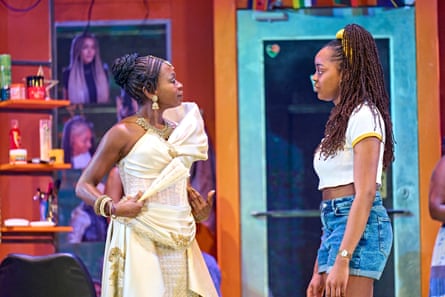
‘Don’t touch my hair” is a racially-charged statement of Black femininity, encapsulating the personal as political. Hair is political here too, though there is plenty of consenting touching in Jocelyn Bioh’s comedy following a day in the life of a Harlem braiding salon.
Bioh’s follow-up to School Girls; Or, The African Mean Girls Play, is again directed by Monique Touko and has dazzled audiences on Broadway. You can see why: it contains such abundant charm, humour and insuppressible, crowd-pleasing energy that it is hard to be anything but seduced by its radiating warmth.
The salon is owned by Jaja (Zainab Jah), who is getting married today to a white American – so gaining American citizenship. In her absence, it is being managed by daughter, Marie (Sewa Zamba), who Jaja has put through private school but has hitherto been unable to get into college due to her immigration status. It contains an assortment of bold hairdressers who are all broadly drawn and might appear like cliched comic types on paper, but they are so lovable, so larger than life, with all the old-school charm of vaudevillians while also sweeping you in to their emotional highs and lows.
There is judgmental old-timer, Bea (Dolapo Oni) who clashes with no-nonsense Ndidi (Bola Akeju), who is only here because her own salon burned down. Miriam (Jadesola Odunjo) is a sweet-natured type who, despite an unhappy marriage and unreliable lover still holds out for love and joy in her life. Aminata (Babirye Bukilwa), is in another unhappy wife who enacts her love of Nollywood (the Nigerian film industry version of Hollywood) in a finger-clickingly funny scene.
If Inua Ellam’s Barber Shop Chronicles showed Black masculinity through the prism of hair-cutting, Bioh’s play centres femaleness – with a comic turn from a single male actor (Demmy Ladipo), who plays a variety of cameo male parts, from sock salesmen to beaus and husbands.
Touko navigates a script in which time passes – fractious moments and happy ones – with expert comic timing and pace, capturing the drama of the salon across 12 hours, including the longueurs as microbraids are painstakingly plaited, customers fought over, rude ones avoided and personal lives divulged, without an ounce of longueurs in the drama itself.
Part of that is down to the charismatic performances and the interludes of music and dance – fabulously catchy in sound and visual effects (good work from video designer Dick Straker on Paul Wills’s revolving set, with mood-lifting African pop numbers by Burna Boy, Naira Marley, Prince Kaybee, Ckay and more) and some great wigs too, designed by Cynthia De La Rosa.
It is, beneath the hijinks and humour, a story of wanting to become American in the time of Donald Trump but without mentioning him in anything but a passing whisper. Characters do not so much believe in the American Dream as much as they need it to be true. And these are not just Black women in a salon, but west African immigrants tending to the hair of middle-class Black American customers who come in with their laptops, self-improvement books and power suits. Bioh lays bare the gulf between them: the latter are sometimes offensive or entitled. All have the unacknowledged privilege of citizenship while those who do their hair talk of their “papers” in anxious or hopeful ways.
The politics – of hair and otherwise – is worn lightly until the abruptly sobering ending. Yet it remains a story about the strength of these women with a true sense of joy. You’d be hard-pressed to see anything else quite this alive and energised in the theatre.