.png) 1 month ago
59
1 month ago
59
The World Cup will be the most lucrative sports event ITV has ever aired, the broadcaster has said, with bosses calling the tournament a “six-week summer Super Bowl moment” for TV advertising.
The channel is airing 51 of the 104 matches across the men’s tournament, co-hosted by the US, Mexico and Canada, which is the biggest yet after an expansion from 32 to 48 teams.
Kelly Williams, managing director of commercial at ITV, told the Guardian its advertising revenues are running about 30% above those it took from the last big football tournament, Euro 2024, when England reached the final.
“This will be our most commercially successful tournament ever,” said Williams. “It is not just one game but six weeks of really big TV audiences. It is effectively our six-week summer Super Bowl moment.”
ITV began selling commercial packages for the World Cup last autumn, with Google taking the headline sponsorship to promote its Gemini and Pixel products. However, it is holding back prime slots around games later in the tournament, which can demand hefty premiums if England progress to the later stages.
The broadcaster does not break out the cost of individual ads but media industry sources estimate that a 30-second commercial in an England game can cost as much as £300,000.
Williams said that at the last World Cup, when there were only 64 matches in total, a typical game averaged 6 million viewers, while those involving England peaked at 20-25 million, depending on the stage of the tournament.
“In a world where viewing habits have changed and audiences have fragmented I think these kind of shared cultural moments are more important and valued by advertisers,” said Williams. “They are just unique audiences. You can’t get them on streaming services, or social media, or YouTube. It is live and free to air.”

The opportunity to reach these audiences has been embraced by advertisers, with ITV so far having sold packages to 220 different advertisers, with 70 of those running TV ads in football coverage for the first time. Williams said that about eight advertisers are new to TV advertising.
One of those is Jeremy Clarkson’s Hawkstone lager brand, which booked slots after the huge media coverage produced by the success of the Hawkstone Farmers’ Choir winning Britain’s Got Talent last month.
The most high-profile ad campaign is Nike’s World Cup ad which, at six minutes, will be the longest commercial ever aired on TV in the UK. The ad of superstar footballers, which will air for the first time during England’s opening match against Croatia, features Cole Palmer, who did not make the squad.
The media regulator, Ofcom, limits the number of minutes of ads a broadcaster is allowed to air in an hour, but this rule works on an average so ITV is able toadjust its overall ad allocation to run the full Nike commercial.

Williams added that one thing that “stood out” among the range of advertisers for the tournament was the number of AI and tech companies booking ad slots. He said that as well as Google there are ads running from Amazon Web Services, Apple, Dell, Microsoft’s Copilot and Meta.
The time difference with North America means that kick-off times for England’s first games are 9pm or 10pm, a potentially more attractive time of day for advertisers than the afternoon times of tournaments held in Europe.
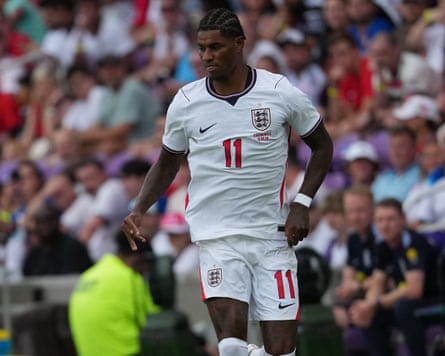
However, while ITV expects to see a boost from audiences watching Scotland’s progress, the times of the group matches are much more unsociable, at either 11pm or 2am.
The BBC has the rights to air the remaining World Cup matches in the UK.
ITV has set up a glitzy studio in Brooklyn, with views of the Manhattan skyline, while the BBC has opted to broadcast out of its studios in Salford, Manchester.
The former lead BBC football presenter, Gary Lineker, has signed a reported £14m deal with Netflix to stream daily versions of his lucrative The Rest Is Football podcast from a studio in downtown New York.
Lineker left the BBC last May, after another row about his social media posts, having been due to host his seventh World Cup.
In April, he said he would have been “in Salford in a green box” instead of “overlooking Times Square with lots of great guests”.
On Tuesday, Alex Kay-Jelski, the director of BBC Sport, unveiled its studio set-up and defended the decision to be based in the UK, saying “the actual end product that people are getting at home, I don’t really think it’s that different”.