.png) 1 month ago
55
1 month ago
55
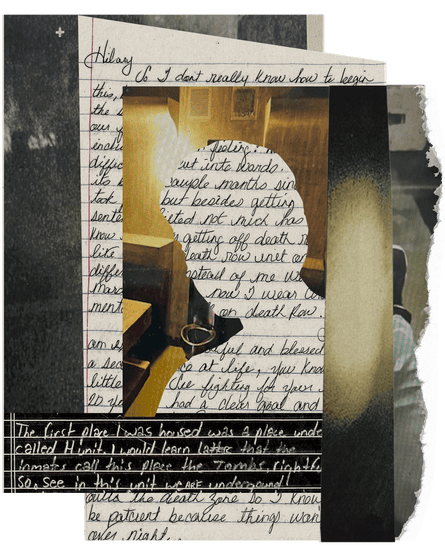
“Down here in the tombs, there aren’t any windows,” writes Tremane Wood from inside his cell, in a modern-day American “dungeon” that few people have ever heard of.
“It’s really like living in cave,” he writes in another letter. “It’s dark and damp. Sometimes this place drives people mad. The hardest part is the isolation.”
Or in another: “You end up loosing [sic] track of days and nights and what day it is … It’s a real form of psychological torture that some people never come back from.”
Wood, 46, spent 17 years incarcerated in H Unit – the underground cells at the state prison in the rural town of McAlester, Oklahoma, where no natural light ever reaches.
According to prisoner letters seen by the Guardian and published here for the first time, H Unit – also known by the prisoners as the “tombs” – features a series of windowless cells that are built banked into the earth. The letters also tell of infestations of vermin, unsanitary conditions, and frequent instances of physical and sexual violence.
The lack of sunlight is a matter of particular concern to the prisoners. Dr Sondra Crosby, an expert in torture survivors and a public health professor at Boston University and Physicians for Human Rights, calls it “a form of cruel, inhuman, and degrading treatment and torture”.
Crosby, who has worked with people imprisoned after 9/11 in CIA “black sites”, says lack of sunlight was “used to punish people in the darkness of the prisons in Afghanistan”.
“In my decades of evaluating survivors of torture, darkness and no sunlight has featured prominently,” she added. “It causes disorientation and you just lose sense of yourself … We know that exposure to light is critical to wellbeing and is necessary to maintain a sense of self.”
Dungeons have housed American prisoners as far back as the revolutionary war, but most underground cells – including those at the notorious island prison Alcatraz – have long since been decommissioned.
Today, there is no national database for prisons that continue to use buried or partly buried facilities. A handful of other facilities do reportedly still use underground cells, but the practice is rare.
The letters from H Unit offer a glimpse into this sunless world. The prisoners – of whom there are currently 248 in total, according to prison authorities – write of living in squalor, and frequent violence and rape. Many are held in solitary confinement, with almost no human contact. Others stay in two-person cells, where they say violence is common because the space is not large enough for two men.
Prisoners are known to be locked in their concrete cells for about 23 hours a day, according to the American Civil Liberties Union; but some prisoners, including Wood, say they are at times locked in their cell for weeks or months at a time.
“Between the two doors is a shower where anything from snakes to mice and bugs will be at your feet,” wrote Edward Sparks III, who has been in H Unit for most of the last four years, including time in a disciplinary cell. He said the mice were so numerous that they hang around on the prisoners’ food trays, and said that “you can catch 15” at a time.
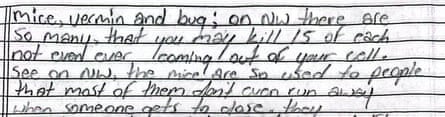
Sparks was imprisoned just before his 21st birthday and is now 24 years old, yet the experience of living underground in H Unit still felt new and raw, he wrote. “All along the walls are holes where water pours into when it rains,” he said, describing the disciplinary cell.
“The [food] trays are kicked in by the guards through human waste,” wrote another prisoner who wants to remain anonymous. He said he went 50 days without a shower, “and it was dark 75% of the time as the power was blown off”. In a separate letter, he wrote that “the guards are putting chilli pepper symbols on their vest as a badge for every inmate that they are spraying with mace and the pepper ball gun. That’s just something I find quite inhumane … like it’s a goal to do this daily to us.” He added: “They’ll just walk up to your cell door and spray you without even asking you to do something. It’s madness.”
Randy Bauman of the ACLU of Oklahoma said: “The lack of access to sunlight and the outdoors exacerbates the mental health harms of solitary confinement.”
H Unit, Bauman noted, was a windowless facility where prisoners “are incarcerated in a concrete environment no bigger than a parking space, for 22 to 24 hours per day. Underground, with no outside exposure or human contact, one prisoner made the comparison of the environment to being buried alive.”
He noted that studies have demonstrated how long-term isolation makes mental illness worse – “or even causes it in those who were healthy when they entered this type of space”, he said. “The people in H-Unit are suffering due to the years they spend there – their minds and bodies are irreparably damaged by the inhumane use of solitary confinement and lack of any outside time.”
‘Years underground’
H Unit was designed as a maximum-security facility for high-risk and death row prisoners. Following prison riots in 1973 that led to a redesign of the facility, the unit was completed in 1991.
As early as 1994, however, H Unit’s underground cells were criticized in a report for Amnesty International for being too dark, small and poorly ventilated for human confinement. Human rights sources say little has changed since.
Also known as “the hole”, the unit – an imposing concrete edifice resembling a massive bunker – is made up of four quads. Prisoners describe regular cells of roughly 8 by 16ft, and maximum-security cells that are even tinier and are known as “the hole within the hole”.
The high-security cells, according to prisoners, are 5-by-9ft concrete cells with a concrete bed. “They have these beds they cuff you to like in a crucifix and leave you there for hours,” wrote one H Unit prisoner who asked to remain anonymous.
Sparks wrote that he still preferred the high-security cells to other parts of H Unit. “Some of the most peaceful time I have done was in high max,” he explained. “Here in this one-man cell I don’t have to worry about being killed in my sleep, even as I sat in the dark for days.
“I’d rather be there because I don’t have to let person after person assault me.”
Now back in a regular section of H unit, Sparks added that he wakes up every night in cold sweats. “I’ve heard men scream and yell and seen them pulled out of cells with blood and waste running down their leg from sexual assault … maybe 5 times,” he wrote.
Prisoners also accuse the guards of ignoring violence. “They [prisoners] may be getting beat or raped,” Sparks wrote, “and the staff just walk on by.”
The US has more than 1 million prisoners, about 6% of whom are held in solitary confinement, according to Solitary Watch. Although prolonged solitary confinement often leads to mental breakdown, its use is at the instruction of prison officials, not the courts, and across the country prisoners are routinely incarcerated in solitary cells for years at a time.
In 2019, the ACLU threatened the Oklahoma state penitentiary with litigation over what it called cruel and inhumane conditions in H Unit. In response, the prison moved many death row prisoners out of H Unit to another part of the prison.
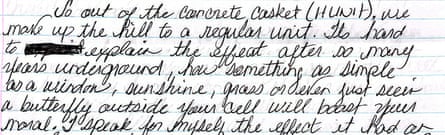
Wood, who was on death row in H Unit until he was granted clemency at the last minute in a dramatic case last year, was among the prisoners who were moved. “It’s hard to explain the effect after so many years underground how something as simple as a window, sunshine, grass, or even seeing a butterfly outside boosts your morale,” he wrote.
But about a year ago, Wood was sent back to H Unit for disciplinary reasons, and in recent months, according to prisoners’ letters, a number of other death row prisoners have also been moved back to H Unit.
Other death row prisoners never got their taste of sunlight in the first place and were left behind in H Unit’s concrete caverns. Human rights sources said many were mentally ill. Prisoners report that some have struggled to survive the experience.
“Many times they are abused, mocked, mistreated by staff and fellow inmates. They are raped, even killed,” Sparks wrote in one letter. “I’ve seen one inmate attempt suicide on three different days.” He said the inmate was found dead after repeatedly pleading for mental health care that he was not given.
Joshua Dawkins, a mentally ill prisoner in H Unit who was sentenced to life for murder, wrote in a letter that he had been hearing voices since he was a child. He said the prison failed to give him adequate mental health care or medication, and that it had punished him for having a mental breakdown. “The voices, the depression, the suicidal thoughts, just an emotional roller coaster,” he wrote.
The north-west quad of H Unit, where some of the mentally ill prisoners are confined along with others being disciplined, according to prisoners, stinks of human feces, thrown by prisoners demanding mats, soap or mental health care.
“All you have to do is close your eyes and think of one of those old insane asylum movies where people are yelling and kicking the doors, the set fires, it’s a real mad house sometimes,” Wood wrote.
Both Wood and Sparks, who describe themselves as otherwise mentally healthy, said they had become suicidal in H Unit in part due to the lack of sunlight.
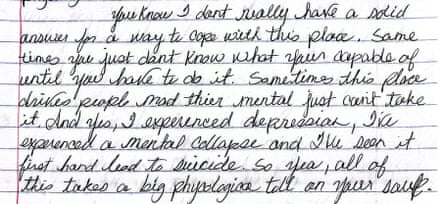
“I’ve experienced depression, I’ve experienced mental collapse,” said Wood. A social worker confirmed Wood took steps to kill himself. Sparks also attempted suicide in H Unit.
“H Unit has this feeling for us inmates of being outcast and thrown into a pit, a dark pit,” he wrote. “I keep telling myself … not to [be] bat shit crazy.”
Asked for comment on the prisoner accounts of vermin, filth, neglect, darkness and other issues outlined in the letters, the Oklahoma department of corrections called the allegations “inaccurate”.
“The Oklahoma Department of Corrections follows all state and federal laws when housing and caring for inmates,” it said.
“ODOC takes all conditions within its facilities very seriously, as we do the safety and security of both inmates and staff. Maintenance-related issues are addressed as soon as they are identified to ensure facilities remain safe and operational. Our dedicated staff works hard every day to maintain facilities and provide care and supervision consistent with established policies and procedures.
“Staff are expected to follow these standards at all times. Any unapproved deviations from policy are promptly addressed when identified to ensure accountability and compliance.”
The Death Penalty Information Center said: “These allegations about Oklahoma’s H Unit raise new and serious concerns about whether the constitutional obligations of prison officials are being met, and they deserve close scrutiny.”
For Wood, at least, H Unit is a thing of the past, after he was transferred this month to the Allen Gamble correctional center in Holdenville, where he finally has a window in his cell.
“It really feels like getting out of war,” he wrote in a recent letter. “I do have a window now though and the sun is shining so that’s a good day in my book.
“I won’t ever get over the impact of being there in [the] tombs or going through what I went through. I won’t ever be the same but imma try my best.”