.png) 3 months ago
41
3 months ago
41
Joel de Mowbray reached breaking point with UK construction in south London in 2020. He was working on a lovely building project, part of Lambeth council’s scheme to make streets more pedestrian-friendly. De Mowbray was installing a public wooden seating area in an underused stretch of street.
“The council were doing treeworks the entire time we were building, felling trees right next to us,” he says. “But we had to go to Ashdown Forest for our supplies. That felt bonkers to me: they were creating the exact material we needed next to our site.”
Everyone with experience of the building industry has similar stories. The ambition is to renovate existing buildings rather than demolish them and to reuse as much material as possible. Instead, the construction industry produces around 62% of the UK’s waste. A lot gets recycled but a lot also ends up in landfill.
“There’s what I call street logic – you see a tree being felled and have a use for that wood – and then there’s institutional logic which is dictated by insurance, safety standards and company liability. There’s a very rigid system but there’s no incentive to change.”
De Mowbray is different, though. After the south London experience he founded Yes Make, a design collective milling urban trees to provide local timber for building projects. “We converted a 1980s electric milk float into a logging vehicle to mill and transport wood. We got a reputation for salvage and were invited to the old Smithfield meat market when the building was stripped. We took away 12 tonnes of mahogany, teak and afromosia that was going in the skip.”
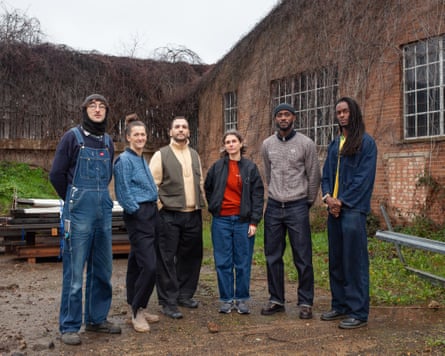
Still, he says, he remembers looking at the site and thinking: “We’re just tinkering around the edges.”
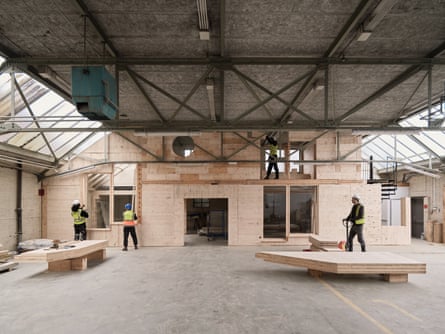
Now, though, he has got to the heart of the matter. Yes Make has joined forces with Resolve Collective, which provides recycled materials for cultural institutions, and the architecture and research practice Material Cultures. Together they have opened a hub set on a 20,000 sq metre industrial site in Newham which promotes circular construction, where materials are reused instead of discarded. It’s called Tipping Point East (TPE) and is the largest hub of its kind in the UK.
“We’re creating a regenerative supply chain for the city we love,” says De Mowbray. “Turning things that would otherwise go to waste into objects that have cultural potential.”
Yes Make processes and certifies used construction materials from building demolition and refurbishment to be donated to community builds or sold at very reasonable prices – “sometimes just 10% of the commercial price”. The materials yard is full of neatly stacked glass panes, sinks and pipes that would otherwise have been thrown away.
Resolve runs Material Store, a collection of display stands, timber and boards reclaimed from museums and galleries to be reused or donated. Material Cultures focuses on bio-based building materials and research. All three offer study visits and training to improve skills and demystify construction. Just as community gardens can connect people with food and nature, the hope is TPE will do the same with the built environment and recycling.
“I was a bit of a lost boy growing up,” explains De Mowbray. “It was only when I got qualifications that I felt I had a skill set and could contribute.”
On the morning of my visit, two saw millers from the organisation National Saw Mills – who are genuinely called Tom and Jerry – show a group of Central Saint Martins students how to use a portable sawmill and cut a 105-year-old sequoia tree from Linford Arboretum in north-east London into planks of timber.
As Tom deftly slices the tree, Jerry explains how British forestry relies on centralised, uniform milling facilities which means that, despite having trees like this sequoia producing perfectly good wood, the UK is the third biggest timber importer in the world behind the US and China.
TPE has a five-year lease on its Silvertown site, and the hope is it will demonstrate how useful hubs like this are for reducing waste, improvising skills and providing a less wasteful and more nimble future for UK construction. It is not easy. TPE has, for example, had to turn away at least 10,000 fire doors since it opened. Not because the doors were damaged but because no one on the Yes Make team has the right training to certify them as operational. They are now scrambling to cover this. “To me,” says De Mowbray, “it’s like the signs I’d see on estates when I was playing with friends as a kid. They say ‘No Ball Games’ but everyone reads them as ‘don’t get caught playing ball games’, and if you break anything it’s your problem. This work feels the same – looking for ways to make the rules work for you.”
There has to be community and industry buy-in for TPE to find success. De Mowbray has a nice Dunkirk analogy for how it can work. “It’s like all the small boats that helped rescue the military in the battle. We need to translate this waste into thousands of smaller-scale projects that can make use of the large scale volumes of waste that we’re collecting. We need thousands of small ships to take the waste away.”