.png) 4 hours ago
5
4 hours ago
5
Three months after Storm Goretti battered St Michael’s Mount in Cornwall, the signs of the storm’s power are still evident in the scars left by uprooted trees, piles of logs and the shaking of heads from islanders who have lived there for decades and never seen the like.
“It really was something,” said Jack Beesley, a senior gardener. “We were shocked the morning after when we saw what had happened. We had been caring for these trees for years and to see so many of them down was very sad. We’ve worked hard to get the place ready for the Easter visitors but it will still be a month or more until we’re back straight.”
Once they are sorted, the gardening team will pause to work out what to do next after losing 80% of the Cornish tidal island’s tree cover to the 100mph winds.
Replanting trees such as Monterey pines, which had grown to the height of a four-storey building, may not be wise given the threat of more frequent storms because of the climate emergency. “We’ll take time, think what the best plan is,” Beesley said. “There’s also an opportunity to adapt, do things differently.”
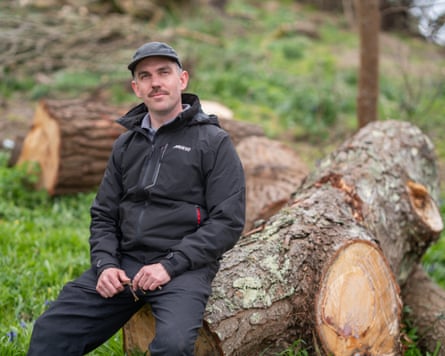
Ian Marsh, the National Trust’s assistant director for the south-west, said thousands of trees had fallen in its gardens and estates across west Cornwall, and he agreed that decisions would have to be made on where to replant and where to let nature regenerate on its own. “It can be good to get more light into wood. That’s a good natural process – but you probably wouldn’t wish for it in quite this extreme a way.”
As well as wreaking havoc at beauty spots, Goretti’s 100mph winds brought down power cables, leaving many people without lighting, heating and means of communication. The impacts are still being keenly felt.
Bridget Wagstaffe, her children Megan and William and their mini lakeland terrier Petal have just moved into their fourth temporary home, after a tree toppled by Goretti smashed into the roof of their cottage in the village of Goldsithney, a few miles inland from St Michael’s Mount.
“It has been traumatic, to say the least,” said Wagstaffe, a shop worker. As well as continually moving while their home is repaired, the family have spent the last three months getting to grips with insurance claims, builders and bills, all while trying to carry on with work and studies. They may not get back home until late summer.
Their small back yard is still filled with bags of ruined clothes waiting to go to the tip, as well as the remains of the tree that fell into the roof. They also have a note from Cornwall council suggesting they may be liable for the cost of emergency work needed to make the house safe. “That seems like a slap in the face,” Wagstaffe said. “It wasn’t our tree that fell on the house.”
Cornwall council said it did not comment on individual cases. But in general it said it had powers to take emergency action where there was deemed to be a risk to public safety as a result of a dangerous building or structure. It was entitled to recover costs incurred from the owner.
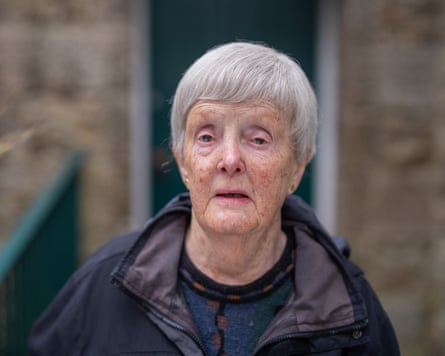
At a church coffee morning in the village of Madron, near Penzance, topics of conversation ranged from the supposed sighting of a ghost (this is a witchy part of Cornwall) to possible fuel shortages caused by the Middle East crisis – and the ongoing impact of Goretti.
Madge Christopher, 86, a retired police civilian worker, said she was left without electricity for 45 hours. “No heating, no hot drinks, darkness,” she said. She felt that the country wasn’t prepared for such crises. “I’m not sure we’re prepared for anything any more,” she said.
Hannah Derrington said she, her husband and teenage sons, also from Madron, lived in candlelight with no heating for four days. “The boys had no internet, which was a shock to them,” Derrington said. Happily, the family have a water butt and so had water to flush the toilet. “That was a blessing at least.”
A repeated complaint that Juliet Line, a Cornwall councillor, has been dealing with is compensation for the outage. Some have been told that because their electricity flickered back on for short periods, they are not eligible.
A National Grid Electricity Distribution spokesperson said the final 2% of claims were being processed this week but under Ofgem rules Goretti was classed as a “category 2” storm, meaning payments applied when customers were without power for more than 48 hours from the point an outage was reported.
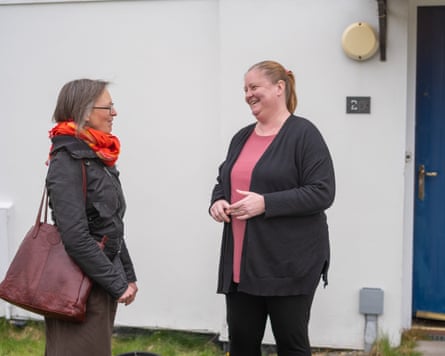
“That seems very unfair,” Line said. She argued lessons needed to be learned from Goretti. “Connectivity was a really big issue. We need to do work to make sure that there’s better infrastructure in place for next time.”
She said there could be some easy gains – for example, making sure the hall in Madron where the coffee morning was taking place had a generator so that it could be a place for people to gather and keep warm next time.
But the feeling remains that faraway Westminster can neglect the far south-west of England. “It’s always a struggle to keep Cornwall on the map and make sure that our situation is understood by the rest of the country because we’re far away and we’re surrounded by water,” Line said. “It’s easy to forget us, isn’t it?”
Some groups and individuals are taking matters into their own hands. Later this month the Transition Constantine group is holding a meeting in its village just south of Falmouth to discuss how they can prepare for the next big storm.
“We were quite cut off for a couple of days,” said one of the organisers, Zoe Rawlence. “This seems a good time to bring the village together and think about what we could have done better and how to be more prepared.”
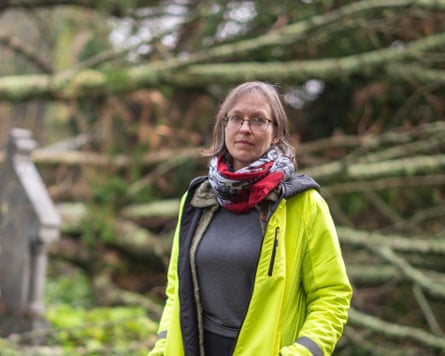
Sam Kirby, a digital marketing consultant and volunteer coastguard rescue officer from the Lizard peninsula, has invested in satellite broadband and a “hefty” solar chargeable power pack. “That would keep us at least lit and online for 48 hours without power. I know a lot of people who have switched from wired connections to Starlink [broadband] since the storm.”
Back at St Michael’s Mount, Kerry Rice, a learning manager, was looking on the bright side. Local schools have taken away some fallen wood to create outdoor seats and tabletops. When children visit, they are allowed to take away a few twigs as a souvenir of Goretti.
“It’s not any old wood – it’s St Michael’s Mount wood,” she said. “This is a very historic place and the storm was a new layer of history that people are experiencing.”