.png) 3 months ago
69
3 months ago
69
Australia’s richest person is reeling after a landmark court decision found her company must pay royalties worth hundreds of millions of dollars to a rival mining dynasty.
Gina Rinehart, a multibillionaire with political connections in both the White House and the Australian parliament, has been described by members of the US conservative movement as “a female Donald Trump”. The 72-year-old, who inherited her father’s iron ore empire in Australia’s Pilbara region, has fought multiple claims against the family company Hancock Prospecting that were first launched in 2010.
On Wednesday, in the Western Australian supreme court, Justice Jennifer Smith found that Wright Prospecting was entitled to its claim for a half share of royalties coming from one of the region’s largest projects – Hope Downs.
Hope Downs is a joint venture between Rio Tinto and Hancock Prospecting and exports about 45m tonnes of iron ore annually from Australia’s north-west each year.
But Hancock Prospecting had a partial victory, with the court rejecting Wright Prospecting’s claim for an equity stake in other mining assets.
The dispute harks back to a business partnership struck in the 1950s by mining prospectors Lang Hancock and Peter Wright. The pair had been school friends and together established a company called Hanwright which was responsible for pegging out vast tenements of iron ore-rich deposits in the region’s Hamersley Range.
The judgment – which ran to more than 1,650 pages – noted that the judge was required to undertake a “lengthy, diverse, and detailed reconstruction of events that occurred between about 1967 to 2005”. This relied on business records from the time that were largely written by people who were no longer alive to testify.
Smith presided over a 51-day trial in 2023 that saw multiple parties represented and more than 4,000 documents submitted.
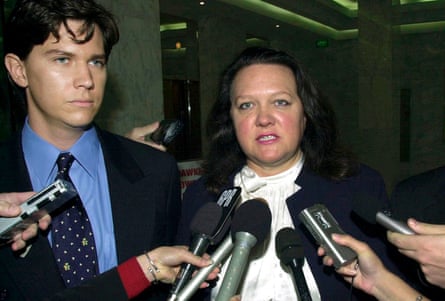
As the case ballooned in complexity after the first claim in 2010, two of Gina Rinehart’s children were also enjoined to proceedings as part of a separate dispute with their mother regarding their inheritance.
However, the court rejected the claim from John Hancock and Bianca Rinehart for an equity share of Hope Downs, saying it “failed at the first hurdle” because the tenements belonged to Hancock Prospecting. Smith upheld Rinehart’s defence that the assets had been wrongly moved by her father, Lang Hancock, in breach of his duties to the company.
Smith, however, confined her findings to the Hope Downs matter, leaving other parts of the family dispute – including the children’s claim to a greater share of the company – to a separate court-ordered arbitration.
John Hancock said the judge’s finding regarding his grandfather was a “difficult pill to swallow”, however, he claimed he was buoyed up by Smith’s remarks about the corporate structure of Hancock Prospecting.
“What we did receive from Her Honour were findings and remarks which are in line with my initial approach to my mother Gina over two decades ago, regarding our family company corporate structure … and consistent with our case.”
The children argue they are entitled to a 49% share of the company under an agreement struck in 1988 between Gina Rinehart and Lang Hancock. Rinehart now controls 76.55% of the company and her children control 23.45%.
John Hancock, Rinehart’s estranged son, called for a reconciliation of his deeply fractured family, saying it was time to put the decades-old dispute behind them.
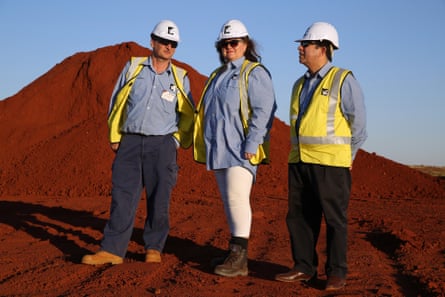

After the verdict on Wednesday, all parties claimed partial victory. Smith, when discussing costs in the case, suggested that Wright Prospecting had “won half of its case and lost half of its case”.
But the loss for Hancock Prospecting is significant, with the company and its joint venture partner, Rio Tinto, now having to pay the Wright family 50% of past and future royalties earned from part of the Hope Downs complex.
Another party to the case, DFD Rhodes, which was the family business of another late mining pioneer, Don Rhodes, also partly won its claim to royalties on some of the disputed mining tenements.
Speaking outside the court, Rhodes’ chief executive, Matt Keady, said that Hancock Prospecting and Gina Rinehart had been “formidable” opponents.
“We are very, very pleased that the judgment has recognised the contribution of Don Rhodes to the iron ore industry,” Keady said.
Hancock Prospecting said its estimated historical payment to Rhodes was $4m a year, and to Wright Prospecting $14m a year, but the Wright camp estimates the amount could near $1bn.

A spokesperson for Wright Prospecting said it “welcomes the decision”.
“These proceedings were commenced in 2010 and, after many delays, we are pleased to finally receive a result in our favour,” they said. “The decision is lengthy and complex. We will review it in detail before determining if any further steps need to be taken.”
Hancock Prospecting’s executive director, Jay Newby, also declared victory after the judgment, saying the court had reasserted its ownership rights over the valuable assets, which was more significant than the ruling over royalties.
“[Hancock] welcomes the … decision which decisively confirms HPPL’s rightful ownership of these tenements firmly rejecting the baseless ownership claims of John, Bianca and Wright Prospecting Pty Ltd (WPPL) in their entirety,” Newby said.
“John, Bianca, WPPL and DFD Rhodes took no risk and made no meaningful contribution to developing the Hope Downs and East Angelas iron ore mines and infrastructure.”
The amount Hancock Prospecting and Rio Tinto are liable to pay will be the subject of a future hearing. Neither side has ruled out appealing against the verdict, meaning the 16-year court case may still have many years yet to play out.