
.png) 1 month ago
64
1 month ago
64
Chen Liang, the founder of Guchi Robotics, an automation company headquartered in Shanghai, is a tall, heavy-set man in his mid-40s with square-rimmed glasses. His everyday manner is calm and understated, but when he is in his element – up close with the technology he builds, or in business meetings discussing the imminent replacement of human workers by robots – he wears an exuberant smile that brings to mind an intern on his first day at his dream job. Guchi makes the machines that install wheels, dashboards and windows for many of the top Chinese car brands, including BYD and Nio. He took the name from the Chinese word guzhi, “steadfast intelligence”, though the fact that it sounded like an Italian luxury brand was not entirely unwelcome.
For the better part of two decades, Chen has tried to solve what, to him, is an engineering problem: how to eliminate – or, in his view, liberate – as many workers in car factories as technologically possible. Late last year, I visited him at Guchi headquarters on the western outskirts of Shanghai. Next to the head office are several warehouses where Guchi’s engineers tinker with robots to fit the specifications of their customers. Chen, an engineer by training, founded Guchi in 2019 with the aim of tackling the hardest automation task in the car factory: “final assembly”, the last leg of production, when all the composite pieces – the dashboard, windows, wheels and seat cushions – come together. At present, his robots can mount wheels, dashboards and windows on to a car without any human intervention, but 80% of the final assembly, he estimates, has yet to be automated. That is what Chen has set his sights on.
As in much of the world, AI has become part of everyday life in China. But what most excites Chinese politicians and industrialists are the strides being made in the field of robotics, which, when combined with advances in AI, could revolutionise the world of work. The technology behind China’s current robotics boom is deep learning, the mathematical engine behind large language models such as ChatGPT, which learn by discerning patterns from huge datasets. Many researchers believe that machines can learn to navigate the physical world the way ChatGPT learned to navigate language: not by following rules, but by absorbing enough data for something like human dexterity to emerge. The aim, for many technologists, is the development of humanoid robots capable of performing factory labour – work that employs hundreds of millions of people worldwide.
The resources being pumped into achieving this goal are staggering. In 2025, China announced a £100bn fund for strategic technologies including quantum computing, clean energy and robotics. Major cities have invested their own resources into robotics projects, too. There are now roughly 140 Chinese firms hoping to build humanoids. Some of the frontrunners made their debut in February, at the lunar new year festival gala, a state-choreographed spectacle loosely comparable to the Super Bowl in terms of bombast and national significance. Hundreds of millions watched as robots performed comedy sketches and martial arts routines. The speed of progress has been startling. Last year, the robots were doing a synchronised cheerleading routine. This year, they did cartwheels and parkour. The intended message was clear: the robots are coming, and China will be the nation building them.
A world in which AI-powered humanoid robots are produced at scale still seems to belong in the realm of science fiction. Late last year, I visited 11 robotics companies in China across five cities to try to grasp just how close we are to the robot future. I met many ambitious entrepreneurs, who were operating in an environment so deeply integrated with municipal governments that the distinction between private and public was losing its meaning. All of them were engaged, in different ways, in the race to build and commercialise robots capable of replacing human workers – and some of them already have eager western buyers.
Inside one of the Guchi Robotics warehouses, a team of employees from General Motors was testing Guchi’s wheel-installation machines ahead of a shipment to Canada. The hull of a white GM truck occupied a raised platform at the centre of the room. The truck, surrounded by four large robotic arms and a jungle of wires, sat inside a yellow safety enclosure made of steel bars. I watched on the sidelines as a bearded GM engineer tinkered with a control panel outside the steel cage.
The engineer, an American man whom I’ll call Jack, worked in GM’s “manufacturing optimisation” division. “To be grim, anything that eliminates people from the production line is basically my job,” Jack told me. General Motors sets job-reduction targets for his division each year, he said, which requires eliminating a set number of factory workers across all plants in North America. His team chose Guchi over a German-based competitor – itself 95% owned by a Chinese company – because the other couldn’t offer a moving assembly line, Jack explained. The purchase of the Guchi machines, he said, would eliminate 12 assembly operators on the line at a single factory. (General Motors did not confirm the job-reduction targets, but a spokesperson said it implements technology to help improve safety, efficiency and quality, “particularly for physically demanding or repetitive tasks.”)
An irony of the Trump administration’s mission to revive industrial production within the US is that much of the machinery required to make America great again comes from the country that motivated America’s industrial revival in the first place. China now accounts for more than half of the world’s new factory robot installations annually. “There’s almost nothing that Chinese engineers can do that Americans can’t,” Chen told me. “It’s really just cost and speed, and how many people you can throw at a problem – we might have 1,000 who can do this work, and they might have 100.”
Chen and I walked to the end of the warehouse, where we now had a frontal view of the GM truck. After watching Jack work for a bit, Chen pointed me to the robotic arms on each side of the car body: “You see those? This is the screwdriving robot. Even if manufacturing does come back to North America, they won’t be putting workers on the line to fasten screws any more. They’ll use robots.”
I wasn’t so sure. Wasn’t one reason that Americans elected Trump because they wanted their blue-collar jobs back? Chen thought this was pure illusion. The world had changed, and so had young people. Chen told me to think about China, where factory culture is deeply ingrained but young Chinese are increasingly reluctant to tolerate the drudgery. “It’s just how people are wired now.” If even Chinese people aren’t willing to do factory work any more, Chen was saying, why would Americans?
One week after my visit to Guchi HQ, I met Chen in north-west Beijing, where the city’s top universities are located. He had invited me to a meeting at the head office of Galbot, one of China’s most hyped humanoid robotics startups. One of its wheeled humanoids appeared in a skit at this year’s lunar new year jamboree, where it handed a male actor a bottle of water from a shelf and folded laundry. Since its founding in 2023, Galbot has pursued a less showy strategy than many of its competitors: building robots that can perform mundane tasks such as picking up items and setting them down elsewhere safely and reliably. The founder, Wang He, told a Chinese reporter recently that their robots are already deployed in several Chinese car factories, though videos appear to show them in highly controlled settings.
Galbot’s “pick-and-place” robots might seem a lot dumber than their backflipping rivals, but a crucial difference is that the robot acrobats operate according to pre-programmed instructions: they are feats of motion control and balance, but they do not go off-script. The kind of technology being developed at Galbot is what roboticists call a vision-language-action model (VLA), which aims to allow machines to operate in unfamiliar and fluid environments, just as humans do. For now, Galbot’s robots cannot reliably do what, for humans, would be trivial tasks – say, washing the dishes – but Wang, has told Chinese reporters he aims to have 10,000 robots handling basic retail and factory work in three years. (Some AI pioneers, such as Yann LeCun, are extremely sceptical that the current paradigm of deep learning will deliver the results companies such as Galbot hope for.)
The purpose of Chen’s visit was to see how Galbot’s robots could be deployed inside an electric vehicle factory, one of the most complex manufacturing environments in the world. Such a feat requires training the robots on a glut of factory scenarios, but there is no ready-made database waiting to be drawn upon. For Galbot to have any chance of deploying their robots in a factory, they need a specialist with decades of complex manufacturing experience who can define the right tasks for the humanoid, what data it needs to learn, and even fill in what the robot cannot yet do. That is what Chen offers to do.
We rode an elevator up to the top of a tower, and filed into a meeting room with a view of Peking University’s lush green campus. A senior Galbot engineer arrived soon after and began to give Chen an overview of the company’s latest developments. Galbot robots had recently been deployed in 10 pharmacies around Beijing, he said, dispensing medication 24 hours a day. Powered by Nvidia chips, they cost about 700,000 yuan (£76,000). At one point, the engineer paused on a slide discussing the technology behind Galbot’s humanoids.
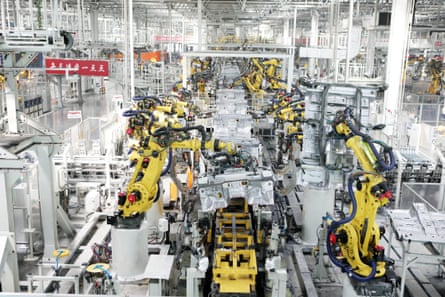
Before the rise of deep learning, the engineer pointed out, industrial roboticists like Chen trained their machines by hand. Programmers wrote explicit instructions for every movement. When something went wrong, they debugged the code and added another line to handle new scenarios. Deep learning promises to replace handwritten instructions with the more flexible VLA model. A prime bottleneck to creating such models – a big reason why the “ChatGPT moment” for robots hasn’t yet arrived – is the scarcity of data.
Researchers have two ways to collect this data. One is through a manual process called teleoperations, where humans guide a robot to do a precise task sometimes hundreds of thousands of times. Each task records a package of data, including visual information, hand positioning, torque, depth, among others, called an “action sequence” that will later be used to train the VLA. The method is labour-intensive, which is why Galbot prefers the second: building virtual environments. “It’s like Avatar,” the engineer told us, referring to the blockbuster film. “I don’t have to physically step on to the battlefield, I just lie in my pod, and can simulate it all.”
The engineer showed us real-life videos of Galbot robots being tested as store clerks, elderly care companions and robot dogs navigating live street traffic for deliveries. The delivery robots, the engineer claimed, could be ready in “two to three years” if they devoted sufficient resources to it. (They hadn’t decided yet.) After learning of all the possibilities, Chen could barely contain his excitement. He proposed a plan to train Galbot’s humanoids to drive a screw. Human workers do this instinctively, but breaking it down for an unscripted robot reveals numerous micro-decisions – finding the hole, lining up the screw, applying the right amount of pressure and torque, and knowing when to stop. The engineer told Chen that Galbot robots could already grasp and manipulate tools like a screwdriver, but he wasn’t yet sure it could align the screw or know how hard to turn it. “Let’s define responsibilities,” Chen reassured him. “What you can reliably handle, and what I’ll take over.”
The two sides agreed on a target: to be viable in the factory, the Galbot humanoid would need to fasten a screw in less than eight seconds. The engineer leaned back, slightly overwhelmed. “You guys have such a wide range of expertise in engineering.”
“Different genes,” Chen replied smoothly. “We can solve the industry’s problems together.”
After the meeting, I walked a block north to a nearby mall, where Galbot had stationed one of its retail robots behind a kiosk in a promotional display. The G1 model is white and mannequin-like. There was still a human worker standing by, presumably in case something went awry. I ordered a Pocari Sweat, a Japanese energy drink, on a tablet. The G1 swivelled toward the shelf, its mechanical arms jutting out to the sides like wings, before one pincer closed around my drink and picked it up. It deposited the bottle on to the counter from slightly too high, so the drink, though it didn’t fall over, bounced a few centimetres to the side.
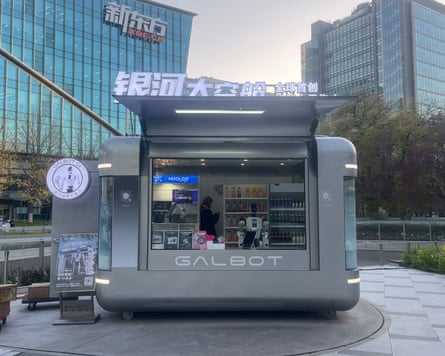
Chen had emphasised, throughout our time together, that this technology was moving faster than I could imagine. But my experience with the G1 robot – essentially a glorified, semi-competent vending machine – made me sceptical. Two months later, in February, I watched the lunar new year gala from my apartment. Galbot’s robot appeared in a pre-recorded segment, and it looked different. The pincers were gone, replaced by 10 articulated fingers. The arms were no longer bulky but lithe and anthropomorphic. When the robot reached for a water bottle on the shelf, it moved much faster and more assuredly than before. How much of this was edited or stage-managed, I do not know. But I got a taste of what Chen was feeling.
If you have seen a Chinese robot dance or do kung fu, chances are it was made by Unitree. Last year, the company shipped more than 5,500 humanoid robots, more than any company in the world. Recently, a viral video appeared showing a concert by the Chinese pop star Wang Leehom in Chengdu, where Unitree robots served as backup dancers. Elon Musk reposted it with a single word: “Impressive.” The viral performances serve as good marketing for China. But Unitree’s main customers are labs and universities, including Oxford, Carnegie Mellon, UC San Diego and Boston Dynamics, which buy the robot and develop software to make them more intelligent. A spokesperson told me Unitree wants their robots to eventually enter factories and homes so they can “take on dangerous, repetitive, and tedious work for people”.
Late one evening, I was in a cab in the city of Ningbo, when I got a message from a Unitree spokesperson. We had planned to meet at their headquarters in Hangzhou, about an hour by train, the next morning, but the company had abruptly scheduled an “important event” for tomorrow that would shut down all the roads near the office. There are not many things in China that can stop traffic and bend corporate timelines. I checked my phone to see where President Xi Jinping was: two days ago, he had attended a sporting event in Guangzhou, but it wasn’t clear where he was heading next. The spokesperson asked if I could come tonight. I looked at the time – it was already 7.32pm. “We’ll be here,” she assured me. I rushed to the train station.
Despite its global stature, Unitree’s headquarters are shockingly modest. The company occupies two weathered buildings in Hangzhou’s tech district, inside an old compound flanked by auto dealers and mom-and-pop stores. When I arrived, around 9pm, most of the Unitree employees were only just getting off work. I was greeted by three media representatives who ferried me to a display area where an array of robots awaited me. One wore a purple boxing helmet and was throwing combinations with an intensity that made me take an instinctive step back. Another was dancing the charleston. Next, a four-legged robot dog cycled through flips and tricks. All the while, the demonstrators kept kicking the robots, hard. The robots absorbed every blow, and never toppled over.
One developer at Boston Dynamics, an American competitor, told me that Unitree’s hardware is highly advanced and remarkably cheap. Their robots start at about $1,600, while comparable American machines cost tens of thousands of dollars. The Boston Dynamics developer attributed Unitree’s advantage to structural conditions. China has two sprawling metropolitan areas – the Yangtze River Delta near Shanghai, and the Pearl River Delta in Shenzhen – which are home to a hive of hardware suppliers so dense that robot-makers can sometimes walk next door for a replacement part. Tweaking a robot prototype can take less than a day in Shenzhen, but weeks in Silicon Valley, where parts may need to cross multiple states or oceans. The ease of building also explains why there are 330 different types of humanoid robots in China. It makes creative destruction into a normal part of the process. “We commercialise one generation of robots,” said Harry Xu, a robotics entrepreneur and researcher at Tsinghua University. Many of that generation inevitably fail. “Then we build the next generation.”
Another way to think about the humanoid robotics industry in the US and China is as a spectrum. At one end sits the general-purpose humanoid, the sci-fi vision of a machine that can do anything a human can do. At the other end is a robot trained to do one thing extremely well, sacrificing breadth for commercial reliability. For all sorts of reasons – the pressure to commercialise, the pull of government contracts, the intense competition that rewards differentiation and profit over research – companies in China get dragged to the modest side. The biggest American tech companies, insulated by deeper venture capital and less commercial urgency, tend to aim for the grail. A plausible future is one where the US leads the technology toward the generalised humanoid, and China supplies the world with cheap, reliable robots that each do one thing very well. The US may eventually produce a single robot that can mow your lawn, walk your dog and babysit your children. But while you wait, you might as well buy three Chinese ones that can do one task each, at a fraction of the price.
The morning after my visit, I took a cab back to Unitree’s offices to see what the activity was. The block around the perimeter had been cordoned off. I hopped out of the cab and walked about a block to Unitree’s front gate, where three suited men stood guard outside, scanning each passerby. Beyond three black public security vans, I couldn’t see anything. I checked my phone and saw that Xi Jinping was 750 miles away in Beijing, hosting a visit from King Felipe VI of Spain. I crossed the street and hailed another cab. When I got inside, the driver was curious to know whether I had seen anything outside the factory. He had just dropped off a Unitree employee and was quick to speculate. “There must be an army group inside.”
His guess was a reasonable one. Two years ago, Chinese state TV broadcast footage of Chinese military drills that showed Unitree robot dogs equipped with machine guns. American lawmakers have suggested that Unitree be cut off from US technologies such as semiconductors. Unitree maintains it does not sell to the military, nor does it endorse military modifications from third parties, but one US-based analytics firm says that Unitree sells to Chinese universities that contract with the military. The scrutiny has affected the robotics industry in China. A spokesperson at a top robotics company told me that they had been warned by authorities not to talk to western media. When I asked Unitree’s spokespeople who the company’s customers were and whether it sold more robots overseas or in China, they replied tersely: “We do both.” When I contacted the company later, Unitree told me the security presence had no relation to the military: it was a government delegation that had come to learn more about robots.
In the same week I visited Galbot with Chen Liang, I made my way to the outskirts of Beijing, to what the city government claims is China’s “largest robot training centre”. The training center is affiliated with Leju Robotics, a company whose robots do not learn from simulations, but real examples provided by human data collectors, or teleoperators. The company’s flagship humanoid, Kuavo, has already been deployed in some electric vehicle factories around China, performing basic tasks such as unstacking cardboard boxes.
Upon entering the lobby, I was greeted by a giant wall monitor displaying a map of China, with five glowing red dots representing each city where Leju had training centres. To the right of the dot was the number of action sequences each site has collected. The largest collection site was here in Beijing, where roughly 100 teleoperators were arranged in neat rows in a sectioned-off corner of a warehouse. Each workstation had two people to every robot, doing a different task, such as wiping down a table, organising cutlery or moving a glass of water. On the second floor, teleoperators trained robots on industrial-use cases, such as sorting and packing boxes. Leju and its corporate affiliates sell some of its data to third parties. The company has also publicly released a slice – 100 hours’ worth – which international researchers can use to hone their vision-language-action models.
I stood at the side of the room and watched as one worker in a VR-like headset manoeuvred his robot’s hand around a potato, lifting it slowly from a table and lowering it into a basket. Then the robot reached for a blue cloth to wipe down the table. Another worker sat behind a laptop, where he logged each action – say, whether it was successful or not – into the database. On the second floor, a team of engineers processed the data, which would eventually be fed into a vision-language-action model. At another workstation, one worker guided his robot to pour water into a bowl. It missed. The water spilled, and began running over the edge. Its human partner stood up from the desk and cleaned up the mess. Then they did the action sequence again.
There wereroughly equal numbers of men and women among the teleoperators. Most looked like they were in their late teens or early 20s. They had been hired through a labour dispatch company, part of a largely invisible network that underwrites China’s economy. Dispatchers recruit workers from villages and vocational colleges, and move them seasonally to where labour is needed, from the iPhone assembly line to working as enforcers during China’s rigid pandemic lockdowns. The same system provides robot trainers for the humanoid age.
Leju’s teleoperators hailed from Shandong, in eastern China, where they are part of a vocational training programme at a local university, studying for practical-sounding majors such as “big data” and “the internet”. Before the robotics boom, these workers may have labelled road signs for autonomous driving systems or moderated content for technology platforms. The workers told me they typically do 15 different tasks a day with the robots – 10 times each, on eight-hour shifts.
Chinese officials have framed teleoperations as a “new vocational training programme”, but there are already reports of how dehumanising the work can be. One former employee who worked at a robot training lab in Tesla’s Palo Alto headquarters told a Business Insider reporter it was like being “a lab rat under a microscope”. When I brought up these questions to the workers, I was stopped by a spokesperson. But in my brief conversations with them, they seemed curious about their work. According to recruitment posters, there are no degree requirements and the pay is about 6,000 to 10,000 yuan a month – about the same as full-time delivery drivers, but with better hours.
Ulrik Hansen, the co-founder of Encord, a data services company based in Silicon Valley, told me that teleoperation is on the verge of “a huge boom”. Encord has a teleoperations centre in the Bay Area and one is opening in Mexico soon. To those who say that robots will take workers’ jobs, Hansen likes to say that teleoperations are the “new manufacturing job”. Confusingly, the word “teleoperations”, refers both to the process of training a robot, as well as the remote control of a robot. “For every 15 to 20 robots, you need a person to manage those robots,” Hansen said. When asked about the vast majority of workers who would not end up managing the robots, Hansen said that the new jobs would outnumber those that are lost, though he did not offer specifics.
Every company I asked rejected my requests to speak to their teleoperators, so I tried another way. There are many job postings for robot trainers on the social media apps Little Red Book and Douyin, the Chinese TikTok, where the comments were filled with the same message: “Are you still recruiting?” I asked some of the jobseekers if they would speak with me, introducing myself as a journalist reporting on China’s robotics boom. A few days went by without a reply. Then one worker wrote back: “Go ahead.” I typed out my first question and hit send. The message immediately bounced back: my account had been flagged for unusual activity. I must have triggered a spam filter or an algorithm designed to pick up unwelcome questions from reporters. The teleoperators exist at the centre of one of the most consequential technological transformations of our time, yet their contributions have been largely invisible.
In China today, it often feels as if new technologies are becoming normalised far more quickly than elsewhere. In the city of Chongqing, on Saturday nights, there are “drone shows” in which thousands of drones arrange themselves above the Yangtze River to form giant luminescent images in the sky: of cityscapes, flowers, animals. In Chengdu, cyclists who stray into motor lanes are admonished by humanoid traffic cops. Commuters in Wuhan, Shenzhen and Beijing are hailing driverless taxis. Part of the reason for this extensive rollout is simply that technology is cheaper to deploy. But it is also the result of a coordinated effort. In the 14 years since President Xi came to power, he has abandoned the language of “market-driven” innovation in favour of the Chinese Communist party’s “unified leadership” in setting technology priorities. Beijing has imposed its will on every corner of Chinese society, and local governments have, in turn, become more responsive, and competitive, in satisfying the centre.

During my visits to robotics startups, I often bumped into mid-level officials from cities such as Shenzhen and Hefei. They sat in meeting rooms listening attentively to engineers half their age. They aim to entice startups back to their localities, to raise them into local champions that attract talent and jobs. The Leju facility – more than 10,000 sq metres of factory space inside an industrial park – had been provided to the company by the district government, as part of a joint venture agreement, just two months before my visit.
Viktor Wang, co-founder of PsiBot, a startup that specialises in making dexterous robotic hands, told me he had received multiple unsolicited offers from municipal governments eager to help him establish training centres. “It’s not just Beijing – Suzhou, Shanghai, Wuhan, everyone is willing to put money behind these [robotics] projects,” he said. The competition is intense. Each city acts like a patron in the Hunger Games, backing their own tribute. Hangzhou has Unitree. Shanghai has AgiBot. Beijing has Galbot. Shenzhen has UBTech.
A day after my visit to Leju, Wang invited me to try out a teleoperation sequence at his Beijing offices. The task was to pick up clothes from a pile and drop them into a bin. PsiBot has been in talks with the fast-fashion retailer Shein to replace workers performing the most basic tasks on the garment line, and Wang told me he thinks he can achieve this by September. I put on skeletal gloves with Velcro straps linked electronically to a humanoid’s hands positioned beside me. The connection between my hand and the machine was not as smooth as I was expecting: it felt clunky, like operating the claw machine in an arcade. As I tried to grab the clothes with my robot hands, my mind half-expected to feel some tactile resistance. It took me several tries to get the machine to do the required motion.
Teleoperating, I realised, is not simply a matter of performing human actions that the robot learns. When you’re doing a sequence, you must move at a speed that the machine can register. You must keep your arms in a set position throughout. You cannot do normal human things such as scratch an itch. (Doing so would “pollute” the data.) The process was more physically taxing and stranger than I expected. We are training our robots to be more like humans; doing so requires that humans act more like robots.
The high-speed rail from Beijing to Hefei cuts through the North China Plain, a vast stretch of flatland roughly the size of California. Six days after my meeting with Galbot, I boarded the train around 6am, and found my seat through a scrum of groggy commuters. Outside, it was dark; nothing to see beyond my own reflection. But as the train hurtled quietly southward, dawn began to break. Tilled fields, apartment towers and electric pylons gradually came into view, flashing by the window. Toward the front of the cabin, a screen was playing a synchronised breakdancing routine performed by Unitree robots. Four hours later, the train pulled into Hefei.
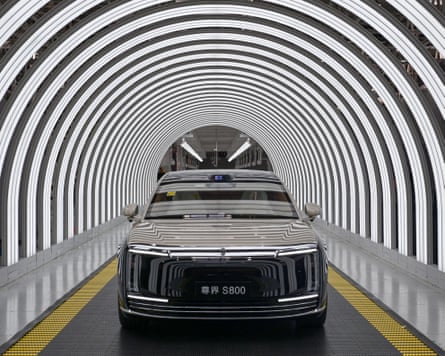
I had come to see a newly built Huawei car factory where several of Chen Liang’s robots, including the wheel-, window- and dashboard-installation machines, had been deployed. Once a rural backwater, Hefei has transformed into an industrial centre that, together with its surrounding areas, produces more cars than Michigan. I took a cab to an enormous factory complex on the southern outskirts, where Huawei churns out its newest electric ultra-luxury sedan, the Maextro S800.
Chen greeted me in the factory cafeteria with his familiar grin. Before we stepped on to the factory floor, his engineers helped me into some steel-toed shoes, while Chen fired off directions to his team. With his hard hat and green vest over his suit, Chen seemed a new man: more confident, the conductor of his own orchestra.
Car factories are typically divided into four zones. The final assembly zone was quiet, clean and bright like a laboratory, its support beams and scaffoldings painted porcelain white. As we walked through the storage region, unmanned carts – low, rectangular platforms – zipped by, ferrying car parts to work stations. Whenever we spotted a human worker, Chen described to me what they did and explained why robots still can’t do it.
We started at the flow racks, where workers pick up component parts – sensors, wires etc – and place them into bins. These kinds of repetitive “pick and place” tasks are seen as particularly ripe for automation. (In October, Figure AI released a video of its humanoid robot doing a similar task at a BMW plant in South Carolina.) Even here, Chen told me, humanoid robots do not yet match up to their human counterparts. “One worker has to manage so many different types of components, and each one needs to be grasped differently,” he told me. The parts themselves were also changing. Just then, he pointed to a metal bracket still wrapped in foam packaging: “You have to strip that off too. It’s a pretty complicated job.”
As we walked deeper into the Huawei factory, we could see a queue of car bodies moving along an assembly line. Workers lined both sides, jumping in and out of the car shell with drills and other tools, tightening bolts and snapping connectors into place. Watching on, I got a sense of just how hard it would be to automate this. The work looked far more chaotic and context-dependent than any pick-and-place task.
When the Maextro sedan reached Chen’s work station, the car was hoisted on to a raised platform, where three robotic arms sprung into action. One arm locked a dashboard into place, the other two bolted them on to the car in seconds. “This is our fully automated dashboard installation,” Chen told me, marvelling at his own creation. The Guchi engineers stood behind a monitor. They were there mostly for troubleshooting. “Before, workers had to guide robotic arms manually, and each car model needed different kinds of tooling because the models varied so widely,” said Chen. No longer. “The progression is fascinating.”
Chen combines the cautious pragmatism of an engineer with the techno-optimism of a founder. Though he is clear-eyed about deep learning’s limitations, he believes much of the assembly work in the factory will be close to fully automated by the mid-2030s. Like many of his peers in the Chinese robotics industry, Chen views the displacement of human labour with detachment. To him, the onrush of technology is no more contestable than the passage of time. When I pressed him to consider the social consequences of his work, he acknowledged that he and his business partners had discussed contingency plans for laid-off workers. Those who are higher-skilled could be used to train the next generation of robots, he said. He did not say how he would deal with lower-skilled workers.
Back inside the Huawei factory, we reached a station where five to six workers huddled under the raised Huawei car, craning their necks to bolt screws and tightening connectors by hand. “Long-term, this causes spinal damage,” Chen told me matter-of-factly. It was better that they be replaced by humanoids.
There are 120 million workers in Chinese factories today, several million of whom, like the workers in front of me, had undertaken three to five years of vocational training. I asked Chen what this meant for their successors, those in middle school hoping to undergo training in advanced manufacturing now. “They definitely need to change careers,” said Chen.
Decades ago, China’s infrastructure build-out of apartment towers, skyscrapers and high-speed rail dazzled the world, but it masked a story of expropriated land, corruption and waste. Today, something similar is happening. The vast build-outs of industries such as semiconductors, solar panels and electric vehicles are impressive to behold, but much of China’s population, which is facing diminishing economic prospects and alarming youth unemployment, are now wondering what all that effort was for. Even those driving China’s flagship industries sometimes bemoan their situation. At his last company, which built machines for EV batteries, Chen worked 16-hour days and clients, who often delayed payments, demanded the impossible. “Something that should take a month, they make you finish in 10 days,” he told me. As government subsidies flood the robotics sector, Chen and his peers are bracing for the usual pattern: price wars and cost cutting manoeuvres that leave companies barely able to turn a profit.
A couple of weeks earlier, back at the warehouse in Guchi’s Shanghai headquarters, Chen and I had watched the General Motors employees prepare to ship Chen’s machines to the west. Chen would shortly be travelling to the US, where he was planning to visit Tesla and General Motors to seek new business opportunities. Under successive administrations, we have heard that the US is committed to decoupling from China, but the reality is more complicated. It is not just American businesses that need China; the reverse is also true. Chen told me that he’d learned a lot from working with GM: how American manufacturers approach process management – the protocols, safety standards and quality controls that, when followed correctly, eliminate errors before they happen. It has made his team more disciplined. Working with Americans is “no longer optional, it’s inevitable,” Chen told me. And besides, he added, “Americans pay on time.”
This article was supported by a grant from the Tarbell Center

Discover a selection of the Guardian’s finest longform writing, in one beautifully illustrated edition. In this issue, you’ll find stories about how private equity is plundering the world and what it’s like growing up in a family of Nazis. Plus: why do we think the perfect buggy will make us better parents? Order your copy today at the Guardian bookshop.