.png) 10 hours ago
8
10 hours ago
8
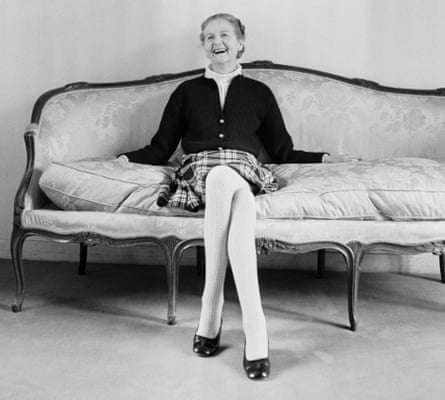
In the summer before university, my mother gave me a copy of The Pursuit of Love. We’d moved countries at the beginning of my A-levels and those months in between had been defined by a level of loneliness I had never known in my life. The sort of loneliness so acute and pervasive it feels like panic, and on top of all that, so shaming to be 17 with nowhere to go and nothing to do on a Saturday night.
Growing up, my mother – a great reader – would say: “When you’ve got a book, you’ve got a friend,” which is why, presumably, I wasn’t a great reader. Then, I’d always had actual friends. And suddenly I didn’t and presumably that is why I accepted the Nancy Mitford paperback and started to read it.
I loved it, immediately. Finished, I asked if there were others and could we get them. I loved them all, more and more with every rereading. There was so much humour, and such solace in sad parts. The novels were so populated, I found company in the characters, and eventually in the person of the author too, privately coming to believe that if I had ever met Nancy Mitford, we would have become friends.
Although my loneliness ended when university began, Nancy remained with me – never as intensely, but always there, so that now, age 48, I still find it hard to believe she isn’t actually my friend.
I never would have described this as a parasocial relationship, although that’s precisely what it is: “a connection that someone feels between themselves and a famous person they do not know”, as the Cambridge Dictionary defined it when they announced it as their word of the year in 2025. To me, the term sounded creepy, an activity of the unhinged. But if it’s common enough to become a word of the year, does that mean everyone is going about life with an imaginary friend? And we readers, especially?
Although current, nothing about the phenomenon is new, the term devised in the 50s by a pair of academics studying the curious connection watchers of television appeared to feel with characters. Unsurprisingly, it’s tricky to gather statistics on relationships that exist solely in the mind. One online study a couple of years back suggested that “51% of Americans have likely been in parasocial relationships”, though “only 16% admit to it”.
While I was writing Sophie, Standing There, my novel about a parasocial relationship between a reader and an author (even writing, I resisted using the term until there was no way around it), my non-imaginary friend Cathy Rentzenbrink was at work on The Agatha Christie Cure, her memoir published next month about returning to her most beloved author in the period following her divorce. Had she developed a parasocial connection with Christie while rereading every one of her novels, and now writing about the author’s life? Yes, Cathy said, insofar as: “I started talking to her and she was talking back. I am a bit embarrassed, not by the experience, which was wondrous, but by what people might say or how they might judge me. I was often scared I was going mad.”
She wasn’t. Not according to Dr Georgia Carroll, a sociologist whose research is focused on parasocial relationships. “I think almost every single person has had one, whether it’s with Taylor Swift, or the millions of people who feel connected to Lewis Hamilton.” While there are commonalities to all – “the key is that the relationship will never become reciprocal” – there is, Carroll believes, a uniqueness to the reader-author version. “With books, it becomes a bit deeper, more often, because they hold such a place in the lives of big readers. Everybody has that favourite book that is so meaningful to them because the author captured something that makes us feel less alone.”
Whether readers are more inclined to loneliness (and it’s in lonely periods that parasocial relationships are most easily formed), our chosen pursuit is solitary, performed only in company with the author. “That one-to-one element is critical,” says Carroll. “The feeling that the author is talking only to you.”
And there is a sense in which book-lovers are most primed for parasocial relationships by the very fact that novels are about imaginary relationships between invented people, and our skill in reading is suspending disbelief. “Readers, as opposed to watchers, have been trained to fill in the gaps,” says Rentzenbrink, “to convert sentences into multi-dimensional worlds.”
“I think it’s all too easy for the lines to be blurred between a character we love, and the author who created that character,” agrees book blogger Tilly Fitzgerald. “If a character is warm and funny, and the kind of person we would choose to be friends with, we can often assume the author will be too.”
Over a lifetime of reading, Barbara Trapido, author of Brother of the More Famous Jack (the cult classic that has surely made her the object of many parasocial relationships), has formed many “deep and extended relationships with characters. For half a year, aged 17, I believed I was Henry James’s Isabel Archer.” And there was a period, she says, “in which I found myself, doubtless through yearning, talking to Shakespeare, but all unawares. It’s massively exciting to have the privilege of talking to the dead.”
Because, in the case of reading, it doesn’t actually matter if the author is alive. “In fact,” Rentzenbrink says, “it makes it a bit easier if they aren’t.” And in a way safer, because they do not change. The politics to one side, the intensity of fans’ anger towards JK Rowling is largely grief for a lost friendship, a version of: “I thought I knew you and I didn’t.”
With a living author, the sense of truly knowing them has become much keener. It wasn’t that long ago you could read an author without ever discovering what they sounded or looked like. Now, putting together a picture of their life is the work of one evening in bed with your phone. And when it comes to the creation of a parasocial relationship, nothing is more potent than the podcast. “It feels more intimate, doesn’t it?” says Jack Edwards, of the hugely successful literary podcast, Inklings Book Club. “We bring the author’s voice into our homes, on to our morning commute, into our safe spaces,” – in my character Sophie’s case, it’s always in the bath – “so it’s a together-aloneness, where we have company in our ears, but otherwise feel unobserved.” It goes both ways, Edwards points out. “We invite authors into our homes, through the listening experience, but often they record from their own homes too.”
Which brings up the other side. That is, how it feels to be an author in this moment. Certainly, readers can be passionate – I have seen Sorrow and Bliss tattoos, inspired by my last novel – but no one I’ve met in real life has wanted anything more than to chat about books, or to tell me what my work meant to them, and how could I be other than glad about that? Likewise, Trapido says, “I’ve always liked readers coming up to say how much they like my books, though, oddly enough, they often apologise for approaching.”
Perhaps the whole thing is the author’s fault anyway, because what we are constantly trying to do is connect, and make you believe in our characters. So the idea that some made-up version of me as an author has provided company for someone who feels as unsurrounded as I did before university, or as Sophie does in my new novel – at no cost to myself – is extraordinary and a privilege. I’m grateful too that Nancy was there for me when I most needed her, and still is. Everyone says we read to know we’re not alone. But you could also say, we read and so we aren’t alone.