.png) 3 months ago
66
3 months ago
66
In one of Pozer’s earliest memories, nearly two decades before he became one of the most talented rappers in the UK, he is six years old, running from his mum’s landlord. “He come knock the door, my mum’s acting like we’re not here, we skid out, go shop. When we’re walking back he’s clocked us, so me and her start running, we hop a gate and we’re now in the communal gardens of an estate. That guy booted open the ting. Me and my mum are pretend-playing with a ball. He picks it up – but all the little hoodlums in the area circle him: ‘What you doing?’”
The way he recounts his life – both in his music and in our conversation, which takes place at a west London recording studio – it seems as if he was always on the move like this, on alert. Born Tyrone Paul and now 23 years old, he moved as a child around south London with his single mother, sometimes with his father when he was out of prison, or a family friend when his father was back on the run. In his teens, “I used to smoke weed with a couple of girls, and I’d say to them: ‘Every day I wake up, it feels like I’m actively tensing my muscles, and I’m not.’ You wish someone could tell you what’s going on.”
Since he crashed into the UK Top 30 in 2024 with his 50m-streaming debut single, Kitchen Stove, he’s been keeping the tempo high, working through his neuroses and telling shockingly frank stories of street life in tracks that use the relentless rhythm of New Jersey club music – as displayed on his debut mixtape, Crossroads, out this week. That’s an unusual rhythm for a British MC – but, he says, “I always felt like I had to be different”.
As a child, “I cried on my own a lot. I was sad about life for a long time. From, like, eight ’til really only the other day, just before I turned 23. Because I was alone, innit?” He grew up in South Norwood, though he tends to say he’s from Croydon, slightly farther south in London, “because South Norwood is very political in terms of all the stuff that’s happened, so I don’t flag the area”. Political how? He looks me in the eye from between his fine dreadlocks. “A lot of people died. Some I was close with.” What did he see? “Too much. To the point now, they told me my dad had cancer, and I didn’t give a shit. I’m asking my gran: ‘Why am I not bawling?’ But I have lost people, and I never had core friends in school, so I had to grieve on my own. So I don’t care: that’s what it done to me, seeing all of that. I’ve got trust issues. And because I’ve never gone to therapy, I don’t know if I’m normal again or not. I like to keep things short and concise. I talk in riddles; I don’t have normal conversations. The hood will do that to you.”
Pozer’s lyrics are full of blades, guns and the drug trade, as poetic as they are wretchedly bleak and violent. They document a life he himself lived, leaving school in year nine to deal weed and steal bikes until he had a case file “this thick”: he holds his hand out as if gripping a stacked hamburger.
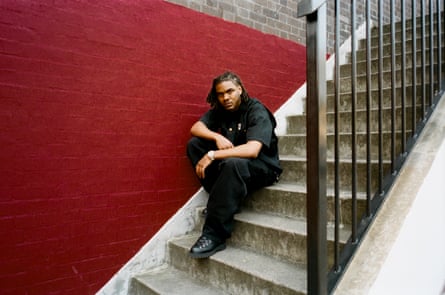
The streets had made him grow up fast: “I used to talk about sex when I was six. Vivid stuff. I was just desensitised to a lot.” Though making sustained friendships was difficult, he’d still “go link my little bredrins, I’m like eight years old, rolling with people way older than me, like 11. You know when you get nail clippers, and it’s come with a tiny knife? One kid is rolling around with that.”
As he reached his early teens, he intended to become a boxer, “until I was like, this is killing me: I’ve got no drip, no gal, I need some money!” So he fell into crime. “You never knew it was bad. Teefing bikes, that was a little fun thing for my and my friends. You’d get nicked for it, but you’d be too young to go to jail. Instead, the YOT [Youth Offending Team] order would send you to a bike workshop to work on bikes, and the bike guys there will tell you how to go and nick bikes! That’s how everyone was learning.”
He was soon surrounded by much worse than nail clippers. He raps about carrying rambo knives, pistols and revolvers, and on the track Jersey King he asserts that his lyrics are authentic: “If I said it, I did it, I mean it / Or if not, seen it / Why would I get up and fib?” Was he threatening people? “In some cases. But I was playing with my conscience, because it was like: ‘What are you doing?’ You get that inner voice. You see the line: this is going to open the door to unlimited spiritual whoopings. There will be no bettering your life. That’s you now, and there is no thinking about being a normal person after that.”

His father, who left prison for good in 2014, warded him off organised crime. “He’d give man the bird’s eye perspective. ‘They will market it to you like you’re going for a job. “Come up here, three days” – they’ll say it so nice that you’re just going to go there and you don’t realise.’ He showed man from young that it’s mind games.” For all that he was often alone and itinerant, Paul had other figures to look up to in his youth, such as his uncle, cousins and their friends, but he laments not having actual career guidance, and youth services that might have given him and his peers more opportunities to stay away from crime. “Giving yutes an outlet, and not glamorising the fuckery, so people don’t know it’s an avenue to go down,” he says. Instead, he saw peers “grow an iron mind. They forget there’s a life outside the hood, they want to be in the low vibe all day long.” He gives the borough of Lambeth as an example of cyclical violence: “The Yardies [gang] have been going crazy there since the 80s. But music and the culture will pump it … this is how it continues.”
Does he risk doing the same with his own music? “With the truths I put in there, I try not to glamorise it,” he replies. “They get their mention. But it’s literally just everything I’ve grown up around. I don’t know life that’s not like the one I’m talking about. If I went in the booth and tried to talk about a day at the pub, I wouldn’t even know where to start.”
As Paul approached adulthood he realised he was caught in a “never-ending cycle that I’ve been exposed to from young”. So he moved out to Kent to live with his mum, from whom he had become estranged during his wayward teenage years: “I had to rebuild my relationship with her.”
He had always played around with rap. “I remember writing bars in primary school, foolish bars. It’s a cultural thing: everyone wants to see who got bars.” Originally, “I was rapping like MF Doom,” the masked US rapper he references in a song of the same name. “At 80 to 90 bpm; I was boom-bapping.” But he started to ratchet the tempo upwards, a reflection of a life, and a mind, always on the move. “I rap like I think,” he says. “The music I’m making now, it’s like medicine. You’re having a bad day? Bang this on. You’re in the gym? Pump this.”
He was 18 when Covid hit, and lockdown gave him the space to write in a more sustained way. Seeing his rapper friends JS and YD blow up on TikTok with one single video, he realised he might also be able to make it, too. After chart success with Kitchen Stove, he had a multimillion-streaming follow-up, Malicious Intentions; appeared on Later … with Jools Holland and the BBC’s Sound of 2025 poll; and has collaborated with AJ Tracey, Aitch, Chase & Status and MCs from across Europe.
“My driving force with doing the music was getting the money to fix what I thought was the problem in my home life,” he says. By the time he started releasing tracks, he was one of 11 half or full siblings thanks to his separated parents’ subsequent relationships. “With doing all this I’ve been able to piece [the family] back together again”, he says, dragging his hands together, arms straining, “like Spider-Man and that train. There’s seven of them in one yard, so I’ve got bare people to think about. I don’t have to provide for them, but I want to help them out here and there.”
Overall, Paul says he’s managed to get a measure of mental stability. “I’ve rebranded as a stoic. It’s my ting now.” Earlier in his life, “with the mandem, I’d just punch you up, we’re having fights, I’m moving rowdy; and with the females, I’m hurt. Now I don’t really penny things like that, I’m chilling. I used to hold on to every thought and dissect it, and stay in a loop,” but now, with an outlet in music, “I’ve stopped that.”
Ultimately, though, he still feels as if he’s on his own. “Even now, I’m shook as shit,” he says. “I don’t have no guidance, at all, in life, from a peer. My music is my inner voice. Selfishly, it’s for me. Because I don’t have nobody helping me.”