.png) 3 months ago
86
3 months ago
86
In 1991, Jim Jarmusch was casting for his anthology film Night on Earth. The premise was simple: five taxi drivers in five cities pick up passengers, set to a soundtrack by Tom Waits. The writer-director wanted Gena Rowlands to play a passenger, but she took some persuading. “Night on Earth was the first film she’d made since losing John [the director John Cassavetes, her husband] and she wasn’t sure. Eventually she said: ‘OK, I’ll be in this film for you.’” Jarmusch does a perfect impression of Rowlands, as he does with everyone he quotes – it’s quite a talent.
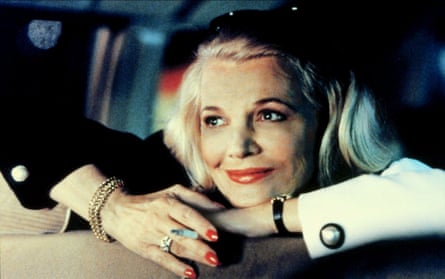
In the first vignette, Winona Ryder picks up Rowlands, who plays a casting director. Ryder, chewing gum, baseball cap on backwards, lights a cigarette; Rowlands, all old-school Hollywood elegance, sits in the back, asking Ryder about her hopes and dreams. Ryder turns down Rowlands’ offer of potential stardom, declaring that her dream is not to act, but to be a mechanic.
Watching it again now, knowing how she was grieving, Rowlands seems infused with melancholy and quiet humanity – but then, that was her great gift to cinema. As for Jarmusch’s gift, it’s surely the empathic, idiosyncratic indie films in which he elicits low-key performances from big stars. He always puts his characters at the centre of his films – as he once said, he has no interest in writing scripts about “sex, revenge, making a lot of money”.
Jarmusch, 73, is talking by video call from a book-lined room in New York to promote his new film, Father Mother Sister Brother, which won the Golden Lion at the Venice film festival last year. He cuts a familiar figure with the sculptural white hair, the tinted glasses, the black clothes, the unintentional pout. Before we get to the film, Jarmusch wants to talk more about working with Rowlands, who died in 2024 at 94. He looks momentarily bereft. “Gena Rowlands. What can I say? What a remarkable, apparently effortless person. Nothing was forced or faked. Coming from the Cassavetes procedure, she knew that the beauty of cinema was to find this real thing and let it come out of you. Man, what an incredibly beautiful experience. One of the most beautiful gifts of my working life.”
He says that while he was shooting the scenes with Rowlands and Ryder, Peter Falk – who starred with Rowlands in the 1974 Cassavetes film A Woman Under the Influence – would ring and say: “Jarmusch, Falk here. What’s going on with Gena? Do you need anything?” Jarmusch laughs (having nailed Falk’s gruff voice). “She was a lioness; she didn’t really need protection.”
A few years after Night on Earth, Rowlands sent Jarmusch a Cassavetes script called Unless That Someone Is You. It was “a beautiful, nonjudgmental love story about a woman and a younger person on the spectrum” that Cassavetes had written for Rowlands before he died. Rowlands hoped Jarmusch might direct; if not, the film would remain unmade. In turn, Jarmusch said he would do it only if Rowlands took the lead role, but she declined. Two years passed, then Rowlands changed her mind; her Alzheimer’s was progressing and, she told Jarmusch, time was running out.
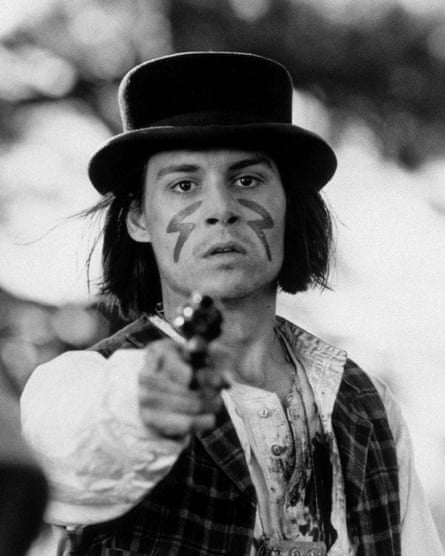
Jarmusch, however, was preparing Dead Man, the 1995 film starring Johnny Depp that the director later described as a “psychedelic western”, and he had to turn Rowlands down. “Dead Man was a nightmare to prepare and I was like: ‘Oh fuck, I can’t do it right now.’ That was the only time I had any interest in directing someone else’s script.”
It was a missed opportunity, I say, but what a compliment to have Rowlands ask him to direct a Cassavetes script. “I know,” he says. “I work with [the cinematographer] Fred Elmes, who worked with both Cassavetes and [David] Lynch, and I feel beautifully connected to both directors through Fred. I’m not a surrealist like David, nor am I quite as visceral as Cassavetes, but I’m a humanist romantic, as John was.”
He leans into the screen. “To be clear, I’m not imitating them. They are beyond me. I’m just in the middle of a fulcrum of those two American film-makers who mean so much to me.”
No one would accuse Jarmusch of imitating anyone. In a career stretching back to his student effort Permanent Vacation and 1984’s Stranger Than Paradise, he has been preoccupied with offbeat Americana, often eschewing traditional narrative pacing in favour of vignettes that explore the quotidian mundanity of life, always finding a way to use his wonderfully deadpan humour. He tells me that he “makes films out of the things other people would leave out. Most directors would cut cab rides out of the plot, but I made a whole film about them. In Coffee and Cigarettes, I was exploring the moments in which you take a break from the real things you’re supposed to do.”
It’s no surprise, then, that Father Mother Sister Brother is more of the same. If anything, it’s more Yasujirō Ozu than ever – Jarmusch is a huge fan of the director whose work was defined by his observations of everyday life in Japan. Father Mother Sister Brother is another anthology, this time a three-part drama set in New Jersey, Dublin and Paris. While there is no overlap in characters, there are recurring motifs, including a pack of skateboarders weaving in and out of traffic and – oddly enough – the resolutely British idiom “Bob’s your uncle”.
In Father, Jeff (Adam Driver) and Emily (Mayim Bialik) drive to see their widowed father (Waits) in his isolated countryside home. Tension rises as the manipulative father insists he is financially insecure and shamelessly asks his well-paid kids for cash.
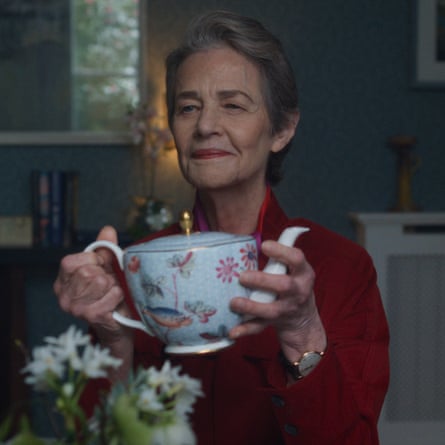
The chat doesn’t exactly flow – the siblings aren’t close – but they are a garrulous trio compared with the Dublin family in Mother. Here, in a grand house on a wide avenue, we meet a mother (Charlotte Rampling), a bestselling author, and her daughters Timothea (Cate Blanchett) and Lilith (Vicky Krieps) for their annual visit. You would be hard pressed to identify Tim and Lilith as siblings. The former is stiff and self-contained, the latter a punky hippy who lies about her success and checks her phone as tea is being poured, yet they bond over the froideur of their progenitor. The mother, meanwhile, is the type to have plastic-covered furniture, if only it were stylish.
In the final triptych, New-York-born fraternal twins Billy (Luka Sabbat) and Skye (Indya Moore) meet in Paris after the death of their parents in a plane crash and return to an empty family apartment full of warm memories.
Jarmusch says that he usually collects ideas for “quite a long time” and then writes a script “very fast”. He often starts with the actors he would like to collaborate with or wants to create characters for. “I was just thinking how interesting it would be if Tom Waits played Adam Driver’s father. Like: wow! And then I thought of Mayim Bialik as Adam’s sister because she was my favourite host on Jeopardy!. I wrote it in, I don’t know, 10 days. Maybe two weeks.” That is super-fast, I say. “I don’t labour over scripts; I cast first then write fast.”
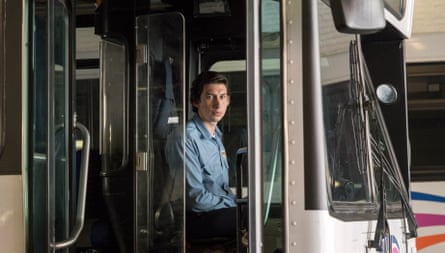
It helps that he works with actors time and again: Waits, whom he met at a party hosted by Jean-Michel Basquiat, in films such as Down By Law, Night on Earth and Coffee and Cigarettes, and Driver in Paterson and The Dead Don’t Die. Blanchett, too, on Coffee and Cigarettes. Over email, Blanchett says: “Jim gives his actors and the crew every last drop of himself. He looks at and listens to the world in a very particular way; he notices elements most of us would miss. He prizes and underscores the oddball parts of people that would normally be discarded or overlooked. Father Mother Brother Sister has, like the man himself, a mysterious deep pulse, with no extraneous elements.”
Jarmusch is resolutely cool, although I don’t think he would dream of using the word to describe himself. Steve Coogan, who was also in Coffee and Cigarettes, points out that the film is “often referred to by auteur film-makers as a touchstone. In terms of kudos, it was the most remunerative two days of my life. I miss him.” (Jarmusch says that he and Coogan “did some crazy shit together in LA and New York; I really miss him, too”.)
When Cannes turned down Father Mother Sister Brother, Jarmusch took it to Venice and surprised everyone by winning the top prize – critics thought it would go to The Voice of Hind Rajab. “I didn’t expect to win,” says Jarmusch. “It was very appreciated, but I’m not interested in the competition of artistic expression. It’s nonsense to me, in a way.” He was, however, pleased that when he took the winged lion sculpture through security at Venice airport, all the workers started shouting: “Bravo! Fantastico! Auguri!” He grins. “It was just so Italian. I was very moved.”
In May, Jarmusch starts shooting his next film in Paris, which he won’t talk about as he is “deeply superstitious”. In 1990, he said that “ambition can be very evil”; he still doesn’t find the money part of film-making easy, saying now that if a potential backer asks him to compromise, he walks away. He dislikes the idea of “someone who used to run an underwear factory telling me how to make a goddam film”. The process is “delicate and difficult”, especially since doing things his own way means he has smaller budgets and less time. It’s part of the reason Father Mother Brother Sister is his first film since The Dead Don’t Die, a zombie horror-comedy, in 2019: “It’s harder every time to get a film made. I’m not a commercial director. I’m not even a professional film-maker.”
We talk briefly about death, since grieving parents living and dead is a central theme of Father Mother Brother Sister. Jarmusch says that he is “not a death-obsessive person at all. In fact, I try to think of it in an almost Buddhist or eastern way. Things are cyclical. I believe that energy isn’t created or destroyed [when we die] … Life is a beautiful gift, but I don’t mourn the idea that I will lose it someday. I’m in very good shape. I swim, I do tai chi, I meditate a bit. I try really hard to live in the present for at least a fraction of a moment.”
For a moment, he looks sombre: “The planet is being destroyed and everything is so fragile that I somehow want to appreciate my life.” Does he have plans for the near future, other than to start shooting in Paris? “I have no plans; I follow the Neil Young plan. He said to me years ago: ‘Jim, the best plan, man, is no plan.’”
In the meantime, he will simply carry on being Jim Jarmusch. “I’m still a cinephile. I’m blown away by watching films of all kinds. I love silent movies, too. They’re like dreams to me. I try to watch a film every day – and I can’t imagine a more beautiful thing to get to do. And then I fight to get to make my own films. I’m lucky, but I’m stubborn as hell as well.”