.png) 2 months ago
63
2 months ago
63
The Royal Academy is billing Rose Wylie as a “rebel artist” for her forthcoming show and at 91, she finds there’s still a lot to rebel against. An establishment that has long underrated women’s work, for one: astonishingly, hers is the first solo show by a British woman to occupy all the academy’s main galleries. Being pigeonholed is another: her giant canvases – with their bold colours, painted texts and wild juxtapositions (Nicole Kidman meets ancient Egypt at a Kent community centre) – have been compared to the work of Jean-Michel Basquiat and Philip Guston. But she does not identify with any one movement and dislikes art that is “up your arse”.
For more than 60 years now, Wylie has lived in her low-slung, 17th-century house in Sittingbourne, Kent, where she rebels against conventional domesticity. Jasmine grows in a tangle through the kitchen ceiling and bouquets of dead flowers crowd another room. A ceramic horse given to her by the actor James Norton, a collector, lies by the windowsill. Next to the sink, two plates of petrified cakes are fuzzy with cobwebs. “I bought that biscuit in Costa two years ago,” says Sara, who works at Wylie’s London gallery, pointing to one of them. She thinks there’s a Battenberg buried somewhere upstairs in the studio.
It would be rude and wrong to describe the house as a mess. There are extraordinary amounts of stuff, but it is clean and tidy, because though Wylie lives alone she loves a visitor. Logs burn in an open fireplace, and she compliments the colour of my tights (blue-grey). We realise I’ve dressed as a sort of tribute, because Wylie often works in tights and a skirt, but today she wears grey checked trousers and a navy pullover, accessorised with plum lipstick. She likes clothes – “the nearest people get to painting and sculpture in their everyday lives” – and was recently photographed here by Juergen Teller for a Loewe campaign. “He had a little pink camera,” Wylie says delightedly, “and one pink fingernail.”
We climb the stairs to her studio, which is hung with strip lights and thickly carpeted with newspaper, a tsunami of Guardian pages cresting around dried cans of oil paint. It is deliciously soft to walk on, far better for a painter’s back than concrete, she points out. Can we also agree not to call it “detritus”? “Journalists talk about the paper, and it’s off the point. My attitude is that you don’t come in and clear up. You come in and work.” Before the pandemic, a Korean team photographed the room inch by inch and recreated it in Seoul. During lockdown, Wylie watched people post pictures from this replica studio on Instagram – “these superbly dressed women, in this environment. It was a marvellous contrast.”
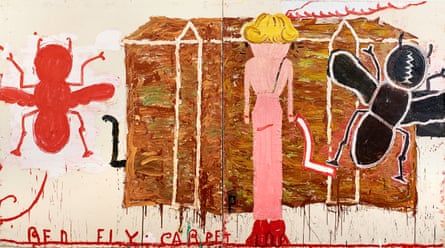
Marvellous contrast is at the heart of her work, which is driven not by theme or autobiography but by images she finds interesting – be they from a Roman mosaic, TV or early Renaissance art. It’s the vast mental leaps Wylie makes that give her paintings their energy and wit: a curving footpath in her garden becomes a gun becomes a tribute to Werner Herzog’s 2009 film My Son, My Son, What Have Ye Done? She talks me through a favourite canvas in the kitchen, an aerial shot of second world war bombs flying over the desert. “Doodlebugs did not go over the desert, they went from Calais to London.” Wylie points to a large silhouette at the bottom of the painting. “And here is a black duck, because that’s Arezzo, and Italian cities have emblems. Arezzo doesn’t have a duck, but I thought it’d be fun.” She put two women on the bomb wings, also “for fun”.
Fun is what it’s about. Wylie’s eyes are full of mischief as she explains her peculiar lines of thinking, while her adoring tabby, Pete, sleeps under her chin. All the work for the Royal Academy has been shipped, but four new canvases are stapled to the walls, two inspired by a fence. “The top of my garden used to be completely secluded – the ivy had taken over. But my neighbour needed a new fence, and men came with a digger and cleared the space. That was upsetting. But I’ve rescued the loss by making it into a painting.” She is calling the result, a bold diptych featuring a lemon-yellow house poking above an orange fence, Jumbo Meat Chopper, because the two elements make the shape of a blade. “I’m absolutely delighted with it.”
Sixteen years ago, Wylie was virtually unknown; today her work hangs in Los Angeles, Cologne and Ghent. The painting of Kidman in Kent, Black Strap (Red Fly), sold for £220,500 in 2021. After studying at Folkestone and Dover Art School in the 1950s, Wylie took 20 years out to raise her three children, and didn’t get her big break until 2010, aged 76, when she was selected for a group show at the National Museum of Women in the Arts in Washington DC. The same year Germaine Greer, then a Guardian columnist, came to visit.
“I got a note asking if she could talk to me, and at 9am she was at the door.” The two women looked through canvases for something Greer might buy. “She said she was absolutely knackered, because holding up all the paintings was physically hard. Germaine wrote a piece that was very helpful.” Afterwards, Wylie had a show in Hastings, a room at Tate Britain, and interest from New York, Moscow and Berlin.
Being a painter wasn’t something she felt she could combine with motherhood. “If you are involved, emotionally and mentally, in painting, which obsesses you, your mind is elsewhere. I decided it was better to be around. People say, ‘Are you angry?’ I was never angry, because working with children is full of creativity.” In the kitchen, there is a photograph of her smoking cigars with her daughter Henrietta and her son Luke John, now her archivist.
For a long time Wylie’s husband, painter Roy Oxlade, was the better known artist. He died in 2014: is she sad he is not here to share in her success? “Well, it can affect the other person. If you have two people painting and one person’s getting a lot of attention, then it’s not too hot for the other one. So it could have been difficult. But he was always supportive.”
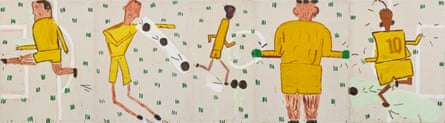
They used to watch Match of the Day together, which is where her interest in footballers began. Not just any footballers: they have to have a certain something. “I like monumental and I like wispy.” Ronaldinho made the cut, as did Thierry Henry, squat Wayne Rooney and wispy Peter Crouch: she painted them all flying around the same pitch in 2006’s Yellow Strip. Who catches her eye on TV now? Did she like The Traitors? “No. The one who runs it, visually she’s not my type. She’s too spooky. I like Isabelle Huppert, someone more metaphysical.”
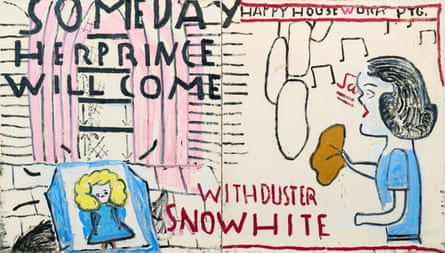
Wylie emerged from motherhood blazing with ambition. She remembers seeing Steve McQueen’s Turner prize-winning 1997 film Deadpan, in which a building repeatedly collapses around him, and wanting to do something as big and immersive. She painted at scale and entered every competition going, producing work that grew in confidence: Snow White dusting alongside the motto SOME DAY HER PRINCE WILL COME; an aerial view of Bayswater during the Blitz, where her mother moved the family in 1940.
She recalls those bombing raids as exciting but childhood doesn’t interest Wylie much. Until she was “five or four”, she lived in India, where her father was head of ordnance in the last years of the British Raj, south of Mumbai. When war broke out, they moved to England, where she inherited a Winsor & Newton paintbox. “My mother suggested I put it in the bath and clean it, but I resented that. I never wanted to clean the paint. I’m still the same.”
Wylie has been underestimated for much of her life – as wife, mother, late starter and model. In her 20s, she was painted for an Aero chocolate ad, a conventional portrait of a swan-necked beauty that she dislikes (“it’s just not very good”). Now she is making up for lost time, working until 3am on another show in Paris: a series that maps her house from the inside out; a dinner party with guests from Jane Austen. After that? “I would love to be in all the major museums, all over the world. I want to be part of the history of visual culture.”
What will she paint next? “I’m a big fan of Henri Rousseau’s painting Unpleasant Surprise. There’s a naked woman, a bear and a man with a gun.” Her plan is to replace the woman with Bette Davis, clothed. “Bette Davis has a good quality, whereas Betty Grable doesn’t. She’s rubbish by comparison.” Wylie is keen to explain the difference because it’s key to what she does: finding the thing that makes a painting roar into life. “Bette Davis is hugely more particular. She has a very strong mouth – a slub of a mouth. She’s good fun.”
Downstairs Sara has set the table for lunch and Pete is shooed off a meat pie. Wylie talks about the other artists she enjoys, the fun ones – Rachel Whiteread and Franz West, “because he stuck a turd on the front of a Rolls-Royce”. When it’s time for me to go, she hands me a giant scotch egg. “Eat it on the train,” she says. “Everyone will watch with envy!”