.png) 1 month ago
39
1 month ago
39
As an unbaptised agnostic raised with no religion, the closest I ever really come to a spiritual experience is when I’m standing in front of an artwork. Last week I went to Florence to do exactly that, drawn there not by Michelangelo’s David or Botticelli’s Birth of Venus, but by the works of Mark Rothko, that titan of US abstract expressionism whose work seems, on the surface at least, distinctly secular and un-Florentine. Yet seeing Renaissance art there had a profound impact on Rothko and his painting, as the exhibition Rothko in Florence makes strikingly explicit. Taking place at Palazzo Strozzi and two other satellite sites, it has been curated by his son, Christopher, and the author and independent curator Elena Geuna.
Is it embarrassing to admit that when confronted with the first large canvas I was drawn to I felt tearful? It was an emotion born of appreciation and astonishment but also – and this startled me – a feeling of gratitude. I felt profoundly lucky to be there, in front of this painting, not long after a time in my life where for various reasons I had been not been feeling all that fortunate at all. To have the chance to take in the paint on the monumental canvas, and absorb the ways the colours – purples, reds, oranges, yellows, blues – blend and in places seem to glow felt hugely significant to me personally. And then, as I continued to look – and as ever with Rothko – I stopped thinking about myself at all.
That’s the beauty of his art, especially in these self-referential times: the way it encourages the identity to break down and dissolve in the face of its contemplation. In that sense, its underpinnings are not so different from those of religious art; in this casting off of the self, then comes awe and wonder.
It is art as meditation, as secular worship. I felt it especially the next day at the former San Marco monastery, where the cells were frescoed by the great Fra Angelico with religious scenes for the private contemplation and worship of each monk. Rothko was overwhelmed when he saw these, having finally got to Florence aged 47, and wanted his own colour field paintings to provoke a similarly intense, spiritual response.
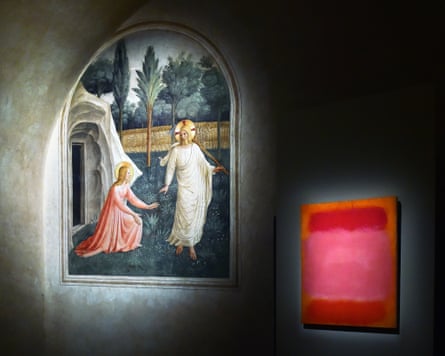
At San Marco some of these frescoes have been paired with works by Rothko in juxtapositions that highlight not only a subtle shared visual language, but their strikingly similar rationale. Rothko spoke of a painting being an experience, and believed in the importance of its quiet contemplation. The spiritual aspect to his practice seems most obvious in the form of the Rothko Chapel in Houston, Texas, a non-denominational place of worship that features 14 of his works in varying shades of black. But here, on a far smaller scale, and in a more uplifting colour palette, was a kind of holiness. My father, who was with me, was similarly moved.
Rothko probably wouldn’t have loved the distinctly un-monastic noise levels at the Palazzo Strozzi, nor the fact that groups of Italian schoolchildren were often looking through their phone screens. Yet when I eavesdropped on their interactions with the tour guide their responses were perceptive and authentic. “I love the yellow,” one teenage boy said. “Why do you think he chose it?” Rothko’s works are apparently being embraced by younger people. It has been suggested that they offer a refuge from the unceasing visual bombardment of infinite scroll. I think it goes beyond that, though: it is a search for greater meaning.
I got Rothko wrong when I was young. When I wrote about the 2008 Tate Modern retrospective, I did a whole pretentious bit referencing Sartre’s Being and Nothingness and the concept of original nihilation. These days I am older and don’t reach so much for theory. The dissolving, floaty response I feel is not so nihilistic. Yes, there’s an element of dissociation, but it isn’t frightening: instead there is a feeling of wholeness. Beatific joy is still possible if you know where to look, and though the schoolkids looked differently, they got it.
I won’t justify my belief in Rothko’s greatness. People who hate, or perhaps are threatened, by his paintings continue to object, and you can try arguing with them, but really all you can do is to recommend that they go and stand in front of one. Perhaps you won’t feel as overcome as I did, but I can guarantee that you will feel something. Afterwards, at the Duomo, I lit a candle for my brother, as I always do, and watched the glowing flame flicker and blur, merging with the darkness around it, ancient. That, I thought. That’s how it feels.
-
Rhiannon Lucy Cosslett is a Guardian columnist