.png) 1 month ago
62
1 month ago
62
He was the ultimate synthesist
David Hockney didn’t just appear out of nowhere like some fully formed artistic wunderkind. His work was a synthesis of so much that came before and was happening around him. He took the ideas of minimalism and abstraction, fused them with the traditions of portraiture, and filtered it all through the innovations in pop and conceptualism that were going on in the 1960s. He was heavily indebted to a lot of other artists, but he synthesised all those influences into something so simple, immediate, digestible and approachable that it became something new.
He was a working-class hero
Working-class boys from Bradford didn’t go to art school. It just wasn’t the done thing. That was for other people. But Hockney was born to subvert expectations. He told the Guardian in 2015: “When I went to art school, a neighbour said, ‘Some of the people in the art school just don’t work at all. Lazy buggers.’ And I said, ‘Oh I am going to work, don’t worry.’” And he did, incessantly, unstoppably, right to the very end.
He changed how we look at perspective
Hockney saw traditional perspective – with all lines leading to a single, distant vanishing point – as not just reductive and boring, but totally unrealistic. We don’t see the world as frozen and static, he thought, our vision is dynamic, constantly shifting. Reverse perspective was his solution: he shifted the vanishing point, putting it behind the viewer, or splitting it off in multiple directions. The result is sometimes dizzying, strange and disconcerting, but much closer to the truth of how we see the world.
He bridged the gap between photography and painting
Photography was central to Hockney’s practice for decades. In more recent years, he incorporated photos directly into his paintings, but his best work with the medium was his collages, where he took multiple snaps of the same thing from multiple angles (often with a Polaroid), creating kaleidoscopic visions of the world around him. The photographs fed into how he painted, and how he painted fed into his photography. The two mediums, by the end, almost became the same thing.
He made landscape monumental
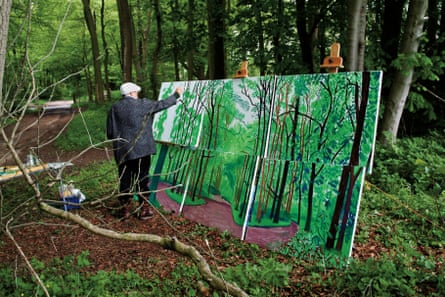
Yorkshire became Hockney’s muse in the mid-2000s, and he returned repeatedly to the undulating hills around Bridlington. In 2007, the forest in Woldgate inspired him to push the idea of landscape to its absolute extreme – he wanted to paint the countryside on a scale that was reserved by art’s big, important subjects: history, scenes from the Bible, national liberation. The resulting paintings were a vast, innovative, almost shocking attempt to elevate the everyday to monumental levels.
He was a technological innovator
He wasn’t shy about adopting new technology, and in his later years took to the iPad with abandon. Painting directly using a digital stylus or his finger allowed him to be immediate and direct. Many critics hated the iPad works, decrying the “loss of the artist’s hand” or describing them as “unaccountably messy”, but what’s incredible is that even on this new, digital, strange medium, his works are immediately recognisable. It doesn’t matter if it’s an iPad – it still looks like Hockney.
He defined the way we see Los Angeles
It took a boy from deepest West Yorkshire to truly capture the sun-drenched, humid beauty of Los Angeles. Hockney moved to California in 1964, and spent the next few decades creating hyper-stylised, ultra-cool visions of life among the palm trees, pools and PoMo architecture of Hollywood and its environs. When we think of LA and how it looks, we see it through Hockney’s lens.
His portraits made stars look human
Portraiture was at the heart of Hockney’s art from the very beginning. His images of his mother are tender and adoring, his portraits of lovers are intimate and sweet. It didn’t matter if he was painting a Rothschild or his cousin, a pop star or a studio assistant, he treated everyone with the same grace. By the end, some of the portraits got pretty patchy and splotchy, but what he never lost was his ability to convey his total love of painting, and his sitters.
He was an immersive pioneer
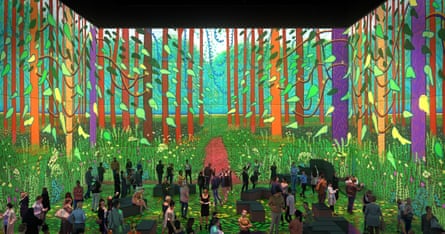
Immersive art became the trend du jour in all the big museums in the early 2020s, and Hockney wasn’t about to be left behind. He took over London’s Lightroom venue with Bigger & Closer (not smaller & further away) in 2025, part-autobiographical documentary, part-digital art exhibition. Just like with the Polaroids and iPads, Hockney saw the potential of new technology to shift perspective, and change how close viewers could get with the art.
He embraced theatre and opera
Hockney’s hugely simple, bold, colourful aesthetic lent itself perfectly to the stage. He designed the set for a production of Ubu Roi at London’s Royal Court theatre in 1966, and came back to theatre and opera design repeatedly throughout his career, working on productions of Tristan und Isolde, Turandot and the Magic Flute among many others, all filled with his paintings brought to life, his signature reverse perspective bringing the viewer right into the heart of it all.
He celebrated his horniness
Hockney’s earliest works were filled with carnal, libidinal imagery: enormous phalluses, bodies chaotically intertwined. They were very randy things, and that was a brave thing for a young gay artist to be doing back in the 1960s, even in swinging London. Hockney’s sexuality was always central to his work, and that helped pave the way for a lot of other gay artists to feel free to express themselves too.