.png) 3 months ago
77
3 months ago
77
The weekend of football threw up great dollops of drama and pathos. One of the tallest and most talented players in the sport buckled like a stricken baby giraffe. Arguably the best footballer in Australia was blanketed by an Irishman. The heart and soul of his club copped a knee to the head that may spell the end of his career. In Adelaide, 46,000 people stood to acknowledge a family that had lost a brother and a son.
We see variations of that every weekend. We see knee injuries and head knocks. We see teams squander winning leads. We see coaches fighting for their jobs. We see the brilliance of players like Nick Daicos, Nick Watson and Jeremy Cameron. It’s all neatly packaged, all easily explained, and all what keeps drawing us back. What we almost never see, and what’s harder to manage, to diagnose and to articulate, is what took place at the MCG on Thursday night. It didn’t come through the filtered lens of the host broadcasters or the curated feeds of the club itself, but through grainy footage from high in the stands.
A few years ago, I watched a friend’s son play in a school game and was immediately drawn to a kid floating across half forward. About half a dozen players in that match ended up being drafted, several in the very hit and miss “Covid draft.” But Elijah Hollands, who kicked six goals, was the one who stood out. He had what coaches called “the footy chip”. He had the spatial and situational awareness of a much older player. It was obvious at certain times this year as well, especially in the Good Friday game, that he was the only Carlton player you trusted with the ball in his hand.
From the moment the footage was uploaded on Thursday night, there was speculation as to what had happened – that he’d been drinking, that he’d taken illicit drugs, that he’d taken the wrong dose of prescription drugs, that he’d had a panic attack. His coach said he had an “off night”. The investigation will now be led by Laura Kane. There will be discussion about the AFL’s illicit drugs policy, especially from those who believe it is too lenient. There will be calls for a “Men’s Health Round” and to “get around one another”.
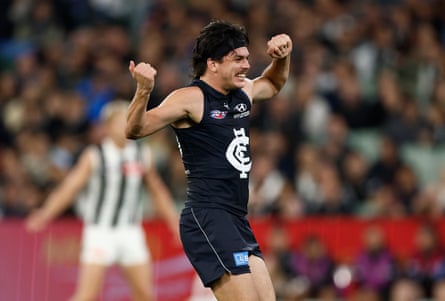
But most of that will miss the point, and dodge the core questions we should be asking – how was a footballer in such a vulnerable state allowed to keep playing? Where was the leadership, both on and off the field? How, in an environment where heart rates, heat maps, statistical printouts and wellness markers are constantly being pored over, could this have slipped through? How could a senior coach who operates from down on the bench with the primary objective of “building greater connection with his players” be so blasé when answering questions about what had occurred? How, in an environment that must rank among the most cosseted in the modern workplace – with an army of doctors, nurses, physios, psychologists, concussion spotters and line coaches at the ready – could he have been allowed to play in that condition? Why, when so many key people seemed to have missed or ignored the red flags, was it almost immediately picked up by punters in the nosebleeds section? And why can’t the CEO offer a better explanation than “we’re leaning into it?”
Footballers and sportspeople suffering from extreme anxiety is nothing new. In 2013, Mitch Morton told he would regurgitate his food before every training session and before every one of his 83 games. Prior to the 2012 grand final, a game he played a key role in, he didn’t sleep for three nights. Gavin Crosisca, a premiership teammate of Carlton’s CEO, self-medicated throughout his career, often on the day of games, with amphetamines and alcohol. Before games, James Hird would stand at the top of the race and lick his palms, a portrait of self-assuredness. But it was a construct. He almost never slept before games, and would agonise all night about playing poorly and being exposed in front of so many people.
All hid it well. All coped in ways befitting the era they played in and the men they played under. But footballers, and young people generally, are so much more open about discussing their challenges than the generations that preceded them. We saw it when Bailey Smith received his All-Australian blazer last year. We saw it in an interview Hollands did with The Age’s Peter Ryan, which was well handled by both parties, in which he spoke about self-medicating and panic attacks.
Anyone who’s had a panic attack, or a “mental health episode”, whether it takes place in their living room, on a crowded train or in front of 80,000 people at the MCG, knows about the helplessness, the terror and the embarrassment. The crucial thing is to have someone in the room, or in the vicinity, who immediately assesses what is happening and who is calm, firm and compassionate.
Football clubs often speak of the care they provide “within the four walls”. And that’s beyond dispute. What matters most however is the care they provide outside of the four walls. What matters most is the care they provide in the most naked environment imaginable – a full stadium, a TV audience of millions, and a pitiless social media ecosystem. That’s when vulnerable players are most in need of protection – with decisive action from a teammate, a medical professional, a coach, even an executive in the stands. Any investigation into Thursday night’s events at the MCG has to ascertain whether the club fulfilled its duty of care.