.png) 2 months ago
48
2 months ago
48
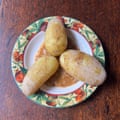
If you’ve ever visited the Canary Islands, you’ll be familiar with papas arrugadas – often translated, somewhat unappetisingly, as “wrinkly potatoes” – which pop up on every menu there. And not, generally, as a side dish, but as a standalone snack to be enjoyed with drinks. I do love a place that takes the spud seriously, and perhaps it’s not that much of a surprise, given that the first potatoes to reach Europe passed through the Canaries on their way from Peru, which, along with the similarity between the rocky soils of the Andes and the islands, probably accounts for the long history of cultivation.
Though many unusual early varieties are still grown for local sale, the Canaries imports both seed and fresh potatoes from the UK (king edward and arran banner have become quinegua and arambana). Once upon a time, ships would leave the islands laden with winter tomatoes for the British market, and return full of tubers. For this recipe, however, you’ll need new season potatoes with thin, delicate skins, and small enough to cook whole. Cooked in salty water until the salt crystals cling to them like frost, they’re served with a fiery dipping sauce that reflects the strong Portuguese and African influences on Canarian cuisine: an unusual but excellent way to celebrate our own early-summer crop.
The potatoes
At the time of writing, we’re in peak jersey royal season in the UK, and though it often seems a shame to do anything to these regal potatoes but serve them with butter, this preparation leaves them plain enough to appreciate their magnificent flavour. Use whichever new season local spud looks best to you; they should be small with skins delicate enough to rub off with your fingernail, but in extremis you could instead use the smooth-skinned, waxy older kind that are often sold as salad potatoes, though they won’t wrinkle in quite the same way (if you squint, the variety may well be printed somewhere on the bag, usually in letters small enough to suggest it’s classified information, but that’s a rant for another time).
The salt
Originally, it’s said, the potatoes were cooked in seawater, possibly reflecting the scarcity of fresh water in some parts of the islands. These days, most recipes call specifically for coarse salt. As it quickly becomes one with the water, I have no idea why, but, having tried both fine and coarse salt, fine grains seem to give an unpalatably salty result, so I’d steer clear of them and also welcome any intelligence in that department (could it be the speed with which fine salt dissolves and is thus absorbed?). You’ll need to temper your shock at the amount used: I haven’t quite gone as far as the recipe on the El Fondo para la Etnografía y el Desarrollo de la Artesanía Canaria website (Fedac – an organisation designed to protect and promote traditional Canarian heritage), which suggests using a quarter of the weight of the potatoes themselves. Yet, I think chef Frank Camorra’s 20g per kilo of potatoes is bit scant, even given his slightly unusual method; Jill Norman, who goes for a fifth of the weight in her book, Winter Food, seems to have arrived at a good compromise, though, in a token nod to general heart health, I’ve reduced that slightly to a sixth.
In truth, the exact amount of salt doesn’t really matter too much, because not all of the salt you add to the pan will end up on the plate – only the crystals that cling to the potatoes will do that – but you will need enough to coat the pan. More importantly, cooking the potatoes in highly salted water seems to give them a creamier texture and a more intensely, almost baked potato character. I notice this in my tests, but am at a loss to explain the phenomenon until I come across J Kenji López-Alt’s experiments with Colombian salt potatoes (though it’s unclear who, if any single region, can take the credit for the idea, it’s also a technique used in upstate New York). To quote him: “Potatoes cooked in heavily salted water lose a good 15% of their initial weight … presumably due to osmosis, the tendency of a solvent (in this case, the potatoes’ internal moisture) to travel across a membrane from an area of lower solute concentration (inside the potato) to an area of higher solute concentration (outside the potato). The result is a potato that has a more intense potato flavour and a denser, creamier texture (as opposed to the fluffier texture of plain boiled potatoes).”
The method
Camorra cooks his potatoes with a mere pinch of salt in his book Movida, then sautes the drained tubers with a couple of tablespoons of fine salt, which, though I’d never turn up my nose at a new potato, gives a result very similar to the usual boiled kind, albeit one that has had an accident with a salt shaker. Instead, it seems imperative to boil them with the salt, and I come across two broad approaches. The first, as espoused by Norman, Fedac and chef Omar Allibhoy, suggests boiling the potatoes until tender, draining them (Allibhoy retains a few tablespoons of water), then returning them to the hot pan and tossing them over a low heat until, to quote Norman, they are “wrinkled and finely coated with salt on the outside”. The second, favoured by José Pizarro, is to cook them until the water evaporates completely. This is much the easiest, but it does risk overcooking the potatoes, because, unless you have the perfect-sized pan for your spuds, as he no doubt does, it takes quite some time to boil dry, so it feels safer to stick with the first method.

Fedac notes that “there are those who prefer to cover the potatoes with water, so that they wrinkle a little, and those who like to put less water and cause them to wrinkle more”, adding “before, the potatoes were also covered with a cabbage leaf”. This cabbage leaf, presumably, traps steam, allowing the cook to use less water for the same job – the Spanish daily paper El Mundo recommends covering them with a cloth and a lid, one assumes for the same reason, and this seems the best approach to me, too (NB any large, stout edible leaf makes an excellent substitute). Fedac advises storing the cooked potatoes in or on cloth, either with or without a slice of lemon for flavour, to “prevent the potato from sweating”. Alternatively, just eat them immediately.
The mojo
Mojo, as Norman explains, means “marinade or sauce” in the New World, but not in Spain, while Marie José Sevilla suggests that “the word mojo derives from the Portuguese molho [meaning sauce] and it is more than probable that one or two of the original mojo recipes, particularly those made with coriander, came originally from Portugal”. Papas arrugadas are most often served with mojo picón, a zingy, red number that’s hot with chillies and garlic and tangy with vinegar, but you may also see them served with mojo verde, which is flavoured with herbs, usually coriander or parsley, instead (Pizarro has a recipe on Food52). Here, I’ve chosen to focus on picón.

The piquancy in its homeland comes from the native picona or the startlingly named pimientas de la puta madre, both of which are hard to get hold of abroad. Picona, also known as palmera, usually comes in at between 8,000-20,000 units on the Scoville scale that’s used to measure chilli heat (which is equivalent to or a little hotter than a jalapeño). Recommended substitutes online include guajillo, serrano and cayenne, and that last one is something many of us have on hand in powdered form.
Using cayenne alone, we miss the fruitiness of the fresh red bell peppers in Pizarro and Camorra’s recipes, while finding the results a little sweet for our taste – I’ve substituted a mild red chilli of the kind you can readily get in UK retailers, though they’re generally coy about the actual variety (a rant for another time). Camorra, Allibhoy, the Tenerife Tourist Bureau and Pizarro all include sweet (ie, not hot) smoked paprika, too, which I like for its colour and richness of flavour; Camorra also pops in the hot sort, though I don’t think that’s necessary, given the cayenne in mine.
The other spice that pops up in most recipes is cumin, which contributes a pleasant, earthy back note (toast the seeds first, as Camorra directs, for maximum flavour). This works particularly well with the mandatory garlic; add it to taste, bearing in mind that some of the recipes, including the one from Fedac, call for a startling six cloves. Vinegar-wise, Camorra specifies sherry, but, as Allibhoy says, anything but balsamic will do (my own caveat: malt will probably taste a bit weird).

Traditionally, vinegar-soaked bread was used as a thickener, but because my mojo is specifically designed to accompany potatoes, I think a thinner consistency is preferable. Last, of course, there’s oil, usually olive, but in this case, and given the strength of the other flavours, you could probably get away with a neutral oil instead. (Note that there aren’t any particularly tough ingredients involved, so the sauce can be easily made in a pestle and mortar as well as a more modern mini chopper.)
Lovely as a starter or nibble, these potatoes are also a great accompaniment to fairly plain barbecued meat or fish (though, in the latter case, you may want to offer a mojo verde, too).
Perfect papas arrugadas
Prep 10 min
Cook 20 min
Serves 4
600g small new potatoes, all roughly the same size
100g coarse sea salt
For the mojo picón
1 tsp cumin seeds
1 pinch salt
3 garlic cloves, peeled and roughly chopped
1 mild-medium red chilli, stalk, pith and seeds removed and discarded, flesh roughly chopped
1 tbsp sweet smoked paprika
¼-½ tsp cayenne pepper, to taste
50ml vinegar (not balsamic or malt)
150ml olive oil, or neutral oil
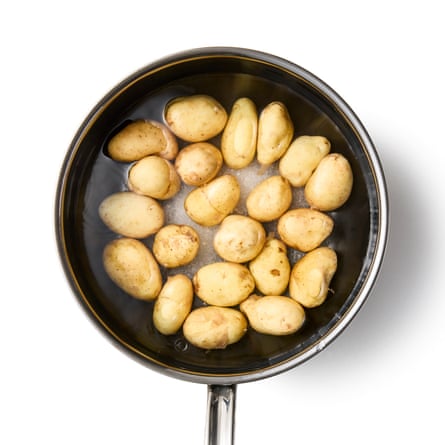
Give the potatoes a scrub, if necessary, but don’t peel them. Put the spuds in a wide pan that’s just large enough to hold them all in a single layer, then add the salt (don’t be alarmed: you won’t end up eating all of it!). Almost, but not quite, cover with cold water.
Put a clean cloth or a large cabbage leaf on top of the potatoes, to cover them, then pop on the pan lid. Bring to a boil, then turn down the heat and simmer for about 15-25 minutes, until cooked through.
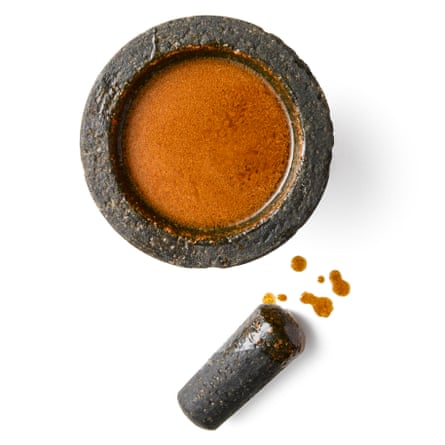
Meanwhile, make the mojo. Toast the cumin seeds in a dry pan until fragrant, then grind to a powder with a pinch of salt. If using a pestle and mortar, add the garlic and pound to a paste, do the same with the chilli, then add the paprika and cayenne (start by adding just a quarter-teaspoon) and vinegar. Gradually beat in the oil until everything’s well mixed, then adjust the seasoning to taste, remembering the extreme saltiness of the potatoes. If you have a mini chopper or stick blender, you can just whizz everything up.
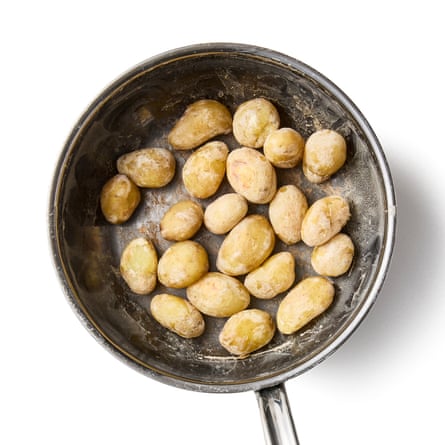
Drain the potatoes and return them to the same pan over a low heat. Cook, shaking the pan to ensure they don’t stick, until coated in salt, then either serve immediately with the mojo or wrap the pan in a tea towel until you’re ready to eat.
-
Papas arrugadas: have you had the pleasure while in the Canary Islands (or, indeed, farther afield), and if so, what was your verdict? Too much salt for your taste, or a real holiday treat? And whether or not you like your spuds salty, which other mojos would you recommend as an accompaniment? (NB: ketchup is not a mojo).