.png) 1 month ago
61
1 month ago
61
Almost as soon as film was invented, it became apparent that boxing was a prime candidate for a spectacle to be showcased by the nascent artform – and to help develop it. Small wonder: as new technologies sought to capture high-stakes emotion, physical intensity, furious spectacle, rivalry and personal turbulence, boxingseemed uniquely capable of absorbing these narratives. That it straddled the class gap further expanded its appeal in this new entertainment – one which would itself foster fresh interest in the sport.
The first sports film was an 1894 short of a six-round match between Mike Leonard and Jack Cushing. Only 23 seconds survive, yet its impact still smarts, 132 years on. Scores of directors have since been drawn to pugilistic stories: everything from prize fights to amateur spars to bare-knuckle brawls. In fact, no sport has been rendered cinematically to quite the same degree, whether through dramas, biopics or documentaries. The British Film Institute’s new season, The Cinematic Life of Boxing, studies this long, symbiotic fascination, and how film has successfully tapped into the sport’s psychological, sociological and political dimensions.
Its curator is Clive Chijioke Nwonka, an amateur boxer since his childhood in London. He thinks that an uncompromising hunt for realism is central to the relationship between the sport and artform. The films he has programmed have “all interacted with that sense of human experience, poverty, struggle, triumph, and with boxing as a sport but also as a way of life”. Unlike football or cricket, boxing is a direct confrontation between two people, whose pressures and intensity are easily legible.
Boxing films usually have their share of stock characters: the underdog fighter eyeing his golden ticket, the showboating champion, the shady promoter, the cynical old trainer blowing the dust off his coaching mitts. But the films for the BFI season have also been selected for their suggestion of the sport as a kind of mood music for working-class lives. Films such as Fighters, Ron Peck’s 1991 ode to East End identity, as well as Visconti’s Rocco and His Brothers (1960) are, he says, “invested in questions about family, mobility, endurance and survival that really transcend genre, approach and time”.
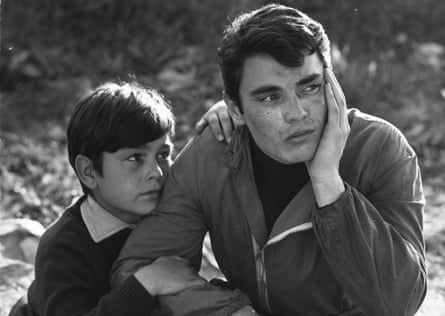
Boxing films often also capture a political zeitgeist. In 1974 in Zaire (now the Democratic Republic of the Congo), Muhammad Ali faced off with George Foreman in the “Rumble in the Jungle” heavyweight championship match. The clash was not purely pugilistic, but also a referendum on ideology during the civil rights era: Ali was the embodiment of Black nationalism, while Foreman represented the vanguard of establishment liberalism. It was, says Nwonka, “the greatest and most significant fight of all time”, and the subject of 1996’s When We Were Kings – “probably the greatest sports documentary of all time”.
Boxing films are not limited to high-stakes fights as a synecdoche for broader political spats. Clint Eastwood’s multi-Oscar-winning Million Dollar Baby about a female fighter, Maggie (played by Hilary Swank), challenges the sport’s deeply rooted misogyny. The film most foundational in the annals of boxing cinematic history, though, is, at root, a granular reflection on class and the difficulties of escaping it.
Since its first outing in 1976, Sylvester Stallone’s Rocky franchise has spanned six films and a spin-off series, Creed, under the direction of Ryan Coogler. “The Rocky franchise is quintessential boxing chum,” Nwonka says, “especially for what was at stake for Stallone and what he had to do to ensure he had a presence in the film beyond being a screenwriter”. Studios wanted Stallone’s script, but wanted another actor to star; cash-strapped Stallone fruitfully stuck his ground. “I’ve been boxing for many years and you’ll seldom find any boxer who hasn’t been influenced to take up the sport either by seeing a Rocky film, or having a Rocky film referenced by someone else.” That means that Rocky is not simply a Hollywood project, but one that moves beyond those constraints and into the world of the sport itself.
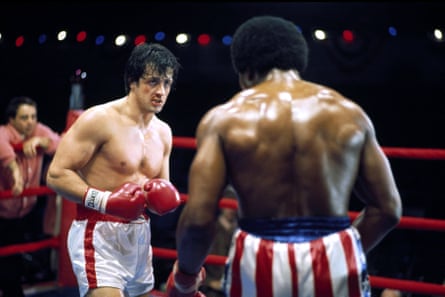
The Rocky franchise has been a barometer for all the films captured in its wake, but the first film remains the hallmark of sporting cinema. While it has sometimes been criticised for its inexpressiveness, the stoical qualities of the film and Stallone’s titular caricature remain an ambitious template for many boxing films: it successfully captures the habitual experience of the sport, outside its more glamorous moments. That adds real credence to a story of a mid-30s, down-on-his-luck boxer who gets a second chance at a world title – from which more universal themes around self-actualisation, self-respect and love can spring. The beauty of Creed is that as a reiteration of the franchise, it has brought the world of Rocky to a new generation. In marrying both series, there is a cross-pollination between the past and the present.
Yet the genre, more than most sports movies, has proved no stranger to cliche – in part the fault of their proliferation, in part the necessary beats of the fights themselves. Indeed, the recent box office flop and failed Oscar-bait film Christy, starring Sydney Sweeney as female boxer Christy Martin, was widely scorned for what many perceived as paint-by-numbers storytelling. With so many boxing films and only so many stories to tell, how does the genre remain fresh?
“I think there is always a danger or trap door of making assumptions about an audience,” says Nwonka, “and the easiest route for getting a project reneged is taking a noted figure and adding some dramatic licence.”
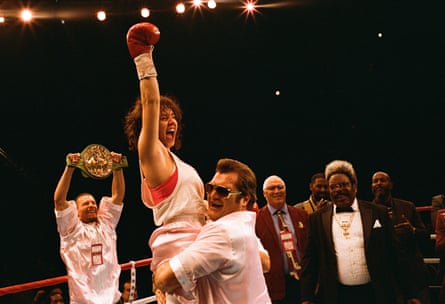
With Christy, he says, “the exigencies of Hollywood hurl a particular person into a role for reasons that are beyond accuracy, suitability or convincingness” – and that often leads to failure. One other aspect is a misguided emphasis on the physical aspect of boxing which too often leads to endless training montages. It means that many boxing films are weighted down by scenes of bodily transformation – pumping muscles, runs across mountainous landscapes, skipping ropes – rather than the broader life cycle of a boxer.
Fight scenes that are too artificial are also a problem, with many real boxers naming such scenes as their main gripe with boxing films. But works such as Martin Scorsese’s Raging Bull, in which the fight scenes are “quite rough, punishing and brutal” meet the mark. Indeed, that film’s careful but savage choreography well communicated the unflinching, visceral reality of being in the ring. It’s Thelma Schoonmaker’s editing – closeup punches, flashing lights, blood dripping off the rope – which showcases those grisly aspects that make for good cinema, as opposed to endless shots of press-ups and abs.
Across the films selected for the season, it is the elasticity of boxing stories that have meant that they have endured for so long. Even if familiar arcs and tropes are still relied on, the best film-makers are able to return to what is the core of these films: the stakes of signing up for a fight, and the physical, psychological and real monetary costs of endurance. That is a reflection of the human condition, which is universal and generational. And so the dance between film and boxing pivots on, reframing old contests for new audiences.