.png) 2 months ago
56
2 months ago
56
The complex operation to repatriate passengers and crew of the hantavirus-hit cruise ship, the MV Hondius, is almost complete.
Up to 150 people have started flying home aboard military and government planes from Spain’s Canary Islands, and the World Health Organization has recommended, but not mandated, a 42-day quarantine once they have landed.
Here’s what we know about how different countries are managing quarantine.
How did cruise passengers and crew leave the hantavirus-stricken ship?
Passengers wore blue medical suits and breathing masks as they disembarked MV Hondius on to smaller boats, according to observers. Those boats docked at a small industrial port in Tenerife. Evacuees then boarded Spanish army buses and travelled to an airport. A protective board separated drivers from passengers.
Evacuees then changed into new protective equipment and pictures showed them on the tarmac being sprayed down by medical officers before boarding repatriation charter flights.
Will hantavirus cruise ship passengers quarantine when the flights land?
The WHO recommends a 42-day quarantine and “active follow-up”, including daily checks for symptoms such as fever. The 42-day quarantine can be carried out at a staffed facility or in isolation at home.
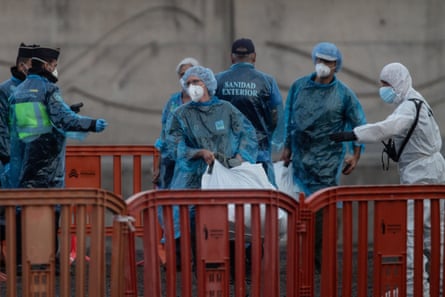
Some health experts are concerned people may not strictly isolate for six weeks. The WHO chief, Tedros Adhanom Ghebreyesus, says his organisation does not ‘force’ its guidance.
Will countries manage hantavirus quarantine and isolation differently?
It’s still unclear. In the UK, the NHS says people will undergo medical tests at Arrowe Park hospital, near Liverpool. The group will initially stay for 72 hours, and arrangements for further isolation assessed.
In Australia, passengers will be taken by ambulance to a hospital to undergo assessment and establish suitable quarantine arrangements. The facility in Sydney’s west has been designed to treat patients with “high consequence” infectious diseases, such as Ebola. It has a dedicated elevator from a helipad and ambulance bay, and its own sewage treatment plant.
France said all of its evacuees – one who is now symptomatic – “have immediately been placed in strict isolation until further notice”. The French prime minister said he would issue a decree to authorise appropriate isolation measures to protect the public.
Are some countries enforcing stricter hantavirus rules?
Yes. Greece’s health ministry said a male evacuee will spend 45 days in mandatory hospital quarantine in Athens. Authorities said the man will be placed in a specially prepared negative-pressure chamber at Attikon university hospital.
In Spain, 14 citizens will be placed in biosafety isolation beds at the Gómez Ulla military hospital in Madrid.
How about the US, as it is no longer a WHO member?
The acting director of the Centers for Disease Control, Dr Jay Bhattacharya, says the 17 Americans and one British national who reside in the US will be flown to the University of Nebraska. At a quarantine facility, their risk levels for spreading the virus will be assessed. After that, they will be given the choice of staying in Nebraska or going home, where their conditions would be monitored by state and local health agencies.
The US health department confirmed on Sunday that one evacuee has mild symptoms and another has tested mildly PCR positive for the Andes strain of the virus.
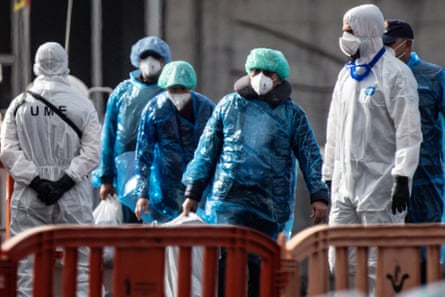
Perhaps complicating matters, some Americans are already back in the US, having disembarked the ship in Saint Helena in the South Atlantic Ocean on 24 April. At least four states – Arizona, Virginia, California and Georgia – are monitoring them.
In January, the US officially withdrew from the WHO. Some experts questioned if that would weaken US access to global virus and disease databases.
What happens to the hantavrius-affected ship and its crew?
The ship should be inspected for rodents, disinfected and ‘appropriate rodent control measures implemented’, the WHO says. Staff involved in the operation should wear PPE including eye protectors, respirators, gowns, and gloves.
The Philippines government has confirmed 38 Filipino seafarers working on the ship will quarantine in Rotterdam before repatriation home.
India confirmed that two of its nationals on board the ship, working as crew, had been evacuated to the Netherlands where they will be quarantined. They have been described as “healthy and asymptomatic”.
What is the public health risk?
Three passengers – a Dutch husband and wife and a German woman – have died, and a small number have fallen sick with the disease. But officials have so far stressed the risk for global public health is low.
‘This is not another Covid. And the risk to the public is low. So they shouldn’t be scared, and they shouldn’t panic,’ Ghebreyesus said.
With agencies