.png) 1 month ago
53
1 month ago
53
Asia-Pacific markets hit by Iran ultimatum
Donald Trump’s threat to ‘obliterate’ Iran’s power plants unless the strait of Hormuz reopens is hitting global stock markets today.
A wave of selling is sweeping through Asia-Pacific markets at the start of the week. Japan’s Nikkei has dropped by 3.4% in afternoon trading, China’s CSI 300 has lost 2.8%, and South Korea’s KOSPI index has slumped by 6.5%.
Trump’s ultimatum, and Tehran’s threat to “irreversibly destroy” essential infrastructure across the Middle East in response, means the war is entering a new phase of escalation, analysts warn.
Markets are finally starting to wake up to the gravity of the potential for long-term impact on energy markets, reports Neil Wilson, investor strategist at Saxo UK.
This is an escalatory doom loop – or ‘escalation trap’ with currently no realistic off-ramp. Neither side has an incentive to back down as the costs of doing so are increasing day by day. Each side thinks pushing harder will force the other to back down.
As well as fears of escalation in the conflict, investors are also bracing for rises in interest rates this year, with central banks under pressure to fight a rise in inflation.
Key events Show key events only Please turn on JavaScript to use this feature
Some economists think the money markets are getting carried away by anticipating four quarter-point increases to UK interest rates this year.
Goldman Sachs, for example, have recently predicted rates will remain on hold though 2026.
They told clients on Friday:
While the inflationary concern may be less than 2022 it is growing, and the message from the Bank of England meeting this week was hawkish, and our economists now think that the MPC will remain on hold for longer and maintain Bank Rate at 3.75% throughout 2026 (versus quarterly cuts from July previously).
They see the Committee gradually normalising policy next year to reach an unchanged 3% terminal rate
The pan-European Stoxx 600 index has also fallen into correction territory, dragged down by those losses in London, Frankfurt, Paris, Milan and beyond.
The Stoxx 600 index is down 1.7% at 563.33 points, more than 10% off its high on 27 February.
UK borrowing costs climb
Britain’s government borrowing costs have risen to a fresh 17-year high this morning.
The yield, or interest rates, on 10-year UK gilts has gained 7 basis points (0.07 percentage points) to 5.05%, its highest level since July 2008.
Yields rise when bond prices fall.
Shorter-dated, two-year gilt yields are rising too – up almost 11bps to 4.66%, which looks to be the highest since May 2024.
Britain’s FTSE 250 share index has tumbled by almost 2.5% today.
The FTSE 250 index contains companies too small for the blue-chip FTSE 100 index, and is seen as a better gauge of the UK domestic economy.
Spire Healthcare (-20%) are the top faller, after takeover talks with two private equity firms Bridgepoint and Triton ended without agreement last Friday.
FOUR UK interest rate increases expected this year
City traders are now betting that the Bank of England will raise interest rates by a full percentage point this year!
The money markets are now pricing in 100 basis points (one percentage point) of increases to UK Bank rate by the end of December.
That would lift rates back to 4.75%, up from 3.75% today – implying four quarter-point increases in rates (or a smaller number of larger hikes).
Last week, after the Bank left rates on hold, governor Andrew Bailey suggested the financial markets were getting ahead of themselves in expecting interest rate rises from the BoE this year.
But investors seem increasingly convinced that it will tighten monetary policy, in an attempt to prevent higher energy prices causing ‘second round’ effects (increased wages and prices)
IG: recession chances rising by the hour
Chris Beauchamp, chief analyst at IG, says:
“Investors who have spent the weekend watching fresh strikes in the Middle East are now waiting to see what will happen when Trump’s 48 hour deadline expires tonight. But they are in no mood to hang around, and have continued to sell stocks and precious metals.
Each day that the war goes does more damage to the global economy and drives inflation higher, with recession chances rising by the hour.”
European stock markets join the sell-off
The stock market sell-off that began in Asia-Pacific markets overnight has spread to Europe.
The main indices are all down sharply at the start of trading:
-
UK’s FTSE 100: – 1.5%
-
Germany’s DAX: -1.9%
-
France’s CACX 40: -1.5%
-
Spain’s IBEX: -1.8%
Traders are responding to a weekend of heightened military action and rhetoric in the Middle East, says Derren Nathan, head of equity research at Hargreaves Lansdown:
The US President has given Tehran until the end of today to reopen the Strait of Hormuz or risk strikes on the country’s power generation facilities. So far, there have been no signs of Tehran backing down, but international diplomatic efforts, including a late-night Sunday call between Donald Trump and Sir Keir Starmer, have intensified in an attempt to avoid further escalation.
FTSE 100 falls in correction territory
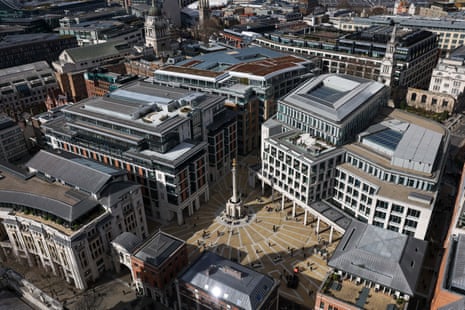
Newsflash: the UK’s blue-chip share index has dropped into correction territory, as fears over the Middle East crisis hit share in London.
The FTSE 100 index has dropped by 154 points at the start of trading, a loss of 1.5%, to 9764 points.
That means it has dropped by more than 11% from its record high set on 27 February, just before the Iranian war began.
A fall of 10% or more is classed as a correction.
Almost every share on the FTSE 100 is down, led by precious metal miners Endeavour Mining (-5%) and Fresnillo (-4.9%).
Rolls-Royce (-4.4%) which makes and services jet engines, and British Airways parent company IAG (-3.2%), are also among the top fallers.
Fears that the spike in energy prices will hurt economic growth are weighing on metal prices today.
Copper has fallen to a over three-month low this morning; the benchmark three-month copper contract on the London Metal Exchange has fallen by more than 1.5% to $11,742 a ton, its lowest since December.
Gold is continuing to tumble – it’s now down by more than 6% at $4,218 an ounce.
Quite a reversal, given it hit almost $5,600 an ounce in late January.
Kathleen Brooks, research director at XTB, says:
Last week, the gold price lost the $5,000 handle, this week the $4,000 handle looks like it is at risk. This means another bruising day could be on the cards for UK equities, after heavy losses for the UK-listed gold miners last week, Antofagasta and Fresnillo both saw their stock prices drop 10%. Aside from oil majors and a trickle of well-received corporate news, there are few hiding places for stock investors at this stage of the conflict.
BBG: Two Indian LPG carriers in transit through strait of Hormuz
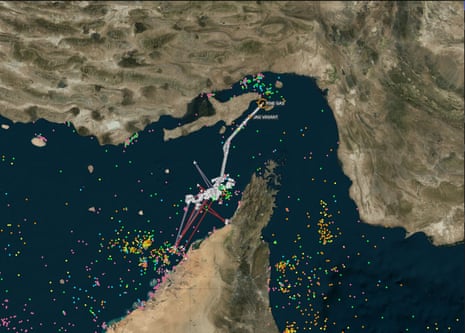
Bloomberg has spotted that two Indian-flagged vessels carrying liquefied petroleum gas are making their way through the Strait of Hormuz, taking a route close to the Iranian coastline.
They reportt:
The Jag Vasant and the Pine Gas, two India-flagged very large gas carriers flagged to India, traveled northwards from the UAE coast toward Iran’s Qeshm and Larak islands early Monday, ship-tracking data show.
The two supertankers were signaling Indian ownership instead of a destination, but are likely to be heading to India, which has been facing acute shortages of LPG, used as cooking gas. The pair follow two other Indian-flagged LPG vessels that made the transit earlier this month.
And here they are: