.png) 1 month ago
43
1 month ago
43
France ’98, when Scotland last faced Morocco at a World Cup – as they do this Friday – and lost a crucial game three-nil. (John McGinn’s winner against Haiti in Boston on Sunday rewrites all the recent records and sets the team on a path to almost certain glory this time around. Obviously.)
But you could have read the runes of Scottish doom in that World Cup by the tunes that Scotland fans had in their ears. Scotland’s song that year was Del Amitri’s masterpiece of melancholy, Don’t Come Home Too Soon, the most downbeat, honest, and lyrical World Cup song ever written – alas, the team didnae listen. And there was the BBC’s World Cup titles for 1998: Fauré’s Pavane, which lifted the moodometer from melancholic all the way to apathetic. (Not that England did much better, despite the surreal street party of Vindaloo, Engerland’s unofficial anthem, and the self-satisfaction of Three Lions, they went out in the round of 16, after David Beckham’s red-card against Argentina.)
In using Fauré for football, the BBC were building on a long history of the beautiful game and classical music, which have always gone together like Scott McTominay and majestic overhead kicks. Edward Elgar’s contribution to Wolverhampton Wanderers’ musical heritage sadly isn’t still sung on the terraces, but his scoring of “He Banged the Leather for Goal!”, setting words he’d read in a match report about his beloved Wolves, might be the first bespoke football chant by a major composer, written in 1898. (It’s also a harmonically dense and chromatically complex wee tune.) Dmitri Shostakovich’s football obsession – he was devoted to the team that’s now called Zenit St Petersburg – was marked in 2016 when Zenit celebrated their 90th anniversary with a Shostakovich-themed pre-match show, inspiring them to beat Spartak Moscow 4-2. And listen to the Football March movement from Shostakovich’s ballet The Golden Age from 1930 to hear how Shostakovich created the drama and noisy energy of a team in orchestral sound, starting with the referee’s whistle and plunging into chaos on the park.
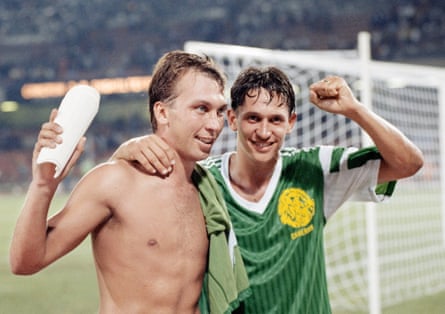
But the moment when football and classical music became indelibly linked was the summer of 1990, when the BBC used Luciano Pavarotti’s rendition of Nessun Dorma as the theme tune for its coverage. Puccini’s aria from his final opera, Turandot, (Nessun Dorma means none shall sleep) tells of Calaf’s plea for insomnia. Princess Turandot has a single night to learn his name. If she succeeds, she can execute him, if she remains ignorant of her suitor’s actual name, she has to marry him and Calaf will be victorious. (Spoiler alert – Calaf wins Turandot’s heart by the end of the show.)
But none of that context was important for the significance of the high As and Bs at the end of the aria (also sung by the Three Tenors as a triple-headed Calaf at their concert on the eve of the final of Italia 90 in Rome) It’s a freak of performance practice, by the way, that the highest and most famous note in the whole aria, that final high B, was marked by Puccini in the score as a slightly slowed-down semiquaver – it should be a very short note. But that “vinceroo-oooo” (I will win) is extended by Pavarotti et al into a whole bar and more, dozens of times longer than Puccini intended. Tenors gonna sing, tenors gonna milk it. Germany duly did win, beating Argentina 1-0.
Current proof of the ongoing classical connections that bind football fans together is the team- and nation-crossing phenomenon of the White Stripes’ Seven Nation Army, which is sung everywhere from club matches to international fixtures from Bruges to Boston. (Club Brugge KV was where it all started in 2003) And, as every fool knows, Jack White borrowed his riff from the first movement of Bruckner’s Fifth Symphony – alas a story too good to be true. White came up with the riff at a sound check in Melbourne, consciously or unconsciously drawing on Bruckner’s symphony.
Yet the musical connection is real. So even if the BBC and ITV have ditched any classical references in their title sequences for this current World Cup, they can’t take Bruckner out of the terraces.
This week Tom has been listening to: {oh!}Orkiestra’s new recording of Mozart’s 29th Symphony and Janiewicz’s Fifth Violin Concerto. It’s the freedom that Martyna Pastuszka and her players dare with all of this repertoire, and the Mozart in particular, that’s wonderful: here’s a symphony that sounds like a collective improvisation from the musicians – and the fortepianist in particular. There’s no other recording of the symphony like it. Listen on Spotify