.png) 3 months ago
73
3 months ago
73
According to the UN 68% of the global population will be urban dwellers by mid-century. Urbanisation at this rate, unprecedented in modern times, means cities are facing an equally unprecedented convergence of crises, from a shortage of affordable housing to increased traffic congestion causing pollution, while reducing safety and liveability.
The consequences are exacerbated by the climate emergency bombarding many regions with severe heatwaves, rainfall, flooding and other extreme weather events. While everyone will feel the effects of these changes, the fallout from failing to cater for them is disproportionately felt by the most vulnerable groups.
The status quo in many cities is to design them for private vehicles, based on the assumption that nearly everyone can and will need to drive. This overlooks the reality that for children, but also many women, older adults and people living with disabilities, this is simply not an option.
More cars means less space to walk, cycle, push a pram or use a mobility aid safely. It means the stress of navigating noisier and more congested streets. Ultimately it means less diversity in street activity.
Conversely, in cities such as Delft in the Netherlands, where we live, authorities have worked for a better balance of space allocation for walking, cycling, public transport and motor vehicles. As a result, Delft’s public spaces are vibrant and active with all types of people moving in social and connected ways. As our family discovered after moving here from Canada, children are able to roam more freely, older adults and disabled people maintain access to their communities, and women feel safer to travel independently.
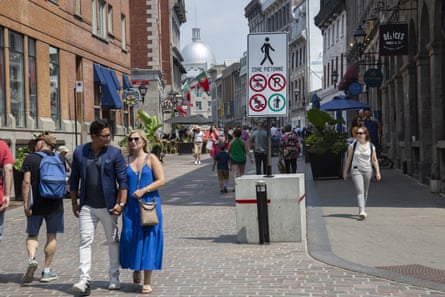
Car-free Rue Saint-Paul in Montreal, Canada. Photograph: Ralph Lauer/Zuma Press Wire/Shutterstock
Given the challenges that city dwellers face, what’s needed is an unprecedented shift in how governments approach infrastructure and policy. But in the vast majority of cities, small pockets of vested interests are digging in to loudly defend a system that works for them. Many city or local politicians mistake the volume of defiance as being representative of the larger community and fall back on empty rhetoric, and ultimately inaction.
But a minority of elected officials have demonstrated that opposition rarely reflects the true popularity of more inclusive urban transformation measures. In many cases, female leaders are spearheading change. Through their own experiences navigating the world as girls and women, as carers, and through decades of being invisible in the planning process, they often understand best that the status quo is not working.
In Barcelona, during Ada Colau’s recent mayoralty, the administration reclaimed a million square metres of pedestrian space, using solutions like the “superblock”, a revelatory intervention that swaps the city’s asphalt expanses for neighbourhood plazas with paint, planters and political will. Over an eight-year period, she tripled the length of cycle lanes to 273km (170 miles), putting 90% of the population within 300 metres of at least one route. The results have been quite dramatic, with city officials citing the creation of 80 new hectares of green space, a reduction in car traffic of 50% and a cut in air pollution by 20% between 2019 and 2023.
In Montréal, Canada, Valérie Plante, who served as mayor from 2017 to 2025, rolled out the most ambitious car-free scheme on the American continent, investing C$12m (£6.5m) to pedestrianise more than 9km along 11 different commercial arteries each summer; opening the streets in front of 2,100 local businesses, and improving their bottom lines. She is also the driving force behind the city’s Réseau express vélo (Express cycling network), which, when complete, will consist of 17 routes spanning 191km of protected lanes maintained throughout the year. Alongside improving how Montréalers move and enjoy their streets, Plante’s “sponge streets” programme is helping to create permeable and absorbent surfaces to offset flooding by introducing green in place of grey asphalt.
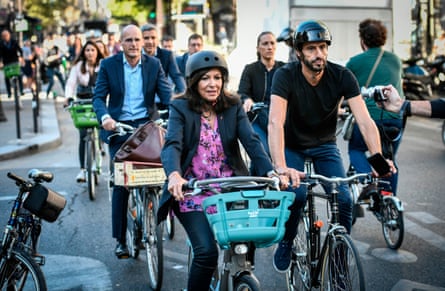
Paris’s famously car-choked streets are finding new life thanks to Anne Hidalgo who, as mayor until last month, transformed the French capital. Hidalgo faced fierce criticism but ultimately found public support for her incredibly ambitious introduction of cycling infrastructure, pedestrian streets and public transport. Investments throughout her tenure include 1,000km of cycling routes, 350 of which are protected from traffic, with a further €250m (£218m) dedicated to growth of the network. Paris is also well on its way to the realisation of 300 school streets (pedestrianising streets near schools), alongside re-greening efforts that will see the removal of 70,000 car parking spaces, and the planting of 145,000 trees and 45km of parks.
These success stories are a result of trailblazers seeking to meet the needs of everyone, not just those with the greatest means or loudest voices. The qualities shared by these changemakers suggests a commonality in how women approach their roles: practising the radical act of empathy, presenting a multi-faceted and long-term vision, valuing the role of care in the daily functions of their cities, building broad coalitions and the need for a firm grip over them to retain power. Of course, these leadership qualities are not – and cannot be – exclusive to one gender.
Regardless, the need for more gender balance in leadership is indisputable. Only 25 of the world’s 300 largest cities have female mayors. Just 5% of municipal leadership positions and 10% of the highest-ranking roles in top architecture and urban planning firms are filled by women. We know that, despite the best of intentions, leaders make decisions based on their lived experience. If they have never experienced navigating the street with a small child, or carried the fear of violence walking alone at night, it can be difficult to have these issues at the forefront of their mind.
Across the world we see that cities whose decision-makers truly reflect the diversity of the places they represent are more likely to have public spaces and mobility infrastructure that benefit the lives of everyone.
-
Melissa Bruntlett and Chris Bruntlett are co-authors of Women Changing Cities: Global Stories of Urban Transformation. Melissa Bruntlett is director of the mobility consultancy Modacity Creative. Chris Bruntlett is international relations manager at the Dutch Cycling Embassy