.png) 2 months ago
65
2 months ago
65
Every two years the art world assembles in Venice for a sprawling celebration of visual arts at which countries “compete” against one another for the prize of best national pavilion. It is a barometer of taste, a shop window for artists and the industry’s biggest get-together – once described by the art historian Lawrence Alloway as an “orgy of contact and communication”.
This year, 99 countries are involved, including Somalia and Qatar, which are among seven first-time participants in an event that was overshadowed by the death of its curator, Koyo Kouoh, just over a year ago. She wanted an event that focused on “enhancement” with a main show called In Minor Keys. Despite the call for calm, a combustible mix of politics and protest punctuated the preview week. The activist group Pussy Riot turned up on site to object to Russia’s inclusion and a strike on Friday in protest at Israel’s inclusion caused several pavilions – including the UK, Austria and France – to close their doors.
Here is a roundup of the key takeaways.
1. Female nudity was everywhere
Austria and its naked speedboat riders, the Danes and their porn stars worrying about men’s sperm counts, Richard Prince’s Girlfriends pictures appropriated from old biker mags. Some of the women watching didn’t much like it – or at least asked where all the men were. The feminist activist group Femen’s involvement with Pussy Riot also involved their signature topless protest.
It’s All Over by Richard Prince. Photograph: David Levene/The Guardian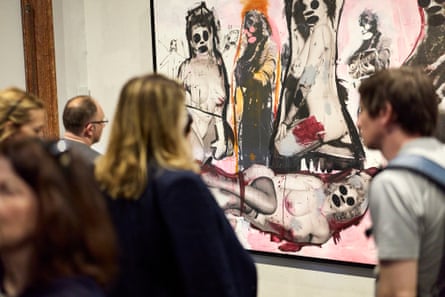
2. How do you deal with Russia?
The presence of the Russians at the biennale for the first time since the country’s war with Ukraine was an unavoidable talking point. On day one, loud music bellowed out of the pavilion and several crates of prosecco were sat outside before being ferried in to partying crowds. Pussy Riot responded by turning up in front of the pavilion on the second day, playing a song called “Disobey” – temporarily forcing it to close its doors as police kept them out.
The British response was stereotypically less direct. At the launch of Lubaina Himid’s work, a representative of the ambassador said a government minister would not be coming because of the Russian involvement. The government eventually confirmed that was the case, adding the UK “strongly opposes Russia’s participation at the Venice Biennale”.
Pussy Riot protesting at the Russian pavilion. Photograph: David Levene/The Guardian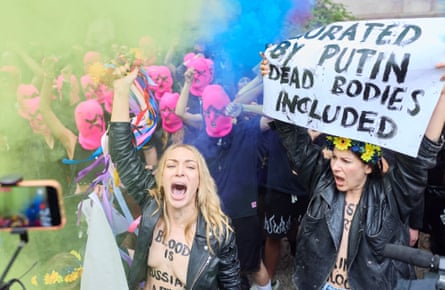
3. Strenuous attempts to avoid ‘woke’ work resulted in terrible art
Not everyone loved the previous US pavilion from 2024 by Jeffrey Gibson, but it was certainly lively with its rainbow colours, regular Native American powwows and dances, and super-queer vibes. Contrast that with Alma Allen’s US pavilion – his “not yet titled” sculptures were devoid of meaning or aesthetic pleasure and looked like something you would see joylessly plonked in a hotel lobby.
Not Yet Titled by Alma Allen in the US pavilion. Photograph: David Levene/The Guardian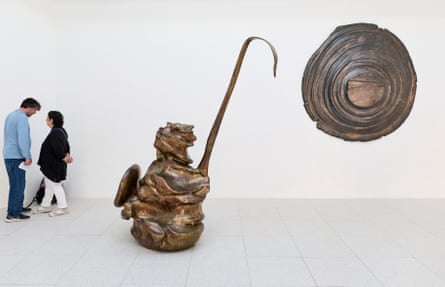
4. Venice rules the seas
The human bell-ringing of Florentina Holzinger was the main draw in the giardini with the Austrian pavilion pulling huge crowds who watched the choreographer’s SeaWorld Venice unfold. Performers climbed weather vanes, sloshed around in circles on jetskis, and were submerged in a tank for four-hour stretches. Maritime themes were a key part of several pavilions: Israel, Uzbekistan and Canada all used water or connections to the sea to shape the work within.
Florentina Holzinger’s work for the Austria pavilion. Photograph: David Levene/The Guardian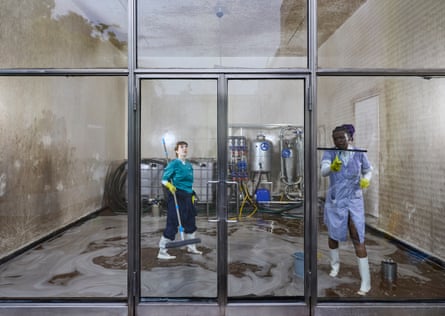
5. Art that stinks the place out
Smelly art is all the rage. In the church of San Giovanni Evangelista in San Polo, site of the Belarusian pavilion, perfumers had created what has been described as the smell of a “freshly dug grave in the Belarus countryside in late August, laid with rotting flowers”. Lydia Ourahmane’s exhibition at the Nicoletta Fiorucci Foundation was scented by a simmering onion and celery stock.
The Syrian pavilion – inside a recreation of a destroyed ancient tomb tower in Palmyra – worked with perfumers from the country, and there were various pongs and fragrances in the Egyptian and German pavilions, too. Luckily, odour did not form a part of Aline Bouvy’s fecal Luxembourg pavilion, titled La Merde; nor of the Austrian pavilion, in which urine, lavatories and a sewage spill all played a big role.
La Merde by Aline Bouvy in the Luxembourg pavilion. Photograph: David Levene/The Guardian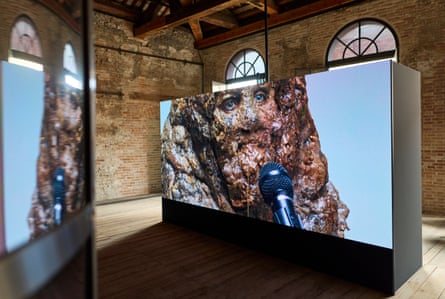
6. Off-site standouts
The absence of work about tech, AI or even video work was obvious in the main In Minor Keys show. Instead, much of the art on display – as per Kouoh’s direction – was low-key and reflective. But two of the best-received works were video pieces that were found off the main biennale site.
The final part in a trilogy of works that started at the 2022 event was found at the Fondazione In Between Art Film, which featured eight new video commissions. Canicula included the likes of the Turner prize winner Lawrence Abu Hamdan, who looked into “sonic weaponry” allegedly used against protesters in Serbia. Gabrielle Goliath’s multiscreen video work, Elegy, was another off-site standout which many thought would have added some heft to the main show.
Elsewhere, Arthur Jafa rolled out some of his greatest hits at his joint show with Richard Prince at the Prada Foundation, including his Love is the Message, the Message is Death which – 10 years on – still stops you in your tracks.
Canicula at the Fondazione In Between Art Film. Photograph: David Levene/The Guardian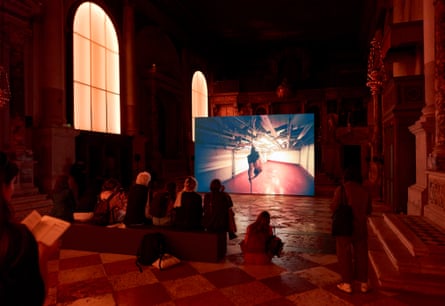
7. The obvious absence of Koyo Kouoh
It is really tough when your lead curator dies while they are curating the group show. Kouoh died suddenly of liver cancer with about a year of work to go and her five-person team decided to pick up the baton and curate it according to her instructions. But there was an air of unfinished business about the resulting group show – you really felt that the vision she really had was only intermittently coming through.