.png) 3 months ago
50
3 months ago
50
Where in France can you get a nutritious and balanced three-course meal for €1?
If you are one of the country’s estimated 3 million students in higher education, the answer is: the university restaurant or cafe.
This month, after a survey showed that almost half the student population were skipping meals because they could not afford to eat, the French government announced that €1 meals, previously means-tested and limited to students with scholarships, would be extended to all.
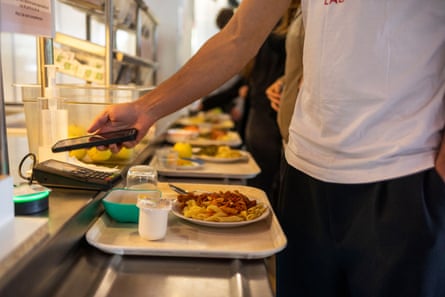
At the Université Paris Dauphine restaurant last week, students were loading their lunch trays with food from one of half a dozen counters. For €1 (86p) they can choose from a selection of starters, a vegetarian, meat or fish main course with potato and vegetable sides and fruit, yoghurt, cheese or a pastry to follow.
On most term days they can also serve themselves from a salad bar or pick a pizza – or both.
Extra dishes are 55c; coffee 60c. It is canteen food and unlikely to win any Michelin stars, but the dishes are varied, tasty and copious.
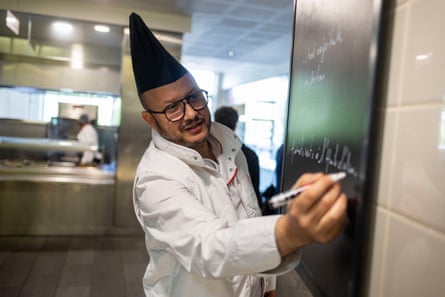
Farid Rouba, the chef who oversees the Dauphine university kitchen, said most dishes were produced in-house and made up of a healthy balance of locally sourced products, many of which are organic. Students have given his menus the thumbs up, he said.
“They gave us 9/10 in a recent questionnaire. Our clients are the students and we listen to them when drawing up the menus. We are feeding people who are the future of France and it’s important they eat well.”
Diane Chelkoff, the director of the Dauphine restaurant, said: “The students can have two balanced €1 meals a day from here, either eating here or take-away.
“It helps those students that are not receiving financial aid but find it difficult to make ends meet.
“Most of the dishes are put together by us here so we know what goes in them. The chef works hard to come up with a good, balanced menu and listens to what the students suggest.”
During busy term days, the Dauphine restaurant seats 2,400 students in three sittings. Take-aways are available in the university cafe next door. Chelkoff said the kitchen is prepared for a surge in demand when the university year begins in September.
Théo Pupunat, 22; Jérémy Reyes, 20; Antoine Lebrun, 20; and Maxence Lapras, 21; all students in finance, marketing or management, were enjoying their lunches and were even going back for seconds.
“We eat here every day. There’s always a good variety,” said Reyes, tucking into a roast leg of chicken, pasta and green beans.

Yuqi Yang, 26, from China, who is studying for a second master’s degree in marketing after a first master’s degree in linguistics at the Sorbonne, said: “I don’t have a lot of money so I always come here to eat. It’s very good.”
Across town at the Mabillon, the university restaurant used by students at the Sorbonne, Maxime Daniel, 26; Mehdi A’ït Naceur, 22; and Julie Bénard, 22; were lunching with their history professor, Laura Hobson Faure.
“I eat here almost every day and there’s always a good choice. I’m on a scholarship so it’s a big saving,” Bénard said.
A’ït Naceur agreed: “It’s a financial help for those who are not on scholarships but who still don’t have much money.”
Daniel, a PhD student, added: “It’s a little basic. If I had to pay the full tariff, I’d probably just get a sandwich or something slightly better quality, but for €1 everyone can eat.”
Hobson Faure, who admitted she had not eaten at the restaurant before, declared her meal – including a main course of lentil and beef patty with potatoes, for which she paid the non-student price of €9.35 – “surprisingly good”.
From 2020 until this month, only students with low incomes or receiving financial aid with housing and fees (roughly a quarter of those in higher education) were eligible for the €1 meals. The rest paid €3.30, which had not increased for five years. Student unions campaigned for the €1 meal to be available for all after the survey showing almost half of students were missing meals to save money and a quarter of them were doing so regularly.
“The country has decided to invest public money in its students,” Bénédicte Durand, the president of the National Centre for University and School Services (CNOUS), the government body responsible for student housing and welfare, told the Guardian.
“Our students are very lucky when you look at what happens in other countries.”
“It’s not just a question of making life easier for those at university, but also a question of social and public health,” Durand added. “Obviously it costs the state money, but I strongly defend the idea that it’s important not just to feed our students but ensure that all, with or without financial aid, can find themselves around the same table with the same meal and that meal is balanced.
“And we all know the problems of public health among the young including sedentary lifestyles and obesity so it’s also a health measure.”
Durand conceded that a universal measure was unusual in a system that means-tests most social benefits, but said the €1 meals, served at the 950 restaurants and cafeterias run by CNOUS, including those at teaching hospitals, were fully supported by the government, which has promised to set aside €120m (£104m) to fund them next year.
CNOUS is now seeking 200 extra staff and paying for more equipment to deal with increased demand.
However, not everyone is convinced the €1 meal for all is a good idea. The future entrepreneurs at Dauphine University felt the subsidy could be better spent elsewhere.
“Those who can afford to pay €3.30 should. I find it anti-equality that everyone should pay the same price when it’s already cheap,” Lebrun said.
Reyes added: “Obviously everyone will say paying €1 for an entire meal is a good thing, but I’d rather the money be put into cheaper accommodation for students.”