.png) 2 months ago
56
2 months ago
56
Even before the final weekend unfolds the 2026 Six Nations can be adjudged already as a vintage one. Three teams mathematically remain in the title race and all of them are still full of running. Whether it is France, Ireland or Scotland who ultimately pull clear, an eventful championship this year will be remembered fondly by almost everybody.
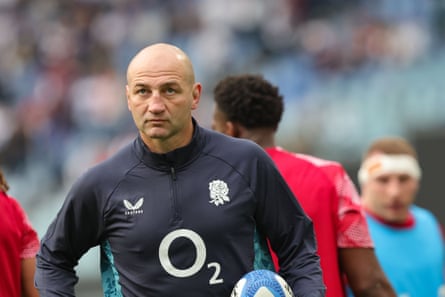
For every beaming winner, though, there inevitably has to be a frustrated, bruised loser. And to put it mildly things have not unfolded in the way England were hoping just a few short weeks ago. “On 14 March in Paris we want to be in a position entering that game where we can achieve what we’re all aiming to achieve,” Steve Borthwick said on 23 January. “We want England fans flooding across the Channel to watch the team in a massive encounter in the final round with the opportunity to achieve what we want.”
At the time it felt out of character for a coach renowned for his studious game-by-game approach. The obvious explanation, from where most of us were sitting, was a desire to challenge his players: don’t be shy of aiming high because that precise mentality will be a necessity at the World Cup next year. Nothing wrong with that, in theory, but it has definitely not had the desired effect.
It is fast approaching the point where England supporters “flooding across the Channel” might be better advised to find a nice restaurant on the Left Bank on Saturday night instead, preferably in an establishment without television or internet. A glass of red and a major steak frites would arguably improve their health and wellbeing more than watching a team increasingly stuck on the boulevard of broken dreams.
Before we go any further it is important to pay tribute to Italy, whose historic first win against England after 35 years of fruitless toil was one of those sporting landmarks that will resonate far beyond the Eternal City. These are many of the same Italian players who were around when the Azzurri lost 36 Six Nations games on the spin so their post-match joy was wholly justified.
It was a triumph not just for this squad but the heroes of yesteryear – the late Ivan Francescato as well as Massimo Giovanell, Diego Domínguez, Mauro Bergamasco, Sergio Parisse and so on – who helped to lay the path to the promised land.
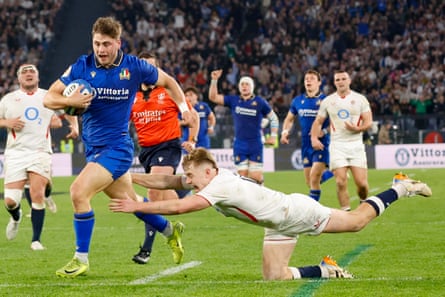
But as one long-serving member of the home management confided on Saturday evening, it did not come as a huge shock inside the Italian dressing room. Along with Scotland and Ireland they had studied England closely and sensed a team wrestling with its identity. Even nine changes to Borthwick’s original starting selection could not remove the overarching sense of a side trapped inside a kick-orientated gameplan that many opponents have now worked out.
England looked slightly better against Italy in the first 50 minutes but, from 18-10 ahead, once again unravelled when it mattered most. Poring over the minutiae of costly yellow cards, poor decisions and errors, however, is becoming less relevant than identifying the underlying reasons why things have fallen so far so fast.
The word on the street is that differences of opinion have arisen within the senior leadership group over the suitability of the gameplan England have been employing. And, true or not, there are obvious contradictions everywhere you look. Boil it down to its data-heavy essence and Borthwick, flanked on matchday by his lieutenants Richard Wigglesworth and Phil Morrow, would clearly love to replicate the no-frills approach all three men have known previously at Saracens. But the head coach is attempting to do so without the crucial cogs – the Vunipola brothers, Schalk Brits, Owen Farrell, Brad Barritt and Alex Goode – who elevated Sarries’ approach to a higher plane.
And for all the talk of England playing without fear and being given generous attacking licence, the reality is an increasing disconnect between the aforementioned Sarries or Leicester blueprint and the more free‑flowing ethos of, say, Northampton. The consequence is a team with a good deal of individual potential but short of genuine belief despite what they say in public. “All right, there have been some holes in our performances over the last three games but there’s no doubt we have improved,” Ben Earl said on Saturday night. “I am still buoyant with where this team’s at.”
You cannot blame Earl, one of England’s most whole-hearted performers, for trying to put a gloss on what is statistically in danger of becoming England’s worst Six Nations campaign on record. But living stubbornly in denial just makes things worse. England need to get real, ditch the psycho-babble and recognise their situation for what it is: a fast-developing crisis.
Consider the following scenario. Get swept away by a vengeful, pumped-up France in Paris and next up is South Africa in Johannesburg in July. After that the plan is to play a reshuffled team against Fiji in Liverpool and send their top men straight to Argentina in preparation to face a much stronger Pumas side than they encountered last summer. At which point, if they are still losing, there will barely be a year left until the World Cup, a narrow window in which to usher in a new coaching regime.
The Rugby Football Union has already expressed a desire to stick with Borthwick rather than twisting. That stance is made slightly easier by the fact England won’t be running out at Twickenham again until November. Loud booing from home supporters paying big bucks is what really makes chief executives twitchy.
That said the gap between what England should be delivering with the talent at their disposal and their increasingly head‑clutching performances cannot be casually ignored. And just as other nations make significant strides, England are running through quicksand. There will be more than just a Six Nations title at stake in Paris this weekend.