.png) 1 month ago
47
1 month ago
47
Niki Lauda once described James Hunt as “one of my few real friends in racing”, the great rivals sharing a genuine bond even as they fought fiercely for the Formula One world championship in 1976.
Its destination was decided at the Japanese Grand Prix – where the sport heads for the third race of this season on Sunday – with this year marking the 50th anniversary of an extraordinary contest when Hunt won his only F1 title in an engrossing finale.
The Fuji Speedway was shrouded in rain and mist and the race start was delayed on that afternoon in late October. Hunt, always tense before a race, was wound up like a spring. The battle between the two drivers, Lauda at Ferrari and Hunt with McLaren, had been hard-fought from the off but 1976 was exceptional more than anything else in that Lauda was still in the fight at all.
Only two months before Fuji he had had the huge accident at the Nürburgring that had almost killed him. That he had returned at all was astonishing, perhaps the greatest individual feat of will and determination in the sport’s history, but then taking it to the wire was almost as remarkable.
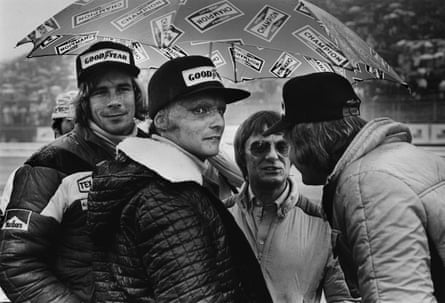
The season had also been marked by the bad blood between Ferrari and McLaren, of protest and counterprotest as the teams wrangled and politicked back and forth. On track Lauda had enjoyed the edge and was 23 points – in the old-money scoring of 10 for a win – ahead after Hunt had been controversially disqualified from the British GP at Brands Hatch, the round before the Nürburgring.
After the accident in which Lauda was pulled from the burning wreckage of his Ferrari, the driver missed only two races before his miraculous return at Monza. His championship lead was down to five points and when Hunt then took two victories in succession at Mosport Park in Canada and Watkins Glen in the US, the Briton trailed by only three points as they flew to Japan.
The interest and scrutiny on the finale was off the scale. Hunt’s boisterous, playboy personality was as infectious as it was fascinating to fans and the media, while Lauda carried the weight of all the attention that had unsurprisingly surrounded his comeback. The pair were centre stage of a drama that had seemed to build far beyond the mere racing, which for both drivers finally came as something of a relief.
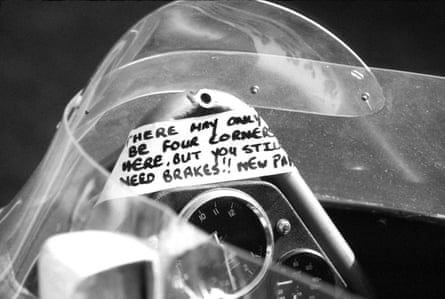
Qualifying had been relatively straightforward, Hunt and Lauda in second and third behind Mario Andretti. However, on race day there was to be no simple narrative. The track, nestled in the shadow of Mont Fuji, was engulfed by a storm. Visibility on the main straight was down to 200m and the start delayed, as all agreed racing was impossible.
The crowd sat stoically beneath umbrellas in the grandstands as the pressure continued to build. Hunt, his mind elsewhere, ambled to a fence, urinating in full view of the crowd. The championship remained in limbo until the organisers and race director decided it was time to start, prompted by their obligations to the TV broadcasters, although conditions had barely improved.
Lauda’s response was typically blunt. “I stood up and said: ‘Are you guys fucking crazy?,’” he later recalled. “The rain has not stopped. It’s got worse, you cannot do this.’”
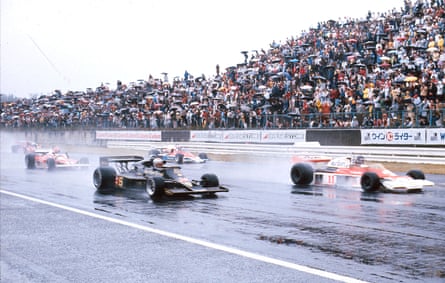
No one was happy but Hunt had made it clear he would compete if the race was to run. He made his way to his car across a plank McLaren had laid down in the pit lane to traverse the puddles swamping the Tarmac.
Lauda had already reached a different conclusion. He knew the title was on the line but would not race in the treacherous conditions. “I told Ferrari beforehand I would do one lap, which I did, and then I stopped,” he said. “I have no regrets. I would do the same again. But I have to say that without my accident, maybe, I would have had the reserves to do it.”
Hunt took the lead from Andretti at the off but after that one lap Lauda entered the pits and came to a halt. Yet the title was still not yet decided. Hunt needed to finish fourth and he duly eked out a lead as finally the storm relented and the track began to dry.
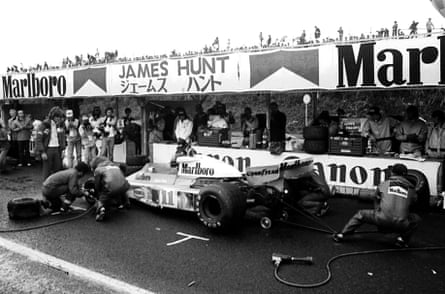
However, he then missed the boards from the team telling him to cool the wet tyres in standing water and with five laps to go his left tyres deflated and he was forced to pit. It was slow in an era where stops were far from the technological masterpieces of today. With front and rear needing changing at the same time, the team physically had to lift the front of the car while the jack was used at the rear. The McLaren crew hurled themselves at it as the tension ratcheted up even further.
It looked to have cost the championship. Hunt emerged in fifth with four laps remaining and for two laps he could not make up a place, the title slipping from his fingers. Then, with typical bravado for such a larger than life character, he made a final charge that took him past Alan Jones and Clay Regazzoni.
It was enough but, in a final dramatic flourish, Hunt did not know. On returning to the pits he angrily berated his team while their team principal, Teddy Mayer, was forced to shout “James, you’ve won!” at him repeatedly until he finally took it on board.
He had taken the title in Japan by one point in what remains one of the great championship deciders, his moment of triumph notably marked also by his huge respect for the path his great friend Lauda had chosen.
“I think Niki made absolutely the right decision. I still feel as I felt before the start, that it was madness to start in those conditions,” he said. “I gotta respect the decision they made. I think it was crazy to start the race but now I’m kinda glad we did.”