.png) 1 month ago
52
1 month ago
52
Earlier today I posed four puzzles from the Hyde Park Math Zine, a maths fanzine from Austin, Texas. Here they are again with solutions.
1. Ring it
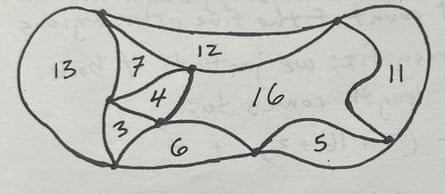
Each region has a perimeter given by its enclosed number. What is the length just along the edge of the entire figure?
Solution 25
The length of the perimeter is the perimeters of the outer areas (12, 11, 5, 6, and 13) MINUS the perimeters of the adjacent areas (7, 3 and 16) PLUS the perimeter of the final area (4).
47 – 26 + 4 = 25
Or think of it from the inside out. The perimeter of the internal section with numbers 3, 4, 7 and 16 is 3 + 7 + 16 – 4 = 22 . (You need to subtract four since otherwise you are including lines that are not in the perimeter of that section.)
P is the sum of perimeters of the outer areas, which is 47, minus the perimeter of the section with numbers 3, 4, 7 and 16. Thus P = 47 – 22.
2. Eight ball
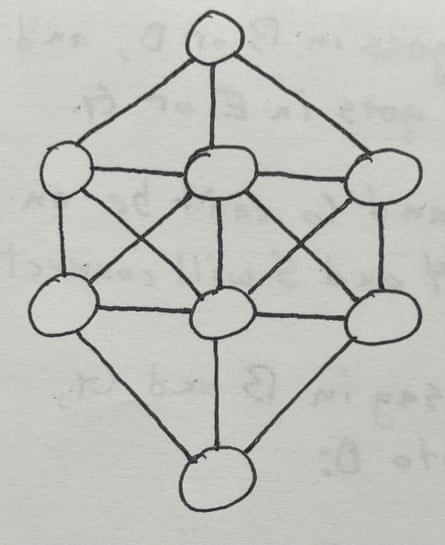
Place the digits 1 to 8 in the circles so that no digit is linked to an adjacent digit. (i.e 3 cannot be linked to 2 or 4)
Solution
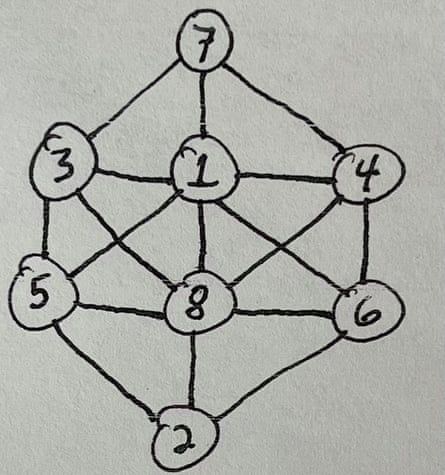
This one is solved using “enlightened” trial and error. The first thing to notice is that the central circles link to all others but one, which means they have to be 1 and 8. (If one of them was, say 2, then it must NOT connect to 1 or 3. But there is only one available circle that does not connect to 2, so you get a contradiction.) After this, this forces the options and you should get the full solution quickly. All solutions are symmetrically equivalent to the one in the image.
3. Round the block
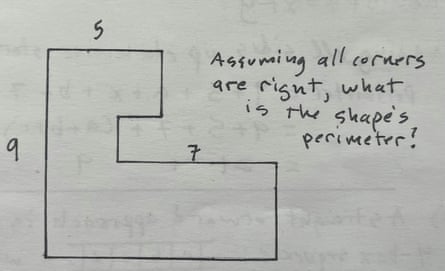
Solution 42
Label the image:

Thinking vertically: a + b + c = 9.
Thinking horizontally: 5 – x + 7 = y.
(Thus x + y = 12)
The perimeter is thus 9 + 5 + 7 + a + b + c + x + y = 42
4. Tennis teaser
Steffi and Boris are playing tennis and their current game score is deuce. If Steffi has a 0.6 probability of winning any point while Boris has the probability 0.4, what is the overall probability that Steffi goes on to win the game?
Solution 9/13
From deuce, three things can happen. Steffi wins two points and wins the game; Boris wins two points and wins the game; they split the points and return to deuce.
The key insight is that the probability of winning from the second deuce is the same as from the first deuce, which means we don’t need to think about infinite series. (I’m assuming some basic familiarity with probability.)
Let P = probability of Steffi winning from deuce. Then
P = (prob of Steffi winning next 2 points) + [(prob of split points) x P]
= (3/5)2 + [(3/5)(2/5) + (2/5)(3/5)]xP
= 9/25 + (12/25)
(13/25)P = 9/25. So P = 9/13
I hope you enjoyed today’s puzzles. I’ll be back in two weeks.
Thanks to Kevin Gately and his wonderful Hyde Park Math Zine.
I’ve been setting a puzzle here on alternate Mondays since 2015. I’m always on the look-out for great puzzles. If you would like to suggest one, email me.